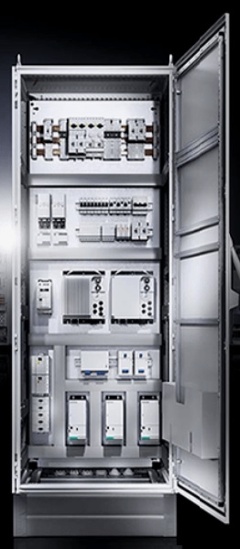
busbar

Why Panel Shops Are Moving to Automated Busbar Panel Modification

Overview

  • As panel shops move from traditional cabling to busbar, they are faced with an important decision: manual busbar modification or automated busbar modification?
  • Panel shops that choose automated busbar modification are faced with an additional decision: outsourced or in-house?
  • Automated busbar modification is faster, less error-prone, more precise, less wasteful, and offers a variety of other benefits.
  • Rittal Automation Systems machinery for busbar modification is helping panel shops to bring automated modification in-house so they can reap these benefits.

The move away from traditional cabling and toward busbar continues, and many panel shops I’ve talked to lately are facing challenges with keeping up with demand. Their customers increasingly want copper busbar, and it’s no surprise. For high-amperage systems, such as those above 1000A, they can’t use cables because they’ll melt. Copper is a great conductor of electricity that handles heat well and helps suppliers in fields like energy & power meet safety standards like UL 891.

In addition to greater demand for busbar from the energy & power sector, panel shops are seeing increasing demand from data centers, where busbar is prized because of its space-saving efficiency, flexibility, and reliability. IT applications are only expected to grow with the advancement of AI, with its massive computing and data storage needs.

Rittal is helping panel shops all over the U.S. make the transition to busbar and capitalize on this demand. From mom-and-pop shops to huge operations, I work with Rittal customers to provide a range of busbar solutions. Sometimes this involves completing busbar modification jobs for customers at the Rittal Application Center (RAC) in Houston, Texas. Lately, though, I’ve had several customers invest in automated busbar modification machinery of their own. Here’s why.

Manual vs. automated busbar modification options

The panel shops I work with are usually producing modified busbar in one of two ways: they are manually modifying it themselves using hand tools or they are outsourcing modification to a facility like the RAC.

Shops are incentivized to move from manual modification to automated modification when they realize that automated modification is:

  • Faster: What might take an operator 15 minutes takes machinery 30 seconds.
  • Less error-prone: Humans make mistakes, but mistakes with busbar are expensive because the price of copper is very high.
  • More precise: Machinery can more easily achieve the strict tolerances required for busbar modification.
  • Less wasteful: Because they are more precise and make fewer mistakes, machines produce less scrap — again important due to the high price of copper.
  • Less reliant on individual operators’ expertise: Manual modification means shops come to depend on specific operators, and operator departures can create problematic knowledge gaps. In a world where shops are competing for skilled labor, automation can help create a centralized knowledge base.

Automated modification is the obvious winner, but outsourcing busbar modification has its pros and cons. The RAC does a fantastic job producing custom modified busbar in as little as a few days, and Rittal provides a turnkey solution that allows customers to buy cabinets and busbar together. There are cases, however, where it is more cost-efficient for growing panel shops or those with very large orders to invest in in-house automation equipment. Plus, with their own machines, shops are able to better control busbar modification lead times — a big pro for many of the shops I work with.

CMA/Flodyne/Hydradyne is an authorized  Rittal distributor in Illinois, Wisconsin, Iowa and Northern Indiana.

In addition to distribution, we design and fabricate complete engineered systems, including hydraulic power units, electrical control panels, pneumatic panels & aluminum framing. Our advanced components and system solutions are found in a wide variety of industrial applications such as wind energy, solar energy, process control and more.

Avoiding a mental breakdown when choosing circuit breakers

Guest contributor: Jessica Yeh, Phoenix Contact USA

Sizing circuit breakers is confusing because there are so many factors to take into consideration. Of course, there are the typical concerns: price, size, and delivery time. But what about everything else?

What trip mechanism should be used? What ampere rating? Dual rated or regular voltage ratings? Why do I need a lockout/tagout? Does a shunt do the same thing as an auxiliary? What does bidirectional mean? What approvals do I need to take into consideration? Do I need NEC Class 2? NEMA? CSA? UL? IEC or IEEE certifications?

These are just a few of the things to consider when choosing a circuit breaker for a specific application.

Stop the ride, I want to get off!

Here’s the thing. Selecting breakers is a complex task, but the following list will give you a few basic ideas to get started in the right direction. This is by no means everything you should consider, but it’s a nice breakdown.

(The good kind, not the mental kind.)

What type of protection are you looking for?

Breakers are activated by various factors including PCB components in the case of electronic breakers, heat in terms of thermal breakers, magnetism for both thermal-magnetic and hydraulic-magnetic breakers, and more. Each trigger has a different reaction time. Depending on how critical the equipment you’re protecting is, you may want to use this basic guide.

Size matters (Use the 80 percent rule)

It’s common practice to choose a breaker with an ampere rating at around 80 percent of the nominal rating of your application. This ensures that you have a nice little buffer in case the current spike is particularly strong. The breaker will be able to trip well before the current level can get too high and cause damage.

Embrace the trip curves  

When someone says “trip curve,” you either have one of two reactions.

A) Cringe and gulp down the nauseating feeling at the thought of having to squint over all those lines and numbers, or

B) Pass the information along to someone else so that they can exhibit reaction A.

While many companies add their own custom trip curves, the most common include B, C, and D curves, which are considered industry standard.

What you want to keep in mind when it comes to trip curves is that it’s not about all the little calculations, but the overall picture. Besides thinking “how fast does this thing need to trip?” also consider it in terms of your equipment.  Sensitive devices should be protected by a breaker that reacts quickly. On the opposite end, equipment with higher startup currents like motors would probably be best protected by a breaker with a delayed trip curve.

Need for approvals

You may have heard the term “Listed” or “Recognized.” You may have also heard the terms “supplemental” and “branch” protection. Depending on your requirements and the type of breaker you’re using, you might need to select a specifically approved breaker. In most cases, these are the four basic types you’ll often see.

Supplementary protectors (UL Recognized) interrupt an electrical distribution circuit and are intended to protect equipment.

Branch circuit protectors (UL Listed) open a circuit during overload and short circuit and are intended to protect the circuit conductors.

Completing the outfit

When choosing an outfit, you always want to get the basics down first, before you start accessorizing. Outfitting a cabinet is no different. Once you’ve chosen your breaker, you can add additional bells and whistles to give you a little something extra. Here are just a few options.

To reset or activate/deactivate the breaker remotely, you would use its remote reset/control. Combined with remote status indication, you can easily service and maintain breakers without going to a job site.

But if you’re already on site, the local status indication feature uses color codes that allow you to easily service and maintain breakers.

Busbars reduce wiring by connecting a series of breakers to a common a power source.

And finally, lockout/tagout keeps things safe by attaching to the trip mechanism and preventing unwanted tampering during testing or maintenance.

As you get further into the process, you’ll still have to consider some of the more advanced questions raised above, but this list gives you some of the basic break(er)down that you need to know to get started! To learn more about circuit breakers and overcurrent protection options, visit www.phoenixcontact.com/cbpluggable

cropped-cmafh-logo-with-tagline-caps.png

CMA/Flodyne/Hydradyne is an authorized Phoenix Contact distributor in Illinois, Wisconsin, Iowa and Northern Indiana.

In addition to distribution, we design and fabricate complete engineered systems, including hydraulic power units, electrical control panels, pneumatic panels & aluminum framing. Our advanced components and system solutions are found in a wide variety of industrial applications such as wind energy, solar energy, process control and more.

Modular Enclosure Accessories Improve Customization and Scalability

Guest Contributor: Rittal Enclosures

5 accessories to enhance TS 8 enclosure functionality  

ts8

With 12 million units sold around the globe, the TS 8 modular enclosure is established as the worldwide-standard. As businesses grow and enclosure needs evolve, many customers are turning to a variety of accessories to scale their solutions. 

These five accessories for lighting, power distribution, viewing and operating, climate control, and assembly are the most popular customizations design engineers and facilities managers are utilizing to maximize their investments. 

1 – For Lighting: LED Compact Lighting System

The Rittal LED Compact Lighting System is a safe, energy-efficient, extra-low-voltage interior lighting solution that delivers full coverage to all corners of the enclosure.  

Enterprise-ready and suitable for voltages ranging from 100–240 V (AC) and 24 V (DC), the LED system can be installed tool-free with clips that connect to a latch-in hook pattern—though optional screw fastening is also available. Magnetic installation is another option, for free positioning within the enclosure. Whichever assembly option you choose, motion detectors or door-operated switches for hands-free illumination are also available.  

2 – For Power Distribution: RiLine Busbar System 

In many regions around the world, busbar systems are the predominant solution for managing power needs now, and in the future. For engineers not familiar with the technology, the RiLine copper busbar system provides reliable power distribution and requires less panel modification, contact points, and wiring work. Busbar systems save space and time for panel builders and offer more contact hazard protection than other cable management options. 

3 – For Viewing Windows and Operating Panels: WKDH Deep Hinged Window Kit 

The Deep-Hinged Window Kit is ideal for installing a viewing window where access to components mounted behind it is required. It is designed to protect HMI displays and components mounted on enclosure panels from wash-downs, rain, snow, sleet, dirt, and dust. The window depth allows for extra-deep pushbuttons (~2”/50mm) and comes with a full-size drill template for easy mounting.  

4 – For Climate Control: TopTherm Filter Fans 

Simply and efficiently manage air flow in your enclosure with filter fans designed for tool-free, snap-in mounting and installation. The TopTherm filter fan’s new diagonal fan technology creates greater pressure stability and constant airflow when installed, even with a contaminated filter mat. This new technology also allows air currents to spread diagonally from the fan, promoting even circulation throughout an enclosure. 

5 – For Base Assembly: Flex-Block Base/Plinth System 

Save assembly time with high-strength plastic corner pieces that clip together base/plinth components. With this system, enclosure transport is uncomplicated, both empty and fully-configured, by removing the base/plinth trim panel. Plus, cable management is straightforward and efficient, saving space for enclosure configuration.

Modular Enclosure Buyers GuideRittal Is Engineered Better 

Whatever your enclosure needs, Rittal has an extensive line of accessories to optimize enclosure functions. Download the Modular Enclosure Buyer’s Guide to see how Rittal products are better than the competition!

cropped-cmafh-logo-with-tagline-caps.png

CMA/Flodyne/Hydradyne is an authorized  Rittal distributor in Illinois, Wisconsin, Iowa and Northern Indiana.

In addition to distribution, we design and fabricate complete engineered systems, including hydraulic power units, electrical control panels, pneumatic panels & aluminum framing. Our advanced components and system solutions are found in a wide variety of industrial applications such as wind energy, solar energy, process control and more.