Guest Contributor: Rittal Enclosures
5 accessories to enhance TS 8 enclosure functionality
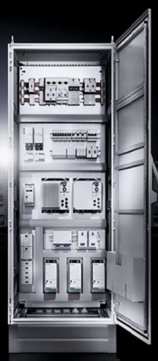
With 12 million units sold around the globe, the TS 8 modular enclosure is established as the worldwide-standard. As businesses grow and enclosure needs evolve, many customers are turning to a variety of accessories to scale their solutions.
These five accessories for lighting, power distribution, viewing and operating, climate control, and assembly are the most popular customizations design engineers and facilities managers are utilizing to maximize their investments.
1 – For Lighting: LED Compact Lighting System
The Rittal LED Compact Lighting System is a safe, energy-efficient, extra-low-voltage interior lighting solution that delivers full coverage to all corners of the enclosure.
Enterprise-ready and suitable for voltages ranging from 100–240 V (AC) and 24 V (DC), the LED system can be installed tool-free with clips that connect to a latch-in hook pattern—though optional screw fastening is also available. Magnetic installation is another option, for free positioning within the enclosure. Whichever assembly option you choose, motion detectors or door-operated switches for hands-free illumination are also available.
2 – For Power Distribution: RiLine Busbar System
In many regions around the world, busbar systems are the predominant solution for managing power needs now, and in the future. For engineers not familiar with the technology, the RiLine copper busbar system provides reliable power distribution and requires less panel modification, contact points, and wiring work. Busbar systems save space and time for panel builders and offer more contact hazard protection than other cable management options.
3 – For Viewing Windows and Operating Panels: WKDH Deep Hinged Window Kit
The Deep-Hinged Window Kit is ideal for installing a viewing window where access to components mounted behind it is required. It is designed to protect HMI displays and components mounted on enclosure panels from wash-downs, rain, snow, sleet, dirt, and dust. The window depth allows for extra-deep pushbuttons (~2”/50mm) and comes with a full-size drill template for easy mounting.
4 – For Climate Control: TopTherm Filter Fans
Simply and efficiently manage air flow in your enclosure with filter fans designed for tool-free, snap-in mounting and installation. The TopTherm filter fan’s new diagonal fan technology creates greater pressure stability and constant airflow when installed, even with a contaminated filter mat. This new technology also allows air currents to spread diagonally from the fan, promoting even circulation throughout an enclosure.
5 – For Base Assembly: Flex-Block Base/Plinth System
Save assembly time with high-strength plastic corner pieces that clip together base/plinth components. With this system, enclosure transport is uncomplicated, both empty and fully-configured, by removing the base/plinth trim panel. Plus, cable management is straightforward and efficient, saving space for enclosure configuration.
 Rittal Is Engineered Better
Whatever your enclosure needs, Rittal has an extensive line of accessories to optimize enclosure functions. Download the Modular Enclosure Buyer’s Guide to see how Rittal products are better than the competition!

CMA/Flodyne/Hydradyne is an authorized Rittal distributor in Illinois, Wisconsin, Iowa and Northern Indiana.
In addition to distribution, we design and fabricate complete engineered systems, including hydraulic power units, electrical control panels, pneumatic panels & aluminum framing. Our advanced components and system solutions are found in a wide variety of industrial applications such as wind energy, solar energy, process control and more.


 It’s not JUST about moving the drives out onto the machine, near or integrated with the motors, but also how you design your entire control system. Think about a conventional Centralized Control Architecture – all of your drives, power supplies and other I/O are jammed into a large cabinet and cables are run to each motor – and since we are talking conventional, this likely means multiple cables (power and feedback for each motor). So in a decentralized solution, the motor, feedback and fieldbus communication needs to be run through a single cable, and the control architecture allows communications to function over the fieldbus loop.
 Imagine now – A decentralized solution, drives located within a meter of the motor they are driving – you cut cabling down to a mere 35 meters! Do the math – an 86% reduction! Throw in extended I/O and your savings jumps to almost 90% SO – Point 1 – Substantially reduced cables cost – not just from the mere reduction in cable length, but in reduced costs associated form cable management trays and even the labor to run the cables.







 Machine Geeks