IO-Link

How hot is hot? The basics of Infrared Temperature Sensors

Guest Contributor:  Jack Moermond, Balluff

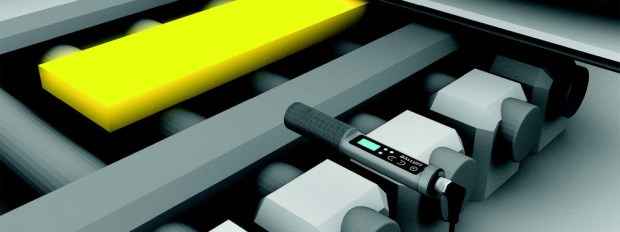
Detecting hot objects in industrial applications can be quite challenging. There are a number of technologies available for these applications depending on the temperatures involved and the accuracy required. In this blog we are going to focus on infrared temperature sensors.

Every object with a temperature above absolute zero (-273.15°C or -459.8°F) emits infrared light in proportion to its temperature. The amount and type of radiation enables the temperature of the object to be determined.

In an infrared temperature sensor a lens focuses the thermal radiation emitted by the object on to an infrared detector. The rays are restricted in the IR temperature sensor by a diaphragm, to create a precise measuring spot on the object. Any false radiation is blocked at the lens by a spectral filter. The infrared detector converts radiation into an electrical signal. This is also proportional to the temperature of the target object and is used for signal processing in a digital processor. This electrical signal is the basis for all functions of the temperature sensor.

There are a number of factors that need to be taken into account when selecting an infrared temperature sensor.

  • What is the temperature range of the application?
    • The temperature range can vary. Balluff’s BTS infrared sensor, for example, has a range of 250°C to 1,250°C or for those Fahrenheit fans 482°F to 2,282° This temperature range covers a majority of heat treating, steel processing, and other industrial applications.
  • What is the size of the object or target?
    • The target must completely fill the light spot or viewing area of the sensor completely to ensure an accurate reading. The resolution of the optics is a relationship to the distance and the diameter of the spot.

  • Is the target moving?
    • One of the major advantages of an infrared temperature sensor is its ability to detect high temperatures of moving objects with fast response times without contact and from safe distances.
  • What type of output is required?
    • Infrared temperature sensors can have both an analog output of 4-20mA to correspond to the temperature and is robust enough to survive industrial applications and longer run lengths. In addition, some sensors also have a programmable digital output for alarms or go no go signals.
    • Smart infrared temperature sensors also have the ability to communicate on networks such as IO-Link. This network enables full parameterization while providing diagnostics and other valuable process information.

Infrared temperature sensors allow you to monitor temperature ranges without contact and with no feedback effect, detect hot objects, and measure temperatures. A variety of setting options and special processing functions enable use in a wide range of applications. The IO-Link interface allows parameterizing of the sensor remotely, e.g. by the host controller.

For more information visit www.balluff.com

cropped-cmafh-logo-with-tagline-caps.pngCMA/Flodyne/Hydradyne is an authorized  Balluff distributor in Illinois, Wisconsin, Iowa and Northern Indiana.

In addition to distribution, we design and fabricate complete engineered systems, including hydraulic power units, electrical control panels, pneumatic panels & aluminum framing. Our advanced components and system solutions are found in a wide variety of industrial applications such as wind energy, solar energy, process control and more.
IO-Link Hydraulic Cylinder Position Feedback

Guest contributor: Scott Rosenberger, Balluff

Ready for a better mousetrap?  Read on…..btl_io-link

Some time ago on Sensortech, we discussed considerations for choosing the right in-cylinder position feedback sensor.  In that article, we said:

“…….Analog 0-10 Vdc or 4-20 mA interfaces probably make up 70-80% of all in-cylinder feedback in use…..”

And while that 70-80% analog figure is still not too far off, we’re starting to see those numbers decline, in favor a of newer, more capable interface for linear position feedback:  IO-Link.  Much has been written, here on Sensortech and elsewhere, about the advantages offered by IO-Link.  But until now, those advantages couldn’t necessarily be realized in the world of hydraulic cylinder position feedback.  That has all changed with the availability of in-cylinder, rod-style magnetostrictive linear position sensors.  Compared to more traditional analog interfaces, IO-Link offers some significant, tangible advantages for absolute position feedback in hydraulic cylinders.

Connectivity

First and foremost, the story of IO-Link is that it offers easy, simple connection of sensors and IO to nearly any industrial network.  You can read more about that here.

Simplicity

Another big advantage of IO-Link is the ability to connect sensors to the network using standard, simple, unshielded M12 connectors and cables.  Compared to analog systems, which require shielded cabling, and sometimes unusual or proprietary connectors, connecting IO-Link sensors to the network is simpler, and usually less costly.

Visibility

Unlike their traditional analog counterparts, position sensors with IO-Link offer built-in diagnostic capabilities.  Sensor status can be monitored over the network, greatly simplifying troubleshooting and fault detection.

Flexibility

This is where IO-Link position sensors really start to shine.  Traditional analog position sensors provide one thing: position feedback in the form of an analog signal (obviously).  IO-Link position sensors provide position feedback, of course…but wait, there’s more.  In addition to position feedback, IO-Link sensors can provide velocity/speed information, temperature, and differential position (the difference between two position magnets).  And the best part?  All of this functionality can be freely configured over the network.  Plus, sensor configurations can be stored and subsequently downloaded to a replacement sensor if necessary.

Suitability

It’s worthwhile to point out that IO-Link linear position sensors are ideal for most positioning or position monitoring applications.  Just as with analog sensors though, they’re probably not suitable for high-performance closed-loop servohydraulic motion control applications.  In those applications, interfaces that are capable of providing super-fast, deterministic data, such Synchronous Serial Interface (SSI) or even Ethernet/IP are more suitable.

You can learn more in this overview flyer.

cropped-cmafh-logo-with-tagline-caps.pngCMA/Flodyne/Hydradyne is an authorized  Balluff distributor in Illinois, Wisconsin, Iowa and Northern Indiana.

In addition to distribution, we design and fabricate complete engineered systems, including hydraulic power units, electrical control panels, pneumatic panels & aluminum framing. Our advanced components and system solutions are found in a wide variety of industrial applications such as wind energy, solar energy, process control and more.

3 Smart Applications for Process Visualization

Guest contributor: Shishir Rege, Balluff

Stack lights used in today’s industrial automation haven’t changed their form or purpose for ages: to visually show the state (not status) of the work-cell. Since the introduction of SmartLight, I have seen customers give new meaning to the term “process visualization”. Almost every month I hear about yet another innovative use of the SmartLight. I thought capturing a few of the use-cases of the SmartLight here may help others to enhance their processes – hopefully in most cost effective manner.

smartlightmodesThe SmartLight may appear just like another stack-light.  The neat thing about it is that it is an IO-Link device and uses simply 3-wire smart communication on the same prox cable that is used for sensors in the field. Being an IO-Link device it can be programmed through the PLC or the controller for change of operation modes on demand, or change of colors, intensity, and beeping sounds as needed. What that means is it can definitely be used as a stack light but has additional modes that can be applied for all sorts of different operation/ process visualization tasks.

Use Case #1: Stack Light Mode for Operation Status – The number of segments can be programmatically changed from 1 to the max segment number provided by the light (up to 5 in a five-segment SmartLight). Colors can be changed to red, blue, green, orange, yellow, white, or any other color of choice. This is the most traditional application of the SmartLight.

Use Case #2: Format Change Indicator – Many of our customers use the level mode to provide feedback to the operators when they are making adjustments to the machine. For example: red might indicate that the machine is out of alignment, yellow might mean the machine is getting closer to the specified alignment, and green might mean the machine is in the zone of alignment. Using the SmartLight in this fashion helped our customers save time in product changeovers because the operators didn’t have to come out of the cell to view the alignment status on a small HMI.  When the alignment of the machine is complete, the SmartLight can be programmed to switch back to the status indication mode or whatever mode of operation desired.

smartlightgifcroppedUse Case #3: Run Light Mode for Maintenance Indication – In this mode there are two colors – one color for the background and another color for the running segment. Along the assembly line where there are multiple work cells continuously processing raw materials in lock-step operation, downtimes are extremely costly. The standard status indicator will only indicate a problem at the work cell when the system stops, but it will not indicate a lack of raw material, for example. The moment the stack light turns red, the operator or the maintenance person is rushed to the site to first figure out what’s wrong before solving the problem. In Run Light mode, the SmartLight can be programmed to indicate different colors for the running segment and the background to show that attention is required at the cell. For example, as long as the running segment is running the machine is operational, but the background color can be changed to indicate raw material shortage, the need for mechanical adjustment of the machine, or the need for some electrical maintenance. Using a SmartLight, whoever is rushing the cell has a very good idea of what is required of them to get the system back up and running.

cropped-cmafh-logo-with-tagline-caps.pngCMA/Flodyne/Hydradyne is an authorized  Balluff distributor in Illinois, Wisconsin, Iowa and Northern Indiana.

In addition to distribution, we design and fabricate complete engineered systems, including hydraulic power units, electrical control panels, pneumatic panels & aluminum framing. Our advanced components and system solutions are found in a wide variety of industrial applications such as wind energy, solar energy, process control and more.

Three Things to Know About IO-Link

Guest contributor: Pat Millott, Balluff

IO-Link has become synonymous with the term “distributed modular I/O”. We know it is universal, smart, and easy, but what exactly is IO-Link? In a nutshell, by utilizing a standard sensor cable, the IO-Link slave device speaks point to point with an IO-Link master. The IO-Link master then combines the data with other IO-Link slave devices and communicates over an industrial network or backplane to the controller. In other words, it can be compared to a simple USB connection: for the most part, any USB device will work in any USB port, as long as the manufacturers of both devices have played by the rules when making the devices.

With that being said, here are three things to know about IO-Link:

  • Cable Length Cable Type and Length

Cable runs between master and slave can be up to 20 meters in length and typically utilize standard automation cables. Most cables, but not all, are M12 A-coded, unshielded, 3 or 4-conductor DC sensor cables.

  • Star ArchitectureStar Architecture

Since IO-Link utilizes a point-to-point serial communication, Star Topology is the only device architecture that can be constructed.

  • IO-Link PortsPort Class A vs Port Class B Devices

While most devices utilize IO-Link port Class A, output devices like valves are now being offered as IO-Link port Class B. Be sure to know if the master and/or slaves are Class A or Class B type ports. Most Balluff devices are IO-Link port Class A.

To learn more visit balluff.us/iolink

About Us

cropped-cmafh-logo-with-tagline-caps.png

CMA/Flodyne/Hydradyne is an authorized  Balluff distributor in Illinois, Wisconsin, Iowa and Northern Indiana.

In addition to distribution, we design and fabricate complete engineered systems, including hydraulic power units, electrical control panels, pneumatic panels & aluminum framing. Our advanced components and system solutions are found in a wide variety of industrial applications such as wind energy, solar energy, process control and more.