
CytroPac

Why Machine Tool Builders Are Rethinking Hydraulic Power Units

Bosch Rexroth Web Editorial TeamEditor

When every square inch of factory floor space costs money, why are machine tools still using bulky hydraulic power units that waste half their footprint?

The Installation Space Problem

Machine tool manufacturers face a constant challenge: customers want more capability in less space. As workpieces get smaller and precision requirements increase, every component needs to justify the room it occupies.

Traditional hydraulic power units haven’t kept pace with this miniaturization trend. A standard 4 kW unit typically requires 100 liters of oil capacity, a separate control cabinet, external cooling circuits, and enough clearance for maintenance access. That’s a lot of real estate for what’s essentially a support system.

Four Innovations That Changed Everything

Bosch Rexroth’s CytroPac takes a completely different approach—one that eliminates the traditional “installation space eaters” through intelligent integration:

1. Optimized Tank Design
By rethinking how oil degasses, engineers reduced tank volume by 80%—from 100 liters down to just 20 liters. That’s the same hydraulic performance in half the space.

2. Integrated Frequency Converter
The fully-wired frequency converter with multi-Ethernet interface lives inside the power unit itself. No separate control cabinet required. For many installations, that eliminates cabinet space entirely.

3. Heatpipe Cooling Technology
Instead of bulky cooling circuits, passive heatpipes transfer thermal energy from the motor, converter, and oil to a central cooling water connection. This cuts another layer of complexity and space consumption.

4. Built-in Condition Monitoring
Integrated sensors monitor fill level, temperature, pressure, and filter contamination—feeding data directly to Industry 4.0 systems through standard interfaces like Ethernet-IP, EtherCAT, and Profinet.

The Quiet Revolution: Noise Reduction Benefits

Manufacturing environments face increasing pressure to reduce workplace noise levels—both for operator comfort and regulatory compliance. Traditional hydraulic power units contribute significantly to ambient noise through pump operation, cooling fans, and pressure fluctuations during load changes.

CytroPac addresses this through multiple integrated design features. The variable-speed drive eliminates the constant high-RPM operation that characterizes fixed-speed systems—the pump only runs as fast as needed for current demand. Combined with optimized tank design that reduces fluid turbulence and heatpipe cooling that eliminates noisy cooling fans, overall sound emissions drop noticeably. Machine tool builders report quieter operation that improves the working environment without requiring additional sound insulation or enclosures.

Energy Efficiency That Pays Back

Energy costs represent a growing portion of manufacturing overhead, making hydraulic system efficiency more than an environmental consideration—it’s an economic one. Traditional fixed-speed hydraulic systems run at full capacity regardless of actual demand, wasting energy during idle periods and low-load operations.

CytroPac’s integrated frequency converter fundamentally changes this equation. The variable-speed drive adjusts pump speed continuously to match hydraulic demand, consuming energy proportional to actual work performed. This approach complies with EU Eco-Design Directive 2009/125/EC while delivering measurable cost savings. In typical machine tool duty cycles with significant idle time between operations, energy consumption can drop 30-50% compared to conventional fixed-speed units. For manufacturers running multiple machines across shifts, those savings compound quickly—turning energy efficiency from a compliance requirement into a competitive advantage.

Why Machine Tool Builders Are Rethinking Hydraulic Power Units

What This Means in Practice

The total footprint reduction? Up to 50% compared to conventional designs of equivalent performance.

But space savings aren’t the only benefit. Machine builders also gain:

  • Faster installation: Connect power, cooling water, data interface, and hydraulic supply—done
  • Reduced assembly errors: Everything’s pre-wired and tested at the factory
  • Lower total cost: Smaller footprint means smaller machine frame or larger work envelope
  • Future-ready connectivity: Condition monitoring enables predictive maintenance strategies

The Control Cabinet Question

Here’s where integration really pays off. When the frequency converter, sensor technology, and motor are all pre-wired within the power unit, many machine designs can eliminate the hydraulic control cabinet completely.

Even when cabinet space remains necessary for other systems, reducing its footprint by 100% for the hydraulic portion creates flexibility for other components or simply reduces the overall machine size.

A Different Design Philosophy

CytroPac represents a fundamental rethinking of what a hydraulic power unit should be. Rather than optimizing individual components and assembling them, the approach integrates everything from the start—designing for the complete system performance in minimum space.

This matters because machine tool economics increasingly favor compact, flexible designs. When manufacturers can offer the same machining capability in a smaller footprint, they win business. When they can integrate hydraulics without sacrificing valuable working space, they differentiate their products.

Beyond Just Smaller

Miniaturization alone wouldn’t justify redesigning a proven technology. But when you combine space savings with energy efficiency (variable-speed drives only consume what’s needed), simplified installation (plug-and-play connectivity), and Industry 4.0 readiness (integrated condition monitoring), the value proposition becomes compelling.

Machine tool builders working in the 4 kW performance range now have an alternative to the “bigger tank, bigger cabinet, bigger footprint” tradition.

Want to see how much space CytroPac could save in your next machine design? Bosch Rexroth application engineers can evaluate your specific requirements and demonstrate the integration advantages.

CMA/Flodyne/Hydradyne is an authorized Bosch Rexroth distributor in Illinois, Wisconsin, Iowa and Northern Indiana.

In addition to distribution, we design and fabricate complete engineered systems, including hydraulic power units, electrical control panels, pneumatic panels & aluminum framing. Our advanced components and system solutions are found in a wide variety of industrial applications such as wind energy, solar energy, process control and more.
New Design for Hydraulic Power Units

Guest contributor:  Andreas Günder, Bosch Rexoth

Optimum power, less installation space: Thanks to new intellectual and design approaches, compact hydraulic power units increase the economic efficiency of machine tools.

Powerful force in a very confined space

In the production world, hydraulics are firmly established. Machine tool manufacturers appreciate hydraulics for their high power density, toughness and modular design. In the lower performance range up to 4 kW, however, there are also some challenges. Since the installation space is often limited, designers and technical purchasers are constantly looking for increasingly compact solutions.

Installation space is valuable

The demand for compact hydraulic drives is not only due to the structurally limited flexibility regarding extensions, modernization measures and refittings but also due to the requirements regarding acquisition costs and assembly times or structural extensions of the working space with given machine dimensions. In addition to the level of integration of the functions, energy efficiency often plays an important role as well. Last but not least, many manufacturers are following the miniaturization trend. If workpieces become increasingly smaller, the moved mass of the machine tool has to be decreased accordingly.

“Installation space eaters” hydraulic power units

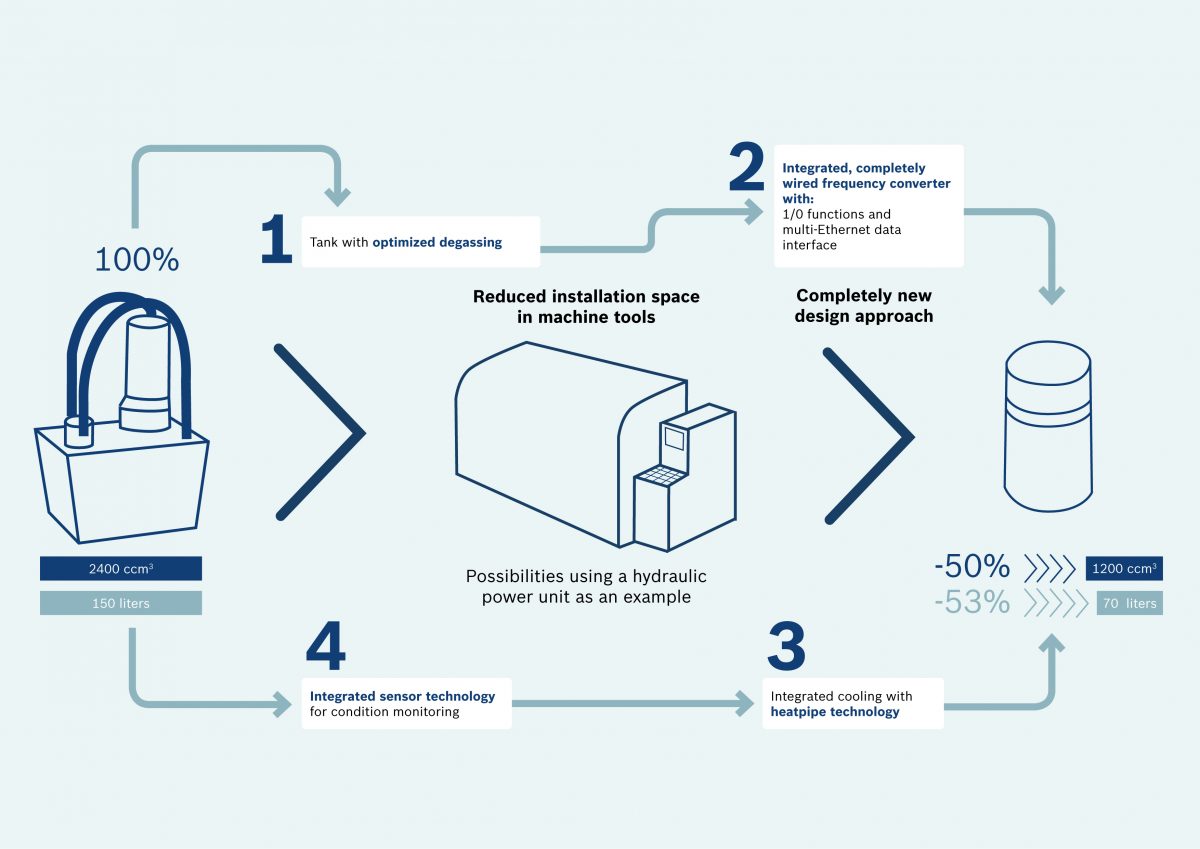
To reduce the installation space, solution manufacturers can start mainly with the following components: hydraulic power unit and control cabinet. When considering this split, it becomes evident that compact power units which are also easy to integrate require completely new design approaches to eliminate all features which waste unnecessary space in the performance spectrum up to 4 kW and to ensure that the units are still compatible with many different machine designs.

Highly integrated design approaches

The features of such innovative design concepts according to the EU Eco-Design Directive 2009/125/EC for example include a tank which is optimized for efficient degassing and reduces the oil volume by up to 80 percent. A much more decisive factor for gaining space is, however, that all functions can actually be integrated in one small power unit – from an economic variable-speed drive for demand-based power output to sensor technology with filling level, temperature, pressure and filter contamination sensors to a completely wired frequency converter.

Bosch_Infografik_EN-1200x849 (1)

Compact and ready for Industry 4.0

For the future viability of this approach with regard to Industry 4.0, a data interface is essential as well. Only with permanent condition monitoring can the operating conditions be optimized comfortably and relevant faults be detected early on. With this equipment, the user only has to connect the electric power, the data interface and the hydraulic supply during installation and the hydraulic power unit is ready for operation

New cooling with heatpipe

So-called heatpipes are considered to be a space-saving innovation regarding the cooling of hydraulic power units. Their high-performance passive thermal conduction allows for a further reduction of the frame size. The heatpipes absorb the thermal energy of frequency converter, motor and hydraulic oil and efficiently transfer it to a central heat sink such as e. g. cooling water…
This ensures an intelligently optimized thermal management within the hydraulic power unit and optimally utilizes the cooling power of the cooling water. There is no need for a separate hydraulic circuit for oil cooling. This reduces installation space, noise emissions, energy consumption and possibilities for leakage.

Heatpipe – Functional principle

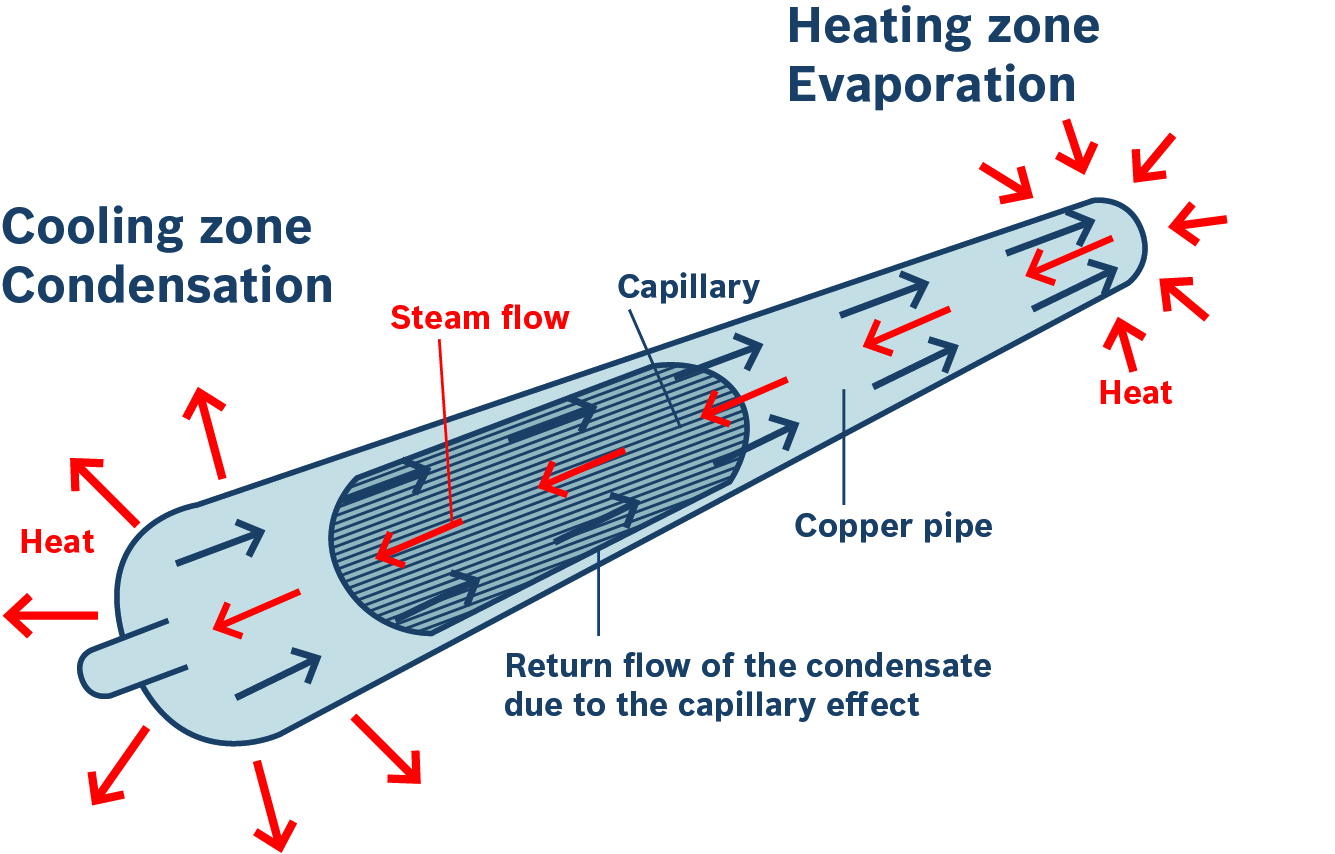
Basically, a heatpipe consists of air-tightly sealed copper pipes with underpressure. Inside, there is a medium which transfers thermal energy. In the temperature range of hydraulic power units, the medium may be e.g. distilled water. The boiling temperature of the water is significantly reduced by the low pressure within the heatpipe, which means that a boiling or condensation process can already take place at low temperatures.

Functionality: If you dip the heatpipe for example in hot hydraulic oil, the thermal energy at the lower immersed part of the heatpipe is transferred to the water. The water exceeds the boiling point, evaporates and absorbs a large amount of thermal energy with low temperature difference (latent heat). The water steam rises to the upper part of the heat pipe which is cooled by e. g. a cooling element. Here, the water steam condensates and gives off the thermal energy to the cooling water. Thanks to the latent heatabsorption and dissipation, the thermal conductivity of heatpipes can be up to 1000 times higher than the thermal conductivity of copper pipes. Due to the high elasticity of the copper pipes, the heat pipe can be easily shaped. In this way, ideal heat paths can be formed inside the hydraulic power unit and the installation space can be considerably optimized. Similar application ranges with equal optimization potential can be found in computer technology. Here, the thermal energy in laptops caused by heat sources such as the CPU are transferred to the central cooling elements using heatpipes.

Grafik_Heatpipe_EN.jpg

Plug & Play: no control cabinet

The frequency converter has a high potential for gaining installation space as well. If it has already been equipped with Multi-Ethernet interface for Sercos, Profinet and other standards by the manufacturer, machine and plant manufacturers are able to reduce the control cabinet requirement for the hydraulic unit by up to 100 percent. As a precondition, however, the sensor technology and the motor in the power unit have to be wired to the frequency converter in such a way that the frequency converter can control the hydraulic pressure autonomously. This means that the control cabinet can not only be designed with smaller dimensions. Sometimes it can even be completely omitted together with the corresponding installation effort and related sources of error.

Conclusion

Fully integrated small power units based on a completely innovative design approach for the performance range up to 4 kW provide machine and plant manufacturers with the advantages of hydraulic drives with very little space requirements. As an alternative to purely electrical solutions, the required energy can be converted into a linear movement in a precise and costeffective manner directly at the working area using a simple hydraulic cylinder. If sensor technology, frequency converter and data interface are integrated as well, users not only benefit from comprehensive condition monitoring but also from a significantly reduced control cabinet footprint or even from a design without control cabinet.
More information fully integrated power units: www.boschrexroth.com/cytropac

Operating principle: https://www.youtube.com/watch?v=sSPemS94G2I

cropped-cmafh-logo-with-tagline-caps.png

CMA/Flodyne/Hydradyne is an authorized Bosch Rexroth distributor in Illinois, Wisconsin, Iowa and Northern Indiana.

In addition to distribution, we design and fabricate complete engineered systems, including hydraulic power units, electrical control panels, pneumatic panels & aluminum framing. Our advanced components and system solutions are found in a wide variety of industrial applications such as wind energy, solar energy, process control and more.