Balluff

Reliable Part Exit/Part-Out Detection

Guest contributor: Dave Bird, Balluff

Walk into any die shop in the US and nine out of ten times, we discover diffuse reflective sensors being used to detect a large part or a small part exiting a die. Many people have success using this methodology, but lubrication-covered tumbling parts can create challenges for diffuse-reflective photoelectric sensing devices for many reasons:

  1. Tumbling parts with many “openings” on the part itself can cause a miss-detected component.
  2. Overly-reflective parts can false triggering of the output.
  3. Dark segments of the exiting part can cause light absorption. Remember, a diffuse sensors sensing distance is based on reflectivity. Black or dark targets tend to absorb light and not reflect light back to the receiver.
  4. Die lube/misting can often fog over a photoelectric lens requiring maintenance or machine down time.

The solution: Super Long Range Inductive Sensors placed under chutes

Most metal forming personnel are very familiar with smaller versions of inductive proximity sensors in tubular sizes ranging from 3mm through 30mm in diameter and with square or “block style” inductive types (flat packs, “pancake types”, etc.) but it is surprising how many people are just now discovering “Super Long Range Inductive Proximity” types. Super Long Range Inductive Proximity Sensors have been used in metal detection applications for many years including Body-In-White Automotive applications, various segments of steel processing and manufacturing, the canning industry, and conveyance.

Benefits of Using A UHMW Chute + Super Long Range Inductive Proximity Sensor in Part Exit/Part-Out Applications:

  1. It is stronger and quieter than parts flowing over a metal chute, readily available in standard and custom widths, lengths and thicknesses to fit the needs of large and small part stampers everywhere.
  2. UHMW is reported to be 3X stronger than carbon steel.
  3. UHMW is resistant to die lubes.
  4. UHMW allows Super Long Range Inductive Proximity Sensors to be placed underneath and to be “tuned” to fit the exact zone dimension required to detect any part exiting the die (fixed ranges and tunable with a potentiometer). The sensing device is also always out of harm’s way.
  5. Provides an option for part detection in exiting applications that eliminates potential problems experienced in certain metal forming applications where photoelectric sensing solutions aren’t performing optimally.

A Two-Out Die with Metallic Chute

Not every Part Exit/Part-Out application is the same and not every die, stamping application, vintage of equipment, budget for sensing programs are the same. Butit’s important to remember in the world of stamping, to try as consistently as possible to think application specificity when using sensors.  That is, putting the right sensing system in the right place to get the job done and to have as many technical options available as possible to solve application needs in your own “real world” metal forming operation.  We believe the UHMW + Super Long Range Inductive System is such an option.

You can learn more in the video below or by visiting www.balluff.us.

 

cropped-cmafh-logo-with-tagline-caps.pngCMA/Flodyne/Hydradyne is an authorized  Balluff distributor in Illinois, Wisconsin, Iowa and Northern Indiana.

In addition to distribution, we design and fabricate complete engineered systems, including hydraulic power units, electrical control panels, pneumatic panels & aluminum framing. Our advanced components and system solutions are found in a wide variety of industrial applications such as wind energy, solar energy, process control and more.

3 Tips for Reducing Downtime

Guest contributor:  Janet Czubek, Balluff

Whether it’s through preventative maintenance or during planned machine downtime, reducing downtime is a common goal for manufacturers. Difficult environments create challenges for not just machines, but also the components like sensors or cables. Below are three tips to help protect these components and reduce your downtime.

sacraficialcableCables don’t last forever. However, they are important for operations and keeping them functional is vital. An easy way to help reduce downtime and save money is by implementing a “sacrificial cable” in unforgiving environments. A sacrificial cable is any cable less than two meters in length and placed in situations where there is high turnover of cables.  This sacrificial cable does not have to be a specialty cable with a custom jacket. It can be a simple 1 meter PVC cable that will get changed out often. The idea is to place a sacrificial cable in a problematic area and connect it to a longer length cable, or a home-run cable. The benefits of this method include: less downtime for maintenance when changing out failures, reduced expenses since shorter cables are less expensive, and there is less travel for the cable around a cell.

hdc_cablesA second way to help reduce downtime is consider your application conditions up front. We discussed some of the application conditions to consider in a previous blog post, but how can we address these challenges? Not only is it important to choose the correct sensor for the environment, but remember, cables don’t last forever. Choosing the appropriate cable is also key to reducing downtime. Welding environments demand a cable that weld beads will not stick to and fuse the cable to the sensor. There are a variety of jacket types like silicone, silicone tube, or PTFE that prevent weld debris from accumulating on the cable. I’ve also seen applications where there is a lot of debris cutting through cables. In this case, a stainless steel braid cable would be a better solution than a traditional cable. Fitting the right protection to the right application is crucial..

gizmo4A third tip to help reduce your machine downtime is to simply add protection to your existing components. Adding protection, whether it is a protective bracket or a silicone product, will help keep components running longer. This type of protection can be added before or after the cell is operational.   One example of sensor protection is adding a ceramic cap to protect the face of a sensor. You can also protect the connection by adding tubing to the cable out version of the sensor to shield it from debris. Mounting sensors in a robust bracket helps protect the sensor from being hit, or having debris cover the sensor.  There are different degrees of changes that help prolong operations.

Metalforming expert, Dave Bird, explains some of these solutions in the video below. To learn more you can also visit our website at www.balluff.us.

About Us

cropped-cmafh-logo-with-tagline-caps.png


CMA/Flodyne/Hydradyne is an authorized  Balluff distributor in Illinois, Wisconsin, Iowa and Northern Indiana.

In addition to distribution, we design and fabricate complete engineered systems, including hydraulic power units, electrical control panels, pneumatic panels & aluminum framing. Our advanced components and system solutions are found in a wide variety of industrial applications such as wind energy, solar energy, process control and more.

Demand the best from your RFID partner

Guest contributor, Wolfgang Kratzenberg, Balluffrfid

That seems like a no-brainer statement, but often I find myself talking to customers who are frustrated with their current vendor for a myriad of reasons. An RFID project can require a pretty decent chunk of capital investment so when something doesn’t go as planned people start looking for answers immediately. This usually presents a great opportunity for us to go in and save the day, but it’s hard for me to ignore the time, money and resources that were wasted. Having witnessed this on several occasions I have concluded that there are a large number of RFID companies who are niche suppliers, but there are very few who can qualify as an RFID Partner. The RFID partner helps ensure success from idea to implementation to future expansion. That said, here is a list of things to consider prior to discussing your application with an RFID company:

  • Does the partner offer hardware that communicates over USB, Serial, TCP/IP, Ethernet/IP, Profinet/Profibus, CC-Link, Ethercat, etc?
  • Does the partner offer a wide range of form factors of readers, tags, and antennae?
  • Does the partner build hardware for multiple frequencies?
  • Is the partner willing to build custom equipment just right for your application?
  • Does the partner offer support before, during and after the project?
  • Does the partner have a core competency in the application?
  • Can the partner meet application specs such as, high temperatures, high speed reading on the fly, storing and reading large amounts of data, high ingress protection rating, etc.?
  • Does the partner develop and design products which are scalable and easily expandable?

If you can answer yes to all of these questions then chances are you are pretty well set. With such a mature technology there are many ways for RFID companies to set themselves apart from one another. However, there are only a few who are willing to do what it takes to be considered a partner.

To learn more about RFID technology visit www.balluff.us/rfid

About Us

cropped-cmafh-logo-with-tagline-caps.png

CMA/Flodyne/Hydradyne is an authorized  Balluff distributor in Illinois, Wisconsin, Iowa and Northern Indiana.

In addition to distribution, we design and fabricate complete engineered systems, including hydraulic power units, electrical control panels, pneumatic panels & aluminum framing. Our advanced components and system solutions are found in a wide variety of industrial applications such as wind energy, solar energy, process control and more.
Three Things to Know About IO-Link

Guest contributor: Pat Millott, Balluff

IO-Link has become synonymous with the term “distributed modular I/O”. We know it is universal, smart, and easy, but what exactly is IO-Link? In a nutshell, by utilizing a standard sensor cable, the IO-Link slave device speaks point to point with an IO-Link master. The IO-Link master then combines the data with other IO-Link slave devices and communicates over an industrial network or backplane to the controller. In other words, it can be compared to a simple USB connection: for the most part, any USB device will work in any USB port, as long as the manufacturers of both devices have played by the rules when making the devices.

With that being said, here are three things to know about IO-Link:

  • Cable Length Cable Type and Length

Cable runs between master and slave can be up to 20 meters in length and typically utilize standard automation cables. Most cables, but not all, are M12 A-coded, unshielded, 3 or 4-conductor DC sensor cables.

  • Star ArchitectureStar Architecture

Since IO-Link utilizes a point-to-point serial communication, Star Topology is the only device architecture that can be constructed.

  • IO-Link PortsPort Class A vs Port Class B Devices

While most devices utilize IO-Link port Class A, output devices like valves are now being offered as IO-Link port Class B. Be sure to know if the master and/or slaves are Class A or Class B type ports. Most Balluff devices are IO-Link port Class A.

To learn more visit balluff.us/iolink

About Us

cropped-cmafh-logo-with-tagline-caps.png

CMA/Flodyne/Hydradyne is an authorized  Balluff distributor in Illinois, Wisconsin, Iowa and Northern Indiana.

In addition to distribution, we design and fabricate complete engineered systems, including hydraulic power units, electrical control panels, pneumatic panels & aluminum framing. Our advanced components and system solutions are found in a wide variety of industrial applications such as wind energy, solar energy, process control and more.


A Simple Out Feed Solution for Progressive Stamping

Guest contributor: Dave Bird, Balluff

Applications where sensor contact is unavoidable are some of the most challenging to solve. Metal forming processes involving over travel can also damage or even destroy a sensor causing failure and expensive unplanned downtime. Manufacturers often try to remedy this with in-house manufactured spring loaded out-feed mechanisms but those are expensive to make by experienced tool and die personnel who have more important things to do . Over the years, I’ve seen this as a pervasive problem in the stamping industry. Many of these issues can be solved with the use of a simple yet effective  sensor actuator system known as a Balluff PlungerProx.

PlungerProx solves a few key issues in Progressive stamping:

  • The flexible trigger/actuation point is fully adjustable to meet sensitive or less sensitive activation points, not possible with “fixed” systems with substantial “over travel” built into the design.
  • It is fully self-contained (minimizing any risk of sensor damage and resulting unplanned machine down time).
  • The device can be disassembled and rapidly cleaned, reassembled, and placed back in service in the event that die lube or other industrial fluids enter the M18 body that can potentially congeal during shut down periods.

See me demo this product in the following video:

About Us

cropped-cmafh-logo-with-tagline-caps.png

CMA/Flodyne/Hydradyne is an authorized  Balluff distributor in Illinois, Wisconsin, Iowa and Northern Indiana.

In addition to distribution, we design and fabricate complete engineered systems, including hydraulic power units, electrical control panels, pneumatic panels & aluminum framing. Our advanced components and system solutions are found in a wide variety of industrial applications such as wind energy, solar energy, process control and more.

To avoid trouble later, consider your application conditions upfront

Guest contributor: Henry Menke, Balluff

Hardly a day passes by where we are not contacted by a desperate end-user or equipment manufacturer seeking assistance with a situation of sensors failing at an unacceptably high rate.  Once we get down to the root cause of the failures, in almost every case it’s a situation where the specific sensors are being applied in a manner which all but guarantees premature failure.

Not all sensors are created equal.  Some are intentionally designed for light-duty applications where the emphasis is more on economical cost rather than the ability to survive in rough service conditions.  Other sensors are specifically designed to meet particular challenges of the application environment and as a result may carry a higher initial price.

Some things to think about when choosing a sensor for a new application:

  • What kind of environmental conditions will the sensor be exposed to?  For example:
    • Very low or very high temperatures
    • Constant exposure to or immersion in liquid water
    • Continuous vibration
    • Extreme shock
    • Disruptive electrical noise (hand-held radios, welding fields, etc.)
    • Chemical contamination
    • Physical abuse or impact
    • Abrasion
    • High pressure wash down procedures
    • Exposure to outdoor conditions of UV sunlight, rain, ice, temperature swings, and condensing humidity
  • Is it possible to relocate the sensor to move it away from the difficult condition?
  • Is the sensor technology the best choice given the kind of application environment that it must operate in?
  • Is there a way to protect the sensor from exposure to the worst of the damaging effects?

When you reach for a catalog or jump on the internet to look for a sensor, it’s a good practice to just stop a moment first and make a list of the environmental challenges that the sensor could face.  Then you will be prepared to make an appropriate selection that best meets your expected application conditions.

About Us

cropped-cmafh-logo-with-tagline-caps.png

CMA/Flodyne/Hydradyne is an authorized  Balluff distributor in Illinois, Wisconsin, Iowa and Northern Indiana.

In addition to distribution, we design and fabricate complete engineered systems, including hydraulic power units, electrical control panels, pneumatic panels & aluminum framing. Our advanced components and system solutions are found in a wide variety of industrial applications such as wind energy, solar energy, process control and more.

Enhancing Stepper Motor Systems with Linear Encoders

Guest contributor, Henry Menke, Balluff

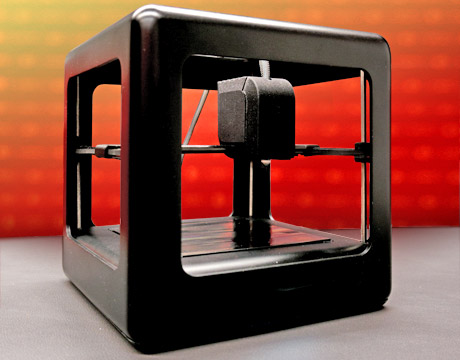
Tabletop automation is a trend that is gaining momentum, especially in the fields of medical laboratory automation and 3D printing. Both of these applications demand a level of linear positioning accuracy and speed that might suggest a servomotor as a solution, but market-driven cost constraints put most servos out of financial consideration. New advances in stepper motor design, including higher torque, higher power ratings, and the availability of closed-loop operation via integrated motor encoder feedback are enabling steppers to expand their application envelope to include many tasks that formerly demanded a servo system.

Meeting the Demand for Even More Accurate, More Reliable Positioning

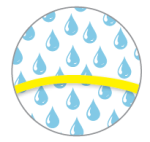
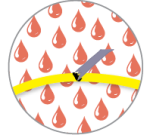
As tabletop automation development progresses, performance demands are increasing to the point that steppers systems may struggle to meet requirements. Fortunately, the addition of an external linear encoder for direct position feedback can enhance a stepper system to enable the expected level of reliable accuracy. An external linear encoder puts drive-mechanism non-linearity inside the control loop, meaning any deviations caused by drive component inaccuracy are automatically corrected and compensated by the overall closed-loop positioning system. In addition, the external linear encoder provides another level of assurance that the driven element has actually moved to the position indicated by the number of stepper pulses and/or the movement reported by the motor encoder. This prevents position errors due to stepper motor stalling, lost counts on the motor encoder, someone manually moving the mechanism against motor torque, or drive mechanism malfunction, i.e. broken drive belt or sheared/skipped gearing.
Incremental, Absolute, or Hybrid Encoder Signals

bmlThe position signals from the external encoder are typically incremental, meaning a digital quadrature square wave train of pulses that are counted by the controller. To find a position, the system must be “homed” to a reference position and then moved the required number of counts to reach the command position. The next move requires starting with the position at the last move and computing the differential move to the next command position. Absolute position signals, typically SSI (synchronous serial interface) provide a unique data value for each position. This position is available upon power-up…no homing movement is required and there is no need for a pulse counter. A recent innovation is the hybrid encoder, where the encoder reads absolute position from the scale, but outputs a quadrature incremental pulse train in response to position moves. The hybrid encoder (sometimes referred to as “absolute quadrature”) can be programmed to deliver a continuous burst of pulses corresponding to absolute position at power up, upon request from the controller, or both.

For more information about magnetic linear encoder systems, visit www.balluff.us.

CMAFH resources for Balluff Linear Encoders

Which cable is best for your application?

Guest contributor, Janet Czubek, Balluff

There are many different types of cable jackets and each jacket works well in a specific application.  The three main sensor cable jackets are PVC (Polyvinyl Chloride), PUR (polyurethane) and TPE (thermoplastic elastomer). Each jacket type has different benefits like washdown, abrasion resistant or high flexing applications.  Finding the correct jacket type for your application can extend the life of the cable.PVC

PVC is a general purpose cable and is widely available.  It is a common cable, and typically has the best price point.  PVC has a high moisture resistance, which makes it a good choice for wash-down applications.

PURPUR is found mostly in Asia and Europe.  This cable jacket type has good resistance against abrasion, oil and ozone.  PUR is known for being Halogen free, not containing: chlorine, iodine, fluorine, bromine or astatine.  This jacket type does have limited temperature range compared to the other jacket types, -40…80⁰C.
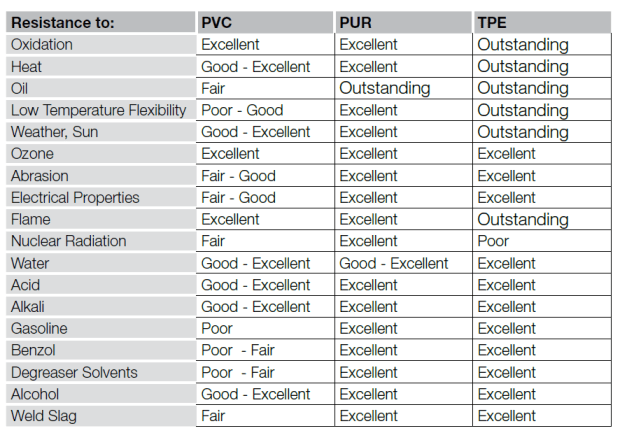
TPETPE is flexible, recyclable and has excellent cold temperature characteristics, -50…125⁰C.  This cable is resistant against aging in the sunlight, UV and ozone.  TPE has a high-flex rating, typically 10 million.

The table below details the resistance to different conditions. Note that these relative ratings are based on average performance. Special selective compounding of the jacket can improve performance.

resistanceto2

Choosing the right jacket type can help reduce failures in the field, reducing downtime and costs.  Please visit www.balluff.us to see Balluff’s offering of sensor cables in PVC, PUR and TPE.

Acids Can Put Your Sensors in a Pickle

Guest contributor,  Henry Menke, Balluff

In many types of metals production, pickling is a process that is essential to removing impurities and contaminants from the surface of the material prior to further processing, such as the application of anti-corrosion coatings.

In steel production, two common pickling solutions or pickle liquors are hydrochloric acid (HCl) and sulfuric acid (H2SO4). Both of these acids are very effective at removing rust and iron oxide scale from the steel prior to additional processing, for example galvanizing or rolling. The choice of acid depends on the processing temperature, the type of steel being processed, and environmental containment and recovery considerations. Hydrochloric acid creates corrosive fumes when heated, so it typically must be used at lower temperatures where processing times are longer. It is also more expensive to recover when spent. Sulfuric acid can be used at higher temperatures for faster processing, but it can attack the base metal more aggressively and create embrittlement due to hydrogen diffusion into the metal.

Acids can be just as tough on all of the equipment involved in the pickling lines, including sensors. When selecting sensors for use in areas involving liquid acid solutions and gaseous fumes and vapors, care must be given to the types of acids involved and to the materials used in the construction of the sensor, particularly the materials that may be in direct contact with the media.

PressureSensor

A pressure sensor specifically designed for use with acidic media, at temperatures up to 125 degrees C.

A manufacturer of silicon steel was having issues with frequent failure of mechanical pressure sensors on the pickling line, due to the effects of severe corrosion from hydrochloric acid at 25% concentration. After determination of the root cause of these failures and evaluation of alternatives, the maintenance team selected an electronic pressure sensor with a process connection custom-made from PVDF (polyvinylidene fluoride), a VitonTM O-ring, and a ceramic (rather than standard stainless steel) pressure diaphragm. This changeover eliminated the corroded mechanical pressure sensors as an ongoing maintenance problem, increasing equipment availability and freeing up maintenance personnel to address other issues on the line.

The basics of IP69K washdown explained

Guest contributor, Will Healy III, Balluff

Ask 10 engineers working in Food & Beverage manufacturing what “washdown” means to them and you will probably get about 12 answers.  Ask them why they wash down equipment and a more consistent answer appears, everyone is concerned about making clean healthy food and they want to reduce areas of harborage for bacteria.  These environments tend to be cool & wet which usually leads the engineers to ask for 316L stainless steel & ingress protection of IP69K from component manufacturers and also ask for special component ratings.
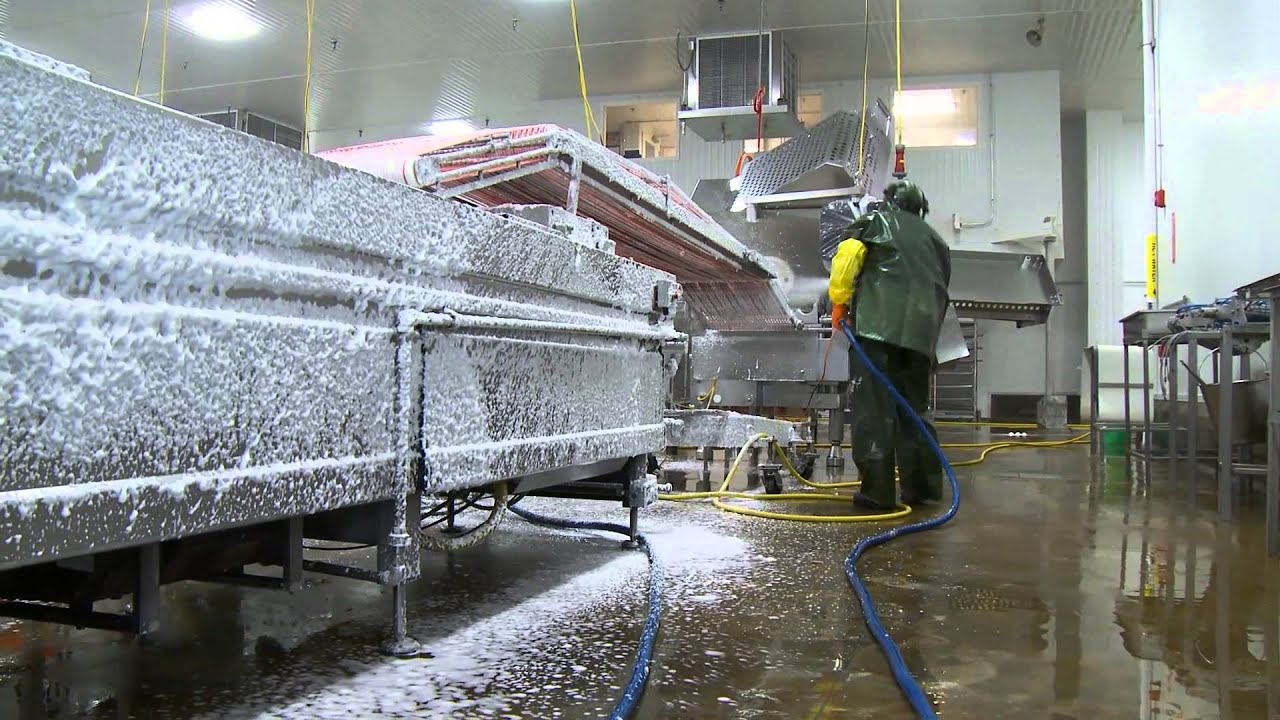
So what are the basic elements of the washdown procedure?

  • Hot! – Minimum 140F to kill microbes & bacteria.
  • High Pressure! – Up to 1000psi to blast away soiled material.
  • Nasty! – Water, caustics, acid detergents, spray & foam everywhere.
  • Hard Work! – Typically includes a hand cleaning or scrubbing of key components.
  • Regular! – Typically 15-20hrs per week are spent cleaning equipment but in dairy & meat it can be more.

What requirements are put onto components exposed to washdown?

  • Stainless Steel resists corrosion and is polished to level the microscopic roughness that provides harborage for bacteria.
  • Special Component Ratings:
    • ECOLAB chemical testing for housings
    • FDA approved materials
    • 3A USA hygienic for US Equipment
    • EHEDG hygienic for European Equipment
  • IP69K is tested to be protected from high pressure steam cleaning per DIN40050 part 9; this is not guaranteed to be immersion rated (IP67) unless specifically identified.

If you are interested in what sensors, networking & RFID products are available for use in food and beverage manufacturing with a washdown environment, please visit www.balluff.us.