Automation

Battery production: Increased capacity through intelligent automation

Guest contributor: Hans Niessen, Business Development Manager Industry Sector Semicon, Electronic Manufacturing and Flat Panel Display at Bosch Rexroth 

Manufacturers of modern energy storage systems are faced with the challenge of developing high-quality batteries offering better performance and marketing them in large numbers in the short term. How can automation help when it comes to producing various models and batch sizes not only quickly and flexibly but also in an economical and environmentally friendly manner?

Electric cars, digital mobile devices, decentralized energy storage systems for wind or solar power: in the coming decade, demand for battery cells will increase dramatically. According to the Fraunhofer ISI’s recently published “Energy storage roadmap”, cell production capacities at European plants will have to increase to several hundred GWh by 2030 in order to meet demand in Europe. Manufacturers are in a race against time and must find ways of getting newly developed battery solutions onto the market in large quantities much more quickly.

Mass production with a high level of flexibility

Because the development of more powerful energy storage systems follows short evolution cycles, it must also be possible to adapt production processes quickly. Process and product improvements identified in the laboratory should be adopted in production immediately. How do the various automation partners cope with these requirements? How do they intend to reduce operating costs while ensuring optimum material and product quality and at the same time taking into account important sector issues such as energy efficiency and the use of resources? To achieve these aims in a convincing manner, they must look at all sub-processes involved in battery production – something that requires a broad knowledge of automation given their specific requirements.

22710-1200x719

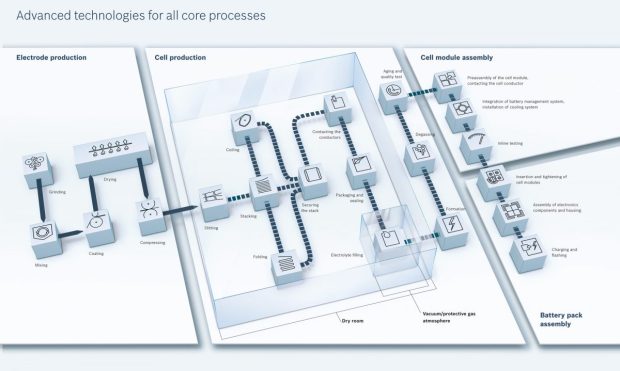
Layout of a battery production facility. Each individual step requires a great deal of highly efficient, flexible automation technology.

High-speed coating of electrodes…

Rechargeable battery cells are manufactured in a variety of forms. Regardless of whether they are cylindrical, prismatic or in the form of a pouch cell, each new generation has specific production and automation requirements. In an effort to achieve greater capacity in an even smaller space, the electrode foils wrapped or folded inside them are becoming increasingly thin and their coating increasingly thick. Highly precise web handling is needed in order to achieve the process speed needed for mass production but without impairing quality. This in turn requires specific functions such as those provided by the Motion Logic Control (MLC) control software from Bosch Rexroth with its libraries. The system is based on the embedded control system XM and allows motion tasks with over 200 distributed axes with sub-micrometer accuracy. Easily parameterizable control algorithms such as speed, force and travel control together with synchronization allow quick engineering with minimal programming work.

22712-1200x801

Coating places huge demands on the production system as it has a significant influence over the properties, operating life and energy density of a battery.

… and structuring

As part of the high-precision roll-to-roll process, the two electrodes along with two separators are combined to produce a sandwich structure and, in the case of cylindrical batteries, are formed into a roll. For prismatic cells, they must be accurately stamped or cut using a laser and then stacked flat or folded in the form of a Z. In order to manufacture pouch cells, the electrode sections must be accurately cut, stacked and then welded. Because the stacking and welding are relatively time-consuming processes, they often lead to inconvenient delays in the overall process.

Production steps for various cell types requiring highly efficient roll-to-roll processes and flexible transport systems to prevent bottlenecks.

Flexible transport prevents bottlenecks

In order to prevent bottlenecks when manufacturing batteries, displays and other electronic products, Bosch Rexroth has developed the Flexible Transport System FTS. It is dimensioned according to the mass to be transported and transports the individual workpiece carriers independently of one another from station to station. As a result, maximum acceleration is possible at all times. The multi-product system can take on exact positioning tasks at the same time. Thanks to a more flexible layout, more time-consuming processes can be carried out in parallel, thus doubling productivity. With these new possibilities, the production of notebook and smartphone batteries could be increased by almost 200 percent without impairing the time to market.

With the Flexible Transport System (FTS), Bosch Rexroth prevents typical bottlenecks in battery, display and electronic production.

Producing battery packs quickly and stably

Before it is closed and sealed, the battery needs to be filled with electrolyte. It should be as full as possible so that only minimal spaces remain in the separator foam. Because the liquid is toxic, the process must be completed quickly in order to avoid contaminating the environment. The individual battery cells are then combined to form modules. Automated systems are also used to produce the housings for the battery packs in large numbers and with minimal waste. Solutions such as the IoT Gateway from Bosch Rexroth which collect sensor and control data and passes them on to cloud platforms or on-premises solutions for analysis and evaluation are ideal for monitoring process stability and making continual improvements.

Highly efficient, flexible module production

A typical battery pack is made up of several cells and a management/cooling system. In order for manufacturers to adapt their existing production lines quickly in the event of product changes or to react to changing batch sizes, they should standardize automation and handling and at the same time ensure adequate flexibility. Once again, the flexible FTS transport system is an option here. Thanks to its scalability for products weighing anything from 1 g to 2,000 kg, it is suitable even for large vehicle batteries.

Green processes: efficient energy use

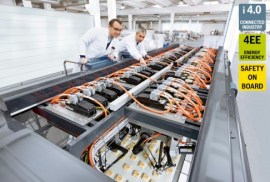
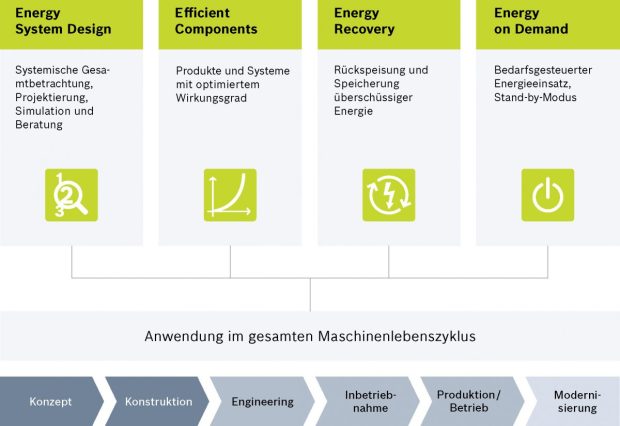
As an automation provider with expertise in a range of technologies and the ability to collect and analyze data from machines and systems quickly and easily, Bosch Rexroth helps machine manufacturers when it comes to green processes too. When used in battery production, the Rexroth 4EE (Rexroth for Energy Efficiency) system helps to increase productivity while conserving resources, cutting emissions and reducing operating costs. This is possible thanks to four levers which work throughout the life cycle:

RD08503_4EE_Grafik_Seite7-1200x826

Rexroth 4EE: The holistic view of machines and systems over their entire life cycle allows energy consumption, emissions and operating costs to be reduced sustainably while increasing productivity.

Productivity requirements demand full expertise

In spite of the various challenges in battery production, the situation from the point of view of an experienced automation partner is not new. The experts from Bosch Rexroth have already helped companies in the solar, photovoltaic and semiconductor industries to cope with the changes in their sectors and can therefore offer users and machine manufacturers competent advice. Over 20 years’ expertise from the printing industry has gone into the company’s roll-to-roll solutions. Open Core Engineering which allows the simulation and virtual commissioning of new automation solutions also plays a key role in reducing the time to market. Bosch Rexroth relies on open standards such as OPC UA in order to continually improve processes and provide condition-based maintenance. With innovative system solutions such as the FTS, global service and an international network of machine manufacturers, the basis for quick and lasting success in the market is already in place.

cropped-cmafh-logo-with-tagline-caps.pngCMA/Flodyne/Hydradyne is an authorized Bosch Rexroth distributor in Illinois, Wisconsin, Iowa and Northern Indiana.

In addition to distribution, we design and fabricate complete engineered systems, including hydraulic power units, electrical control panels, pneumatic panels & aluminum framing. Our advanced components and system solutions are found in a wide variety of industrial applications such as wind energy, solar energy, process control and more.
5 Ways Flexible Manufacturing has Never Been Easier

Guest Contributor: Tom Rosenberg, Balluff

Flexible manufacturing has never been easier or more cost effective to implement, even down to lot-size-one, now that IO-Link has become an accepted standard. Fixed control and buried information is no longer acceptable. Driven by the needs of IIoT and Industry 4.0, IO-Link provides the additional data that unlocks the flexibility in modern automation equipment, and it’s here now!  As evidence, here are the top five examples of IO-Link enabled flexibility:

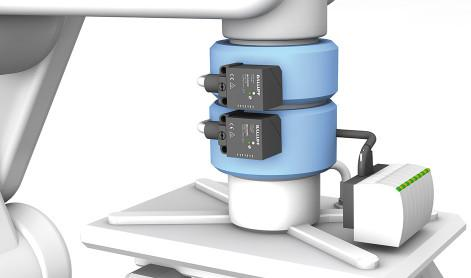
#5. Quick Change Tooling: The technology of inductive coupling connects standard IO-Link devices through an airgap. Change parts and End of Arm (EOA) tooling can quickly and reliably be changed and verified while maintaining connection with sensors and pneumatic valves. This is really cool technology…power through the air!

Image1


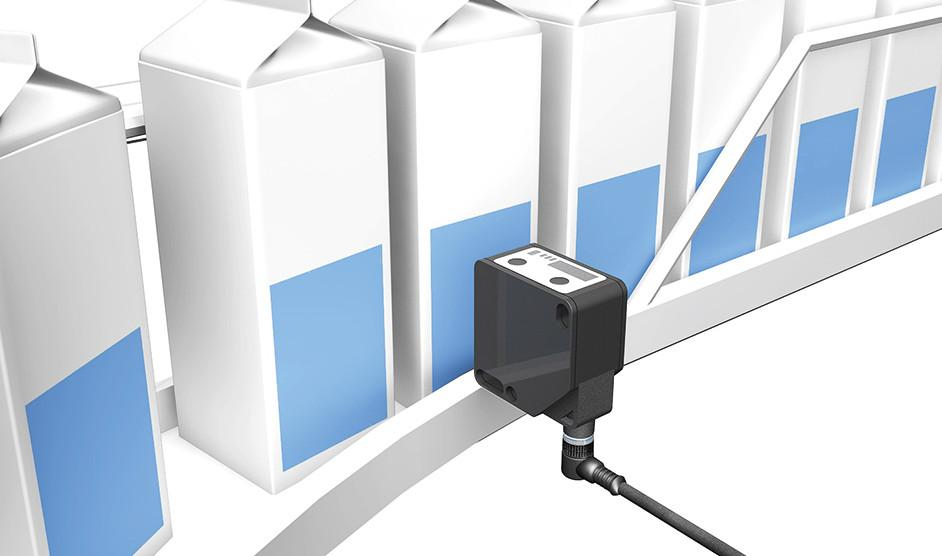
#4. On-the-fly Sensors Programming: Many sensor applications require new settings when the target changes, and the targets seem to always change. IO-Link enables this at minimal cost and very little time investment. It’s just built in.

Image 2


#3. Flexible Indicator Lights: Detailed communication with the operators no long requires a traditional HMI. In our flexible world, information such as variable process data, timing indication, machine status, run states and change over verification can be displayed at the point of use. This represents endless creativity possibilities.

Powertrain visualisieren


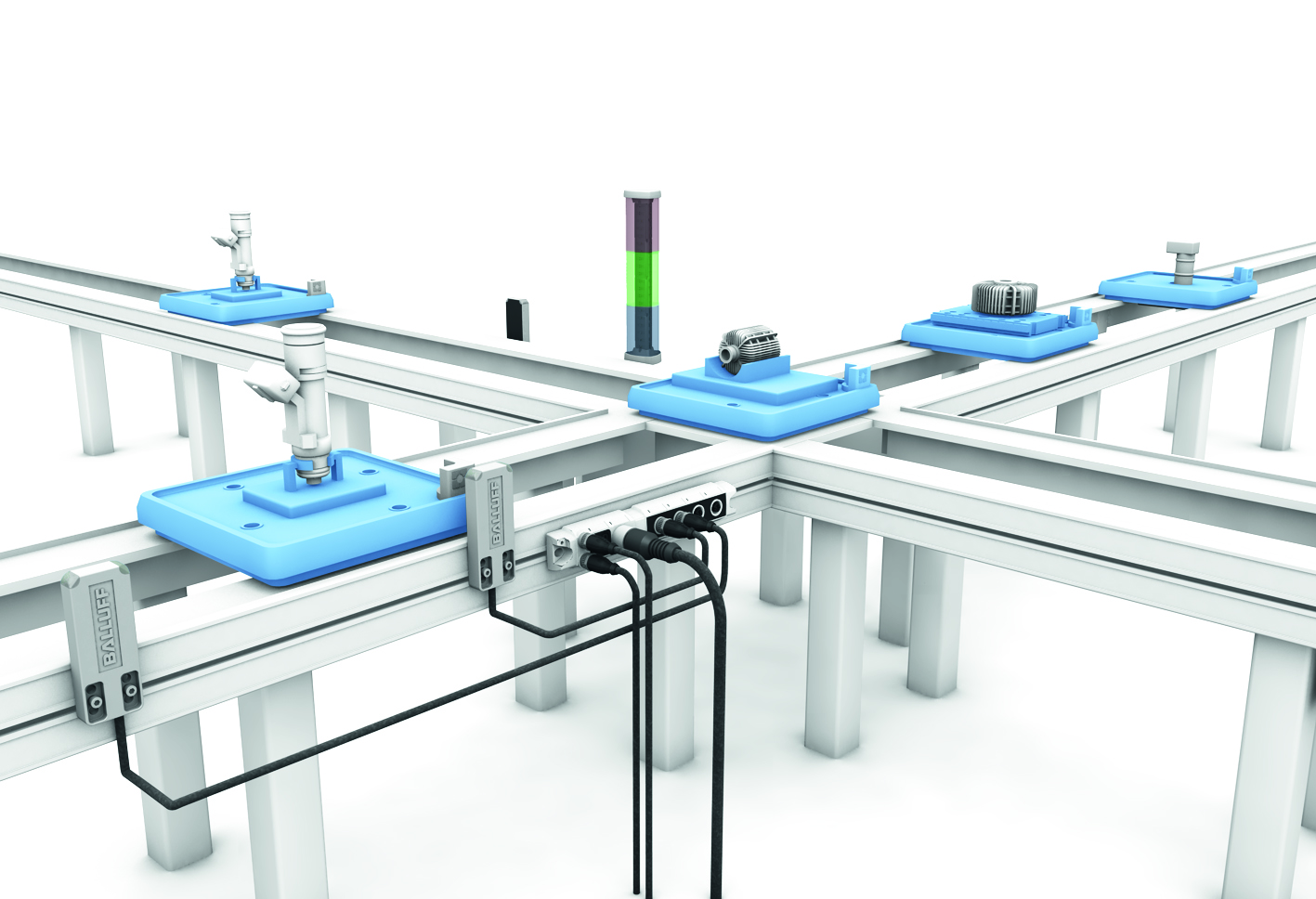
#2. Low cost RFID: Radio Frequency Identification (RFID) has been around for a while. But with the cost point of IO-Link, the applications have been rapidly climbing. From traditional manufacturing pallets to change-part tracking, the ease and cost effectiveness of RFID is at a record level. If you have ever thought about RFID, now is the time.

7_1_Produktionsdaten_Dokumentieren


#1. Move Away from Discrete to Continuously Variable Sensors: Moving from discrete, on-off sensors to continuously variable sensors (like analog but better) opens up tremendous flexibility. This eliminates multiple discrete sensors or re-positioning of sensors. One sensor can handle multiple types and sizes of products with no cost penalty. IO-Link makes this more economical than traditional analog with much more information available. This could be the best technology shift since the move to Ethernet based I/O networks.

8_1_induktiver_Abstand

So #1 was the move to Continuously Variable sensors using IO-Link. But the term, “Continuously Variable” doesn’t just roll off the tongue. We have discrete and analog sensors, but what should we call these sensors? Let me know your thoughts!

To learn more about RFID and IO-Link technology, visit www.balluff.com.

cropped-cmafh-logo-with-tagline-caps.pngCMA/Flodyne/Hydradyne is an authorized  Balluff distributor in Illinois, Wisconsin, Iowa and Northern Indiana.

In addition to distribution, we design and fabricate complete engineered systems, including hydraulic power units, electrical control panels, pneumatic panels & aluminum framing. Our advanced components and system solutions are found in a wide variety of industrial applications such as wind energy, solar energy, process control and more.

Why Rexroth? Top Four Reasons to Choose Rexroth Drives & Controls

Todd Sharp, Motion Control Sales Manager, CMA/Flodyne/Hydradyne

CMA/Flodyne/Hydradyne is a leader in the design and commission of drive and control
systems for our customers for over 30 years, and one question that we often hear is “Why is Rexroth the best?”  There are many brands competing for the drive and control market, and here at CMAFH, we have working experience with most if not all of them. Our engineers program,  repair and upgrade many of the brands of control systems, and we have the ability to integrate any brand into our custom projects at our customer’s request. Having specialized in Bosch Rexroth products for many years, we understand the unique strengths of the product line.

Rexroth drives and controls can be differentiated from competing brands in four very distinct ways.

1. Product Breadth

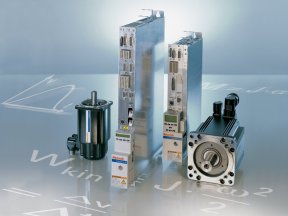
The IndraDrive product family spans the power range from 100W to 4MW. This product family can operate as an open loop frequency drive/sensor less vector drive up to a multi-axis integrated motion and logic controller that can be either stand alone or drive resident. The IndraDrive product family also includes a cabinet free drive integrated motor. This entire IndraDrive product family is supported by the same software.Indradrive 2016 13187

  • Power range from 100W to 4MW
  • Range of technology from open loop V/F and sensor-less vector control to multi-axis integrated motion and logic control
  •  Integrated motion and logic control – controller or drive resident
  •  Cabinet free drive integrated motor

2. Connectivity

Rexroth’s drive and control platform supports all common communication buses including Ethernet I/P, EtherCAT, Profinet, SERCOS, CANopen, Powerlink, Profibus.
We can control 3rd party motors regardless of brand or type, and we can operate all common feedback types including TTL, 1vpp, Endat, Hiperface, SSI, resolver. Our drives are available with a 2nd encoder input with a 1MHZ input frequency. Our control supports all common machine programming languages like ladder, FB, ST, IL… plus all common IT and engineering languages like C#, C++, Java, Labview, Matlab.

  • Supports all common communication buses including, Ethernet I/P, EtherCAT, ProfiNet, SERCOS, CANopen, Keyvisual_inkl_Logos_w486Powerlink, Profibus
  • Controls all 3rd party motors regardless of brand or technology type
  • Operates all common feedback types (TTL, 1vpp, ENDAT, Hiperface, SSI, resolver) with drive based second encoder input with up to 1MHZ input frequency
  • Supports all common machine programming languages (ladder, FB, structured text, instruction list) plus all common IT and engineering type languages like C#, C++, Java, Labview, Matlab

3. Functionality

Whether it’s drive or controller based, Rexroth offers multi-zone tension control, vibration dampening/anti-slosh control, high speed registration control, advanced electronic camming and hydraulic control. We also support zoned safety control with safe torque off and full safe motion; controller or drive based. Yes, drive based safe motion control!

  • PMK2801_02R_WEBMulti -zone tension control
  • Vibration dampening/anti-slosh control
  • High speed registration control
  • Advanced electronic camming
  • Supports all common hydraulic functions
  • Integrated safe torque off and safe motion control


4. Support

Rexroth designs, engineers and manufactures all products they sell. All are standard and sold throughout the world. In the US, hundreds of local high-tech distributors are Rexroth trained and certified to provide full sales, service and application support.  Additionally, Rexroth maintains sales, service and application support facilities in every region of the US, plus scores more globally.

  •  All products are standard and sold throughout the world
  • Bosch Rexroth maintains sales, service and application support facilities in every region of the US and scores more globally
  • In the US hundreds of local high-tech distributors are Rexroth trained and certified to provide additional sales, service and application support

Bosch Rexroth_2012

Do you have questions about this post?  Please contact us:

Go back

Your message has been sent

Warning
Warning
Warning
Warning

Warning.

About CMA/Flodyne/Hydradyne

cropped-cmafh-logo-with-tagline-caps.png

CMA/Flodyne/Hydradyne is an authorized  Bosch Rexroth distributor in Illinois, Wisconsin, Iowa and Northern Indiana.

In addition to distribution, we design and fabricate complete engineered systems, including hydraulic power units, electrical control panels, pneumatic panels & aluminum framing. Our advanced components and system solutions are found in a wide variety of industrial applications such as wind energy, solar energy, process control and more.
Resources:

Engineered Systems Capabilities

Shop for drives online

Indramat Repair Center

Rexroth Drives & Controls Training

Press productivity improves with controller upgrade

Guest contributor: Richard Meyerhoefer, Delta Computer Systems

Fastener stamping machine output triples after tuning the motion with a solution from Delta Computer Systems.

Improving the productivity of a manufacturing process by speeding up the operation of an old machine can be very difficult, driving plant managers to purchase new equipment. It’s often possible, however, to replace the control system, maintaining the old mechanics, and get the performance of a new machine for much lower cost. Hydraulics distributor CMA/Flodyne/Hydradyne (CMAFH) of Hanover Park, Illinois, recently assisted in such an upgrade for a manufacturer of fastening components. The machine was a press used to imprint patterns on the surface of metal fasteners with a punch that fits into the bottom of a 4″ bore hydraulic cylinder (Figure 1). As the punch comes down it reshapes the top of the fastener and its edges to provide a locking feature.

Motion controller selection

Figure 1. Diagram showing motion controller connections in the fastener press machine

In the past, the manufacturer used a programmable logic controller (PLC) to operate a two-position, bang-bang valve to drive the cylinder, but company engineers found imprecise results that limited production to around 60-to-70 parts per minute. As a result, the company moved to a proportional valve and closed-loop controller that operated the valve based on cylinder position/acceleration. The controller would open the valve quickly and then back off the valve as the cylinder got closer to making contact with the fastener. This method enabled an increase in production to approximately 140 parts per minute. But to meet competitive pressures, company managers demanded the rate be increased, driving the need for a new electro-hydraulic motion controller.

Company engineers called CMAFH, with whom they had worked on automation solutions for more than 20 years, to recommend a new controller for the company’s old bang-bang machine.

Hooking up the controller

The Delta RMC75E motion controller (Figure 2), recommended by CMAFH engineering manager Norman Dziedzic, accurately controls position and force, to control acceleration with more precision than the closed-loop controller previously used. Dziedzic programmed the motion controller to move the cylinder to a predetermined position while monitoring the force being applied by the punch. When the force reaches a particular value, the controller is switched to force control mode to ensure that adequate force is ultimately applied to the fastener. The old closed-loop control system used position control only, with some input from a load cell within the tool to verify that a certain minimum force was applied to the part.

“The Delta controller operates similar to that, but is easier to control,” says Richard Mellor, engineer at the fastener company. Every motion step made by the other controller was initiated by the PLC, and there was lag time in passing position information. “The beauty of the Delta controller is that the motion program now resides in the controller,” Mellor adds.

Now, the PLC just does overall machine control, triggering the Delta RMC to press the part at the appropriate time. When the pressing operation is complete, the Delta controller knows, based on the position and force ranges inputted to the controller, whether the pressed part is a good part or a bad one, and notifies the PLC. The Delta RMC75E gets cylinder position feedback from a linear magnetostrictive displacement transducer (LMDT) via a synchronous serial interface (SSI) to the controller. To measure force, the system uses a fatigue-rated (rugged) force transducer (shown in Figure 1).

Programming, tuning

Figure 2.  The Delta RMC75E motion controller can control up to two motion axes simultaneously

Dziedzic set up the motion program initially, and he fine-tuned the loop parameters working with a fastener company engineer. The two also developed the code to implement quality testing of the finished parts.

“I find the Delta very easy to program, but I have 30 years in as a controls engineer. If you’ve had anything to do with PLC or message display packages, it’s relatively intuitive to find your way around,” Mellor says

For tuning the motion, Dziedzic relied heavily on Delta Computer Systems’ Plot Manager software, which allows an engineer to view multiple key motion parameters versus time on a single graph (Figure 3). The plot shows three press cycles, where the red curve is the actual position of the press cylinder, the blue curve is the actual velocity of the cylinder, and the force being applied by the die to the work piece is shown by the black line. The cyan line is the target cylinder position. When the motion system is perfectly tuned, the actual cylinder position curve overlaps the target position, indicating that any positioning error caused by the mechanical aspects of the system – for example, the compressibility of the fluid or the friction of the moving parts – has been compensated for by the control algorithm. In Figure 3, the flat yellow line indicates the command force which must be applied to the part to make the press operation successful. The circle marked A highlights the point in time when the actual position (red line) begins to deviate from the target position (cyan line) as the tool comes into contact with the part. This is also when the force (black line) begins to climb. Then, at point B, the change in actual velocity (blue curve) shows force control taking over from position control. Area C in the plot shows when the actual force meets the target command force to signal a successful operation. Area D shows harmless motion transients that are caused by retracting the cylinder quickly to prepare for pressing the next part.

Using the Plot Manager, motion characteristics that occur too quickly to be visible to the naked eye can be analyzed and corrected if necessary, enabling the manufacturing process to be accelerated.

Results

Figure 3.  Delta’s RMCTools plot Manager software shows axis position and force versus time, enabling precise tuning of the motion.

One of the fastener company’s other key requirements on the controller upgrade project was to provide a means of accessing process data using the controller in order to do a pass/fail test on the finished parts.

“We track final position reached and maximum force achieved,” Dziedzic says. Previously, the company needed an external analog device to do this. Now, the Delta RMC75E eliminates this need by making process parameters available for the PLC to read directly over Ethernet. “The fact that the Delta controller can do this in addition to controlling the cylinder provides a huge benefit to them.”

“We have been very happy with the performance increase we have gotten with the Delta motion controller,” Mellor adds. “Even if we hadn’t gotten the performance, Delta’s ease of use in system setup and tuning would have made the difference.”

With the Delta RMC75E controlling the operation of the cylinder, the machine can now process up to 180 fasteners per minute.

“We can move faster because we have more control over the proportional valve, yielding tighter control loops and better control of the gain in the system,” Mellor says.

Another advantage of using the Delta RMC is operation repeatability; the controller is able to control the force exerted in each cycle to a tolerance of ±40 lb out of 10,000 lb applied.

ABOUT US

cropped-cmafh-logo-with-tagline-caps.png

CMA/Flodyne/Hydradyne is an authorized  Delta Computer Systems distributor in Illinois, Wisconsin, Iowa and Northern Indiana.

In addition to distribution, we design and fabricate complete engineered systems, including hydraulic power units, electrical control panels, pneumatic panels & aluminum framing. Our advanced components and system solutions are found in a wide variety of industrial applications such as wind energy, solar energy, process control and more.

Drive for Technology 2016: New products with real benefits

by Harry Aghjian, CEO CMA/Flodyne/Hydradyne

Since 2004, CMA/Flodyne/Hydradyne has hosted a tradeshow and learning symposium every two years for our customers called the Drive for Technology.  The Drive for Technology has become known in our region for being a compact, powerful trade show where attendees can learn about new products and technology in an intimate setting.

This past April 19-20,  the Drive for Technology closed with our highest attendance to date – over 571 customers primarily from Illinois and Wisconsin – and some of the best attendee reviews we have had!

It is encouraging that our customers came from hundreds of miles away to be at the show.  We worked hard to combine an information rich event with some fun.  Our pig roast and barista bars were examples of the “fun” part.  The key for us, however,  was the information portion of the two day event.

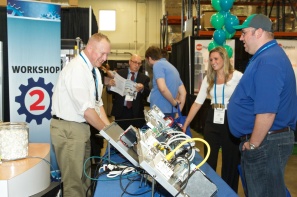
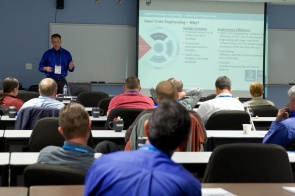
The Drive for Technology used three channels to impart new products, new theories & new technologies to our customers:  technical seminars,  hands-on workshops and a vendor trade show.   Using the Internet of Things or, if you prefer, Industry 4.0 as our theme, we highlighted some of the newest technologies known to our industry.

4A8A2750

One such example is the Rexroth MLC-H controller.  MLC-H is the only open architecture controller that allows the mixing of hydraulic axis and electric servo/stepper axis under one programming environment using a digital SERCOS III interface.  The truly revolutionary part of this new technology is its Open Core interface.   Open what?  One easy example to illustrate Open Core: the MLC-H is open to external devices such as smart phones and tablets.  Having an open interface makes the MLC-H  a truly future proof technology supporting all the Ethernet-based protocols!

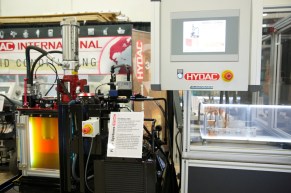
Another example is the OXiStop, OXS from Hydac.  Simply put, OXS allows us to shrink hydraulic reservoirs by up to 8x (less oil) and reduce operating costs up to 3x.  These are real benefits from products that are brand new to our industry.

4A8A2634

Our final mission was to allow our customers to “take with” the key information that they were presented with at the show.  We supplied an on-line link from our web site to download 100 +MB of information and data complete with application examples from each technical seminar.

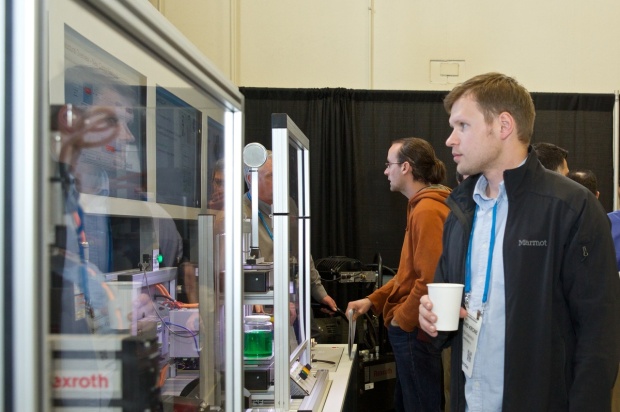
Bosch Rexroth, for example, conducted four technical seminars, two workshops and set-up a 40 ft. booth to display their technology.  That’s a lot of information, and our customers were able to digitally walk away with everything that they needed at the end of the two day show.  That’s what the Drive for Technology is all about!

4A8A2969

4A8A2822

Virtual commissioning saves precious time

Guest contributor:  Steffen Winkler, Vice President Sales Factory Automation, Bosch Rexroth

Ever shorter product life cycles and the desire for smaller batch sizes constantly present designers and programmers of production machines and lines with new challenges. To save time and costs, machine builders increasingly rely on model-based engineering, which creates unimagined potential for efficiency enhancement and cost reduction especially during commissioning – thanks to Bosch Rexroth.

The commissioning of machines is a very elaborate process so far. The reason for this is, among others, that programmers can test and optimize their machine program only on the real machine. Thus, 70% of the time that is needed for the commissioning of the control technology is mainly used for time-consuming and therefore cost-intensive optimization measures of the program. This occupies machine space in the assembly hall and causes considerable additional expenses at approaching delivery dates, like additional night shifts.

However, a majority of this optimization tasks can be virtually performed before through model-based engineering. The advantages are obvious: Starting with the first CAD click, all design data could be created in a PLM system. On this basis, a behavior model of the machine is created. Bosch Rexroth therefore provides 3D models and behavior models of its components. In the simulation software, PLC programmers can then test new control functionalities directly at the behavior model of the virtual machine, without the machine must be set up in the assembly hall.

Controller waits for simulation results

Therefore, a simplified machine model additionally had to be used in the simulation environment so far. The computing power of current PC technology is usually insufficient to simulate the complete machine model synchronously to the real-time behavior of the PLC and motion control.

But this deficit is a thing of the past thanks to the Open Core Engineering from Bosch Rexroth. The controller adapts itself to the timing of the simulation and waits for its results before the next motion cycle is executed. Thus, a real behavior of the simulation of the complete machine model is guaranteed.

When the machine is put into operation at the customer’s site, the engineers only need to start it in the ideal case – more extensive optimizations are thus needless. Open Core Engineering supports all established system simulation platforms like MATLAB Simulink and environments on the basis of the open modelling language Modelica, like the 3DEXPERIENCE platform from Dassault Systèmes or SimulationX.

Consistently digital engineering in practice

The example of the American packaging manufacturer WestRock shows how huge the potential savings are in practice. For the model-based development of their machines, the company relies on the 3DEXPERIENCE platform from Dassault Systèmes, which also supports Open Core Engineering. Directly in the simulation environment, the engineers can thus check and optimize all machine movements and put the control virtually into operation. Subsequently, the knowledge gained here is directly incorporated in the engineering environment IndraWorks from Rexroth. In this way, WestRock could shorten the entire development time from design to commissioning drastically.

Read more about the success story WestRock

A new automation project: best price or best service?

by Harry Aghjian, CEO CMA/Flodyne/Hydradyne

Long Term Liability

In the world of automation, most projects are defined by the amount of risk the machine builder will incur. An important factor is knowledge of current standards: UL standards and OSHA standards, CE directives and many others may apply to your project depending on the final installation location of the equipment. The liability that the machine user incurs is over the life of a given machine.  That could be a long time — five, ten, 25 years?   We have all worked on machines that have been in service for over 50 years!

No matter how large or how small, from the start, an automation project needs to dynamically formulate a plan to mitigate the risk using common methods such as hard guarding (barriers) or soft guarding (ie. light curtains). As the machine performance specifications are defined, a given project engineer now has an enormous task on his or her hands. The project engineer must meet or exceed the performance requirements at the lowest market cost.

A Simple ExampleRexroth Indradrive Mi visual6741 (2)

 Let’s assume the automation project requires a single axis of point to point motion.  Let’s make one more assumption that this motion or axis requires an electric actuator and sufficient thrust as to be powered by a 380 or 460v, three phase power source (high power stuff).  The sum total of all the manuals that a project engineer needs to read and re-read to successfully size, program and integrate all of the ancillary components equal about 4000 pages of documentation!  That’s before doing the actual machine risk assessment.

In today’s competitive market where speed to market and innovation are keys to success, does a project engineer really have time to read 4000 pages?  One could simply duplicate the last project or BOM (bill of material) — but have we then truly been innovative and taken advantage the latest in automation technology?  The answer is to leverage the market knowledge.  Your technology supplier must first and foremost be a “source of knowledge”.   The product knowledge supplied can be more important than the given component.  The sum of these components, along with superior product knowledge, allows the project engineer to be innovative and accelerate the machine to market.

Product Knowledge is King

I was recently reading the latest web ad from a company that touts lowest price “direct” from their warehouse. In my opinion they lacked the key ingredients that a project engineer needs…product knowledge and local service. Product knowledge when sizing the automation system. Product knowledge when developing the BOM options. Product knowledge when starting up the automation system. Product knowledge when doing the risk assessment.

Most industrial automation suppliers provide competitive pricing. I ask that you judge your next supplier based on their knowledge and their ability to service your needs, at your location and at your convenience. Great service along with great knowledge will produce the most cost effective solution.