INDUSTRIAL NETWORKING

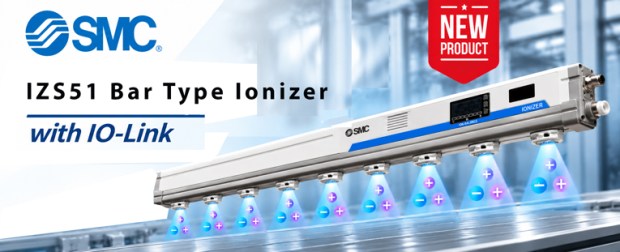
SMC IZS51 Bar Type Ionizer

Intelligent Static Control: Improving Machine Performance with SMC’s IZS51 Bar Ionizer

Faster static neutralization, smarter diagnostics and more efficient machine design.

Static electricity is an invisible force that can create very visible problems on the production floor. From packaging materials sticking together to dust accumulation on manufactured components, uncontrolled static can compromise product quality, disrupt automated processes and reduce productivity.

As machine builders continue to develop faster, more compact and connected equipment, static control deserves greater consideration during the design process.

SMC’s IZS51 Series Bar Type Ionizer brings together high-speed static neutralization, IO-Link connectivity and a compact design to address these challenges.

Why static electricity matters in industrial automation
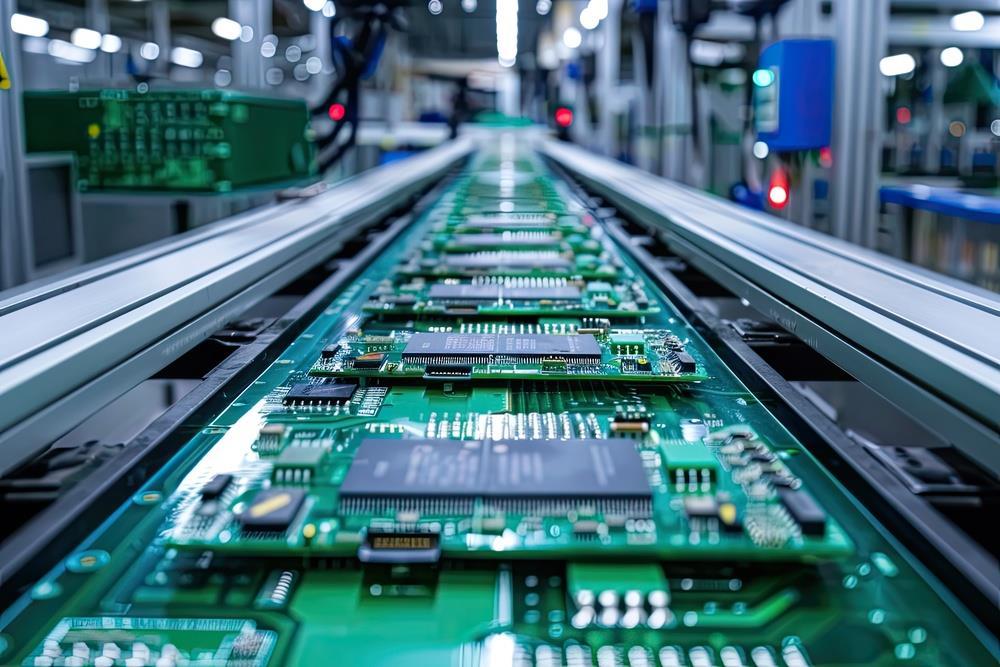
Static charges commonly develop when materials come into contact and separate, particularly when handling plastics, films, paper and other nonconductive materials.

In automated manufacturing environments, static buildup can contribute to:

  • Material handling issues — Parts sticking together or resisting separation.
  • Product contamination — Dust and airborne particles attracted to charged surfaces.
  • Packaging inconsistencies — Film adhesion and material feeding problems.
  • Electronic component damage — Electrostatic discharge affecting sensitive components.
  • Unplanned downtime — Production interruptions caused by material jams and handling issues.

Integrating static neutralization directly into the machine design can help address these issues before they impact production.

Faster neutralization in a smaller footprint
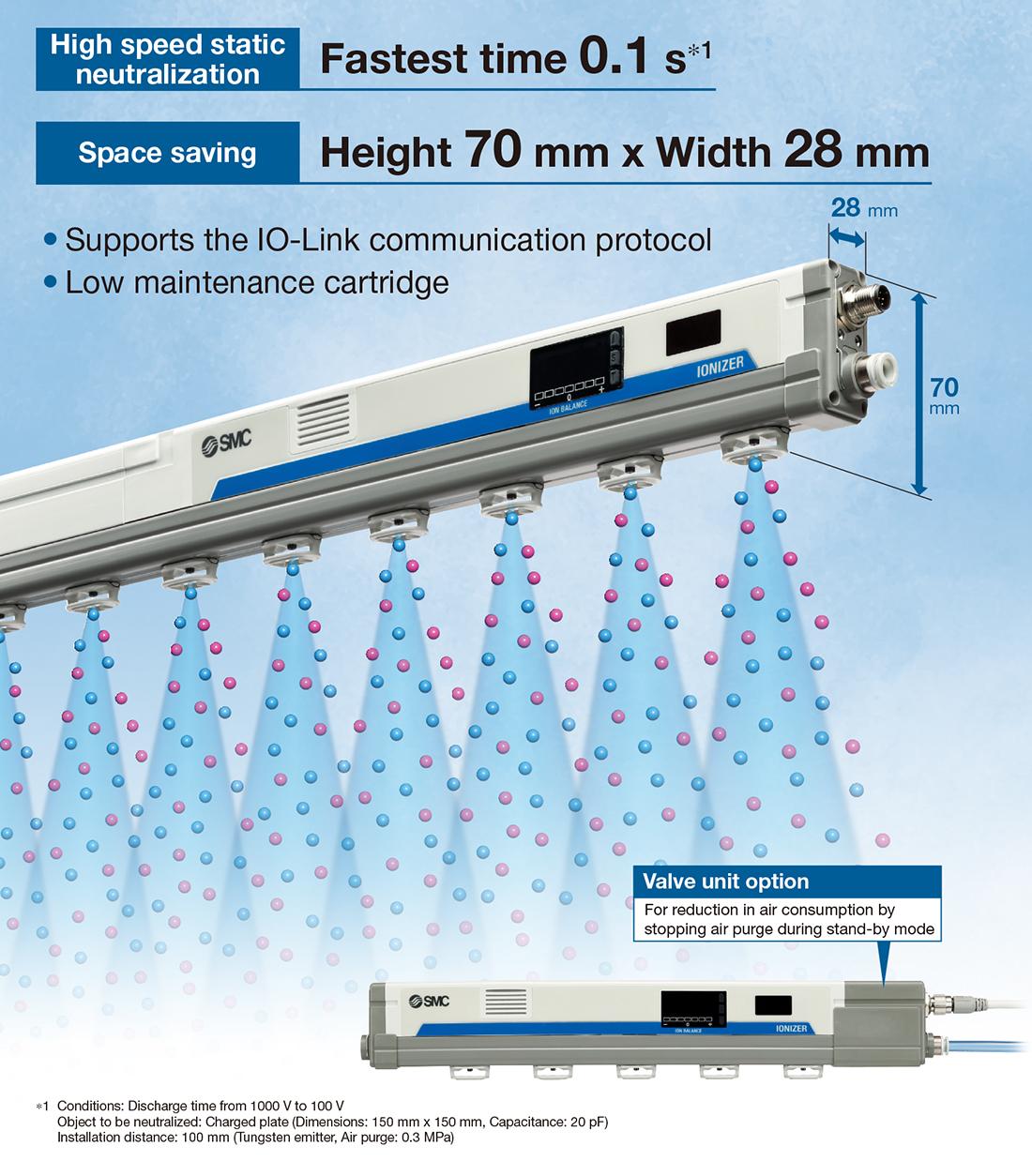
SMC’s IZS51 offers static discharge times as fast as 0.1 seconds under specified test conditions, making it particularly attractive for high-speed automated applications.

With a cross-section measuring just 70 × 28 mm, the ionizer can be incorporated into equipment where installation space is limited. An integrated power supply and same-side routing of pneumatic and electrical connections further simplify machine integration.

The series is available in 37 lengths, extending up to approximately 8.1 feet, providing flexibility for everything from compact assembly stations to wide-web processing equipment.

Bringing static control into the connected machine
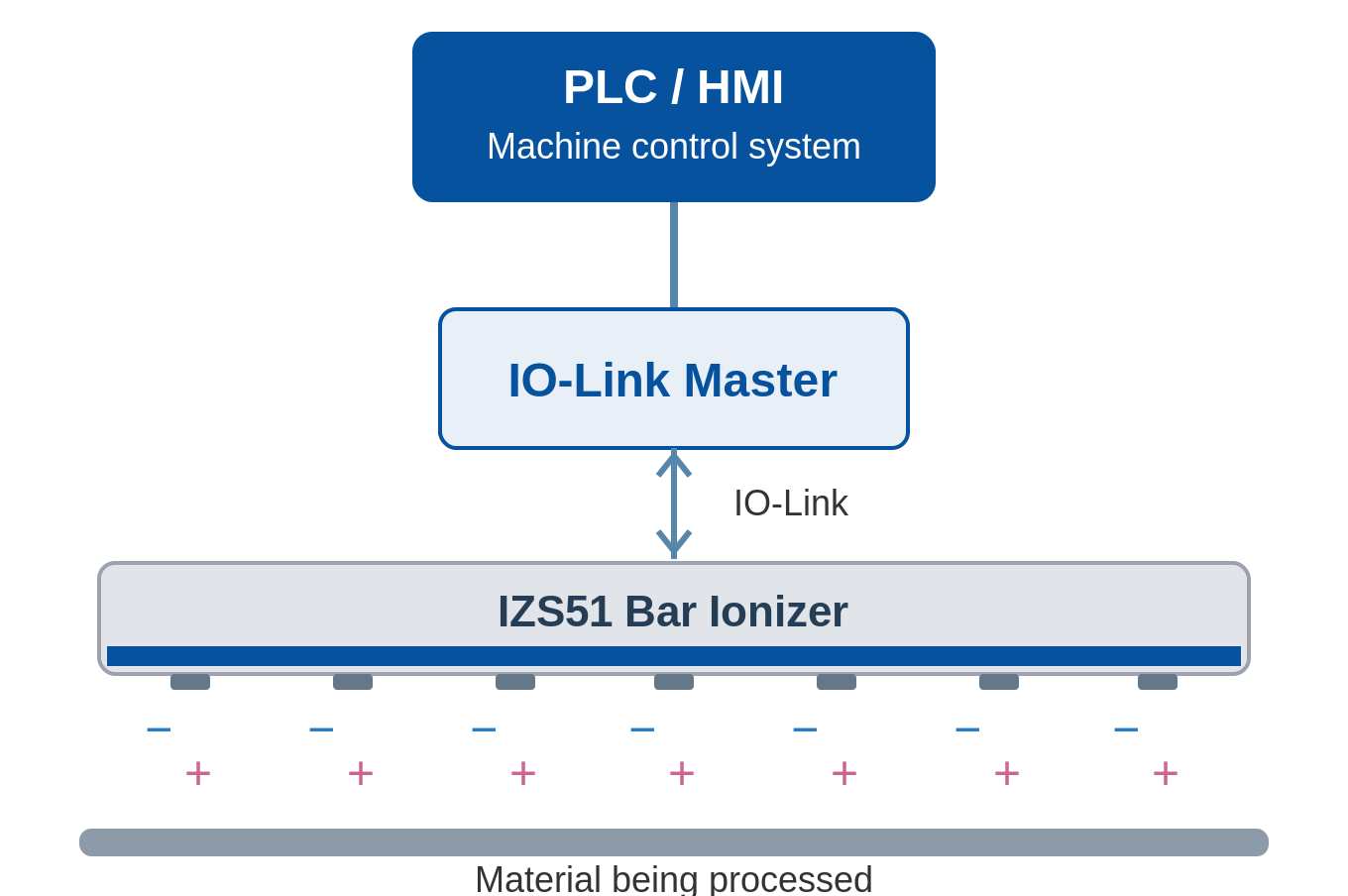
One of the most significant advantages of the IZS51 is its IO-Link communication capability.

Traditionally, static neutralization equipment may operate independently of the broader machine control system. IO-Link gives machine builders the opportunity to integrate static control into their connected automation architecture.

Through IO-Link, users can access operating information, monitor ion balance, adjust parameters and review device status remotely. Maintenance detection also provides greater visibility into equipment condition.

For OEMs and system integrators, this creates opportunities for simpler commissioning, centralized diagnostics and more proactive maintenance strategies. SMC Corporation+1

Reducing compressed air consumption and maintenance
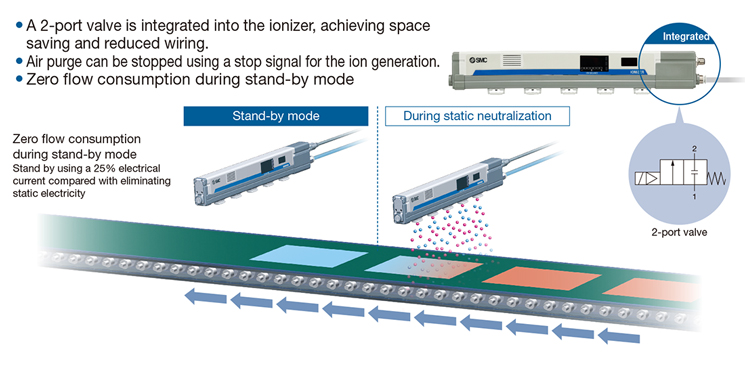
Compressed air efficiency is an increasingly important consideration in industrial machine design. The IZS51 offers an optional integrated two-port valve that allows air flow and ion generation to be suspended during standby.

The redesigned emitter cartridge also helps minimize contamination while improving ion transfer efficiency.

Additional design features include automatic ion balance adjustment, an integrated alphanumeric LCD display and multiple emitter cartridge configurations. Together, these features can help simplify routine maintenance and reduce unnecessary resource consumption. SMC Corporation+1

Where can machine builders use the IZS51?

The IZS51 is worth considering for a wide range of industrial applications, including:

ApplicationPotential benefit
Packaging machineryImproved film feeding and handling
Printing and convertingReduced dust attraction and material adhesion
Injection moldingEasier separation and handling of molded parts
Electronics manufacturingReduced electrostatic discharge risk
Automated assemblyMore consistent component handling
Battery manufacturingImproved control of static-related contamination

When selecting an ionizer, engineers should consider material properties, line speed, installation distance, available compressed air and machine communication requirements.

See the IZS51 in action
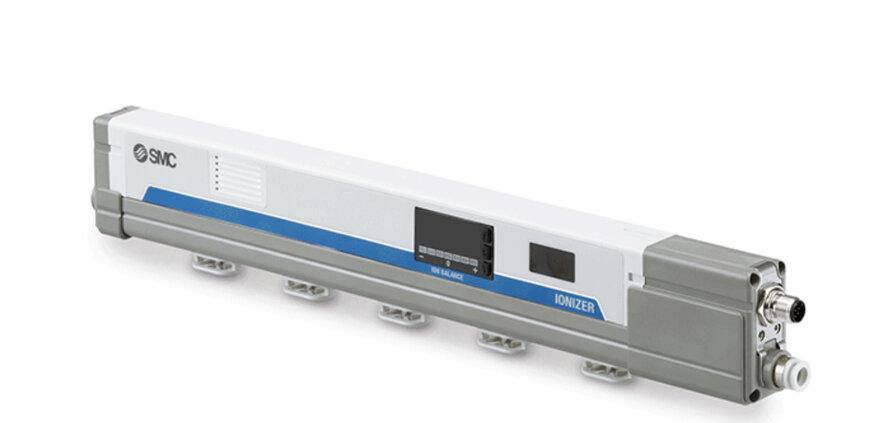
IZS51 – Integrated Bar Ionizer with IO-LinkSMC Corporation of America

Watch the product video

Make static control part of your next machine design

Whether you are developing a new machine, upgrading existing equipment or troubleshooting a production issue, incorporating intelligent static control can contribute to a more reliable and efficient manufacturing process.

At CMA/Flodyne/Hydradyne, our team can help you evaluate your application and select the appropriate SMC static neutralization solution for your equipment.

Explore the SMC IZS51 Series | Download the Product Catalog | Contact CMAFH

The Emergence of Device-level Safety Communications in Manufacturing

Guest Contributor: Tom Knauer, Balluff

Manufacturing is rapidly changing, driven by trends such as low volume/high mix, shorter life cycles, changing labor dynamics and other global factors. One way industry is responding to these trends is by changing the way humans and machines safely work together, enabled by updated standards and new technologies including safety communications.

In the past, safety systems utilized hard-wired connections, often resulting in long cable runs, large wire bundles, difficult troubleshooting and inflexible designs. The more recent shift to safety networks addresses these issues and allows fast, secure and reliable communications between the various components in a safety control system. Another benefit of these communications systems is that they are key elements in implementing the Industrial Internet of Things (IIoT) and Industry 4.0 solutions.

Within a typical factory, there are three or more communications levels, including an Enterprise level (Ethernet), a Control level (Ethernet based industrial protocol) and a Device/sensor level (various technologies). The popularity of control and device level industrial communications for standard control systems has led to strong demand for similar safety communications solutions.

Safety architectures based on the most popular control level protocols are now common and often reside on the same physical media, thereby simplifying wiring and control schemes. The table, below, includes a list of the most common safety control level protocols with their Ethernet-based industrial “parent” protocols and the governing organizations:

Ethernet Based Safety Protocol Ethernet Based Control Protocol Governing Organization
CIP Safety Ethernet IP Open DeviceNet Vendor Association (ODVA)
PROFISafe PROFINET PROFIBUS and PROFINET International (PI)
Fail Safe over EtherCAT (FSoE) EtherCAT EtherCAT Technology Group
CC-Link IE Safety CC-Link IE CC-Link Partner Association
openSAFETY Ethernet POWERLINK Ethernet POWERLINK Standardization Group (EPSG)


These Ethernet-based safety protocols are high speed, can carry fairly large amounts of information and are excellent for exchanging data between higher level devices such as safety PLCs, drives, CNCs, HMIs, motion controllers, remote safety I/O and advanced safety devices. Ethernet is familiar to most customers, and these protocols are open and supported by many vendors and device suppliers – customers can create systems utilizing products from multiple suppliers. One drawback, however, is that devices compatible with one protocol are not compatible with other protocols, requiring vendors to offer multiple communication connection options for their devices. Other drawbacks include the high cost to connect, the need to use one IP address per connected device and strong influence by a single supplier over some protocols.

Device level safety protocols are fairly new and less common, and realize many of the same benefits as the Ethernet-based safety protocols while addressing some of the drawbacks. As with Ethernet protocols, a wide variety of safety devices can be connected (often from a range of suppliers), wiring and troubleshooting are simplified, and more data can be gathered than with hard wiring. The disadvantages are that they are usually slower, carry much less data and cover shorter distances than Ethernet protocols. On the other hand, device connections are physically smaller, much less expensive and do not use up IP addresses, allowing the integration into small, low cost devices including E-stops, safety switches, inductive safety sensors and simple safety light curtains.

Device level Safety Protocol Device level Standard Protocol Open or Proprietary Governing Organization
Safety Over IO-Link/IO-Link Safety* IO-Link Semi-open/Open Balluff/IO-Link Consortium
AS-Interface Safety at Work (ASISafe) AS-Interface (AS-I) Open AS-International
Flexi Loop Proprietary Sick GmbH
GuardLink Proprietary Rockwell Automation

* Safety Over IO-Link is the first implementation of safety and IO-Link. The specification for IO-Link Safety was released recently and devices are not yet available.

The awareness of, and the need for, device level safety communications will increase with the desire to more tightly integrate safety and standard sensors into control systems. This will be driven by the need to:

  • Reduce and simplify wiring
  • Add flexibility to scale up, down or change solutions
  • Improve troubleshooting
  • Mix of best-in-class components from a variety of suppliers to optimize solutions
  • Gather and distribute IIoT data upwards to higher level systems

Many users are realizing that neither an Ethernet-based safety protocol, nor a device level safety protocol can meet all their needs, especially if they are trying to implement a cost-effective, comprehensive safety solution which can also support their IIoT needs. This is where a safety communications master (or bridge) comes in – it can connect a device level safety protocol to a control level safety protocol, allowing low cost sensor connection and data gathering at the device level, and transmission of this data to the higher-level communications and control system.

An example of this architecture is Safety Over IO-Link on PROFISafe/PROFINET. Devices such as safety light curtains, E-stops and safety switches are connected to a “Safety Hub” which has implemented the Safety Over IO-Link protocol. This hub communicates via a “black channel” over a PROFINET/IO-Link Master to a PROFISafe PLC. The safety device connections are very simple and inexpensive (off the shelf cables & standard M12 connectors), and the more expensive (and more capable) Ethernet (PROFINET/PROFISafe) connections are only made where they are needed: at the masters, PLCs and other control level devices. And an added benefit is that standard and safety sensors can both connect through the PROFINET/IO-Link Master, simplifying the device level architecture.

Safety

Combining device level and control level protocols helps users optimize their safety communications solutions, balancing cost, data and speed requirements, and allows IIoT data to be gathered and distributed upwards to control and MES systems.

cropped-cmafh-logo-with-tagline-caps.pngCMA/Flodyne/Hydradyne is an authorized  Balluff distributor in Illinois, Wisconsin, Iowa and Northern Indiana.

In addition to distribution, we design and fabricate complete engineered systems, including hydraulic power units, electrical control panels, pneumatic panels & aluminum framing. Our advanced components and system solutions are found in a wide variety of industrial applications such as wind energy, solar energy, process control and more.