IO-Link Hydraulic Cylinder Position Feedback

Guest contributor: Scott Rosenberger, Balluff

Ready for a better mousetrap?  Read on…..btl_io-link

Some time ago on Sensortech, we discussed considerations for choosing the right in-cylinder position feedback sensor.  In that article, we said:

“…….Analog 0-10 Vdc or 4-20 mA interfaces probably make up 70-80% of all in-cylinder feedback in use…..”

And while that 70-80% analog figure is still not too far off, we’re starting to see those numbers decline, in favor a of newer, more capable interface for linear position feedback:  IO-Link.  Much has been written, here on Sensortech and elsewhere, about the advantages offered by IO-Link.  But until now, those advantages couldn’t necessarily be realized in the world of hydraulic cylinder position feedback.  That has all changed with the availability of in-cylinder, rod-style magnetostrictive linear position sensors.  Compared to more traditional analog interfaces, IO-Link offers some significant, tangible advantages for absolute position feedback in hydraulic cylinders.

Connectivity

First and foremost, the story of IO-Link is that it offers easy, simple connection of sensors and IO to nearly any industrial network.  You can read more about that here.

Simplicity

Another big advantage of IO-Link is the ability to connect sensors to the network using standard, simple, unshielded M12 connectors and cables.  Compared to analog systems, which require shielded cabling, and sometimes unusual or proprietary connectors, connecting IO-Link sensors to the network is simpler, and usually less costly.

Visibility

Unlike their traditional analog counterparts, position sensors with IO-Link offer built-in diagnostic capabilities.  Sensor status can be monitored over the network, greatly simplifying troubleshooting and fault detection.

Flexibility

This is where IO-Link position sensors really start to shine.  Traditional analog position sensors provide one thing: position feedback in the form of an analog signal (obviously).  IO-Link position sensors provide position feedback, of course…but wait, there’s more.  In addition to position feedback, IO-Link sensors can provide velocity/speed information, temperature, and differential position (the difference between two position magnets).  And the best part?  All of this functionality can be freely configured over the network.  Plus, sensor configurations can be stored and subsequently downloaded to a replacement sensor if necessary.

Suitability

It’s worthwhile to point out that IO-Link linear position sensors are ideal for most positioning or position monitoring applications.  Just as with analog sensors though, they’re probably not suitable for high-performance closed-loop servohydraulic motion control applications.  In those applications, interfaces that are capable of providing super-fast, deterministic data, such Synchronous Serial Interface (SSI) or even Ethernet/IP are more suitable.

You can learn more in this overview flyer.

cropped-cmafh-logo-with-tagline-caps.pngCMA/Flodyne/Hydradyne is an authorized  Balluff distributor in Illinois, Wisconsin, Iowa and Northern Indiana.

In addition to distribution, we design and fabricate complete engineered systems, including hydraulic power units, electrical control panels, pneumatic panels & aluminum framing. Our advanced components and system solutions are found in a wide variety of industrial applications such as wind energy, solar energy, process control and more.

Basic Color Sensor Overview

Guest contributor:  Jack Moermond, Balluff

In the past, color sensors emitted light using red, green and blue LEDs. The sensors were then able to distinguish colors using the RGB components of the reflected light back to the sensor’s receiver. As technology has progressed true color sensors have been developed that not only can compare colors but measure them more accurately than the human eye.

Color sensors are based on diffuse technology and can be compared to a fixed focus or convergent sensor because of the focused light spot. Unlike color contrast sensors that only detect the difference between two colors based on brightness, color sensors can detect a wide range of colors.

cielabTrue color sensors typically use white LEDs which allow for a greater color spectrum evaluation. Combine this with the CIELAB color system which is one of the most versatile color systems and the result is a color sensor that equals or exceeds the human eye. The CIELAB color system is a three-dimensional independent infinite representation of colors. The L component for lightness and a and b components for color are predefined absolute values. Lightness varies from black (0) to the brightest white (100). Color channel a varies from green negative 100 to red positive 100. Color channel b varies from blue negative 100 to yellow positive 100 with gray values at a=0 and b=0.

Due to the technology, color sensors can check only a small spot of color but can check this spot amazingly fast – up to 1.5 kHz in case of the Balluff’s fiber optic BFS 33M which also has a range of 400mm. Unlike a color sensor camera, which will focus on the object’s surface pattern and may cause false readings the true color sensor will ignore patterns thus providing more accurate color detection. In addition the true color sensor will have more outputs than the color camera.

Smart color cameras are working with RGB but could work also with HSV color models. They could be used to check larger areas for the same color or color codes on a part, but have slower update rate of 50 Hz. Special cameras for faster applications are available in the market but at higher costs. It is important that the light source for the smart color cameras be a white light with a standardized white balance, and that this light must kept constant for all checks to avoid errors.

The sophistication on the front end of the color sensor can be much more advanced and still remain a cost effective option for industrial use due to the fact that a camera requires a much larger processing system. The more sophisticated the sensors are in the camera the more robust the processor must be in order to process or map the data into an image.

To learn more:  Request a digital copy of Balluff’s Photoelectric Handbook here.

cropped-cmafh-logo-with-tagline-caps.pngCMA/Flodyne/Hydradyne is an authorized  Balluff distributor in Illinois, Wisconsin, Iowa and Northern Indiana.

In addition to distribution, we design and fabricate complete engineered systems, including hydraulic power units, electrical control panels, pneumatic panels & aluminum framing. Our advanced components and system solutions are found in a wide variety of industrial applications such as wind energy, solar energy, process control and more.

3 Smart Applications for Process Visualization

Guest contributor: Shishir Rege, Balluff

Stack lights used in today’s industrial automation haven’t changed their form or purpose for ages: to visually show the state (not status) of the work-cell. Since the introduction of SmartLight, I have seen customers give new meaning to the term “process visualization”. Almost every month I hear about yet another innovative use of the SmartLight. I thought capturing a few of the use-cases of the SmartLight here may help others to enhance their processes – hopefully in most cost effective manner.

smartlightmodesThe SmartLight may appear just like another stack-light.  The neat thing about it is that it is an IO-Link device and uses simply 3-wire smart communication on the same prox cable that is used for sensors in the field. Being an IO-Link device it can be programmed through the PLC or the controller for change of operation modes on demand, or change of colors, intensity, and beeping sounds as needed. What that means is it can definitely be used as a stack light but has additional modes that can be applied for all sorts of different operation/ process visualization tasks.

Use Case #1: Stack Light Mode for Operation Status – The number of segments can be programmatically changed from 1 to the max segment number provided by the light (up to 5 in a five-segment SmartLight). Colors can be changed to red, blue, green, orange, yellow, white, or any other color of choice. This is the most traditional application of the SmartLight.

Use Case #2: Format Change Indicator – Many of our customers use the level mode to provide feedback to the operators when they are making adjustments to the machine. For example: red might indicate that the machine is out of alignment, yellow might mean the machine is getting closer to the specified alignment, and green might mean the machine is in the zone of alignment. Using the SmartLight in this fashion helped our customers save time in product changeovers because the operators didn’t have to come out of the cell to view the alignment status on a small HMI.  When the alignment of the machine is complete, the SmartLight can be programmed to switch back to the status indication mode or whatever mode of operation desired.

smartlightgifcroppedUse Case #3: Run Light Mode for Maintenance Indication – In this mode there are two colors – one color for the background and another color for the running segment. Along the assembly line where there are multiple work cells continuously processing raw materials in lock-step operation, downtimes are extremely costly. The standard status indicator will only indicate a problem at the work cell when the system stops, but it will not indicate a lack of raw material, for example. The moment the stack light turns red, the operator or the maintenance person is rushed to the site to first figure out what’s wrong before solving the problem. In Run Light mode, the SmartLight can be programmed to indicate different colors for the running segment and the background to show that attention is required at the cell. For example, as long as the running segment is running the machine is operational, but the background color can be changed to indicate raw material shortage, the need for mechanical adjustment of the machine, or the need for some electrical maintenance. Using a SmartLight, whoever is rushing the cell has a very good idea of what is required of them to get the system back up and running.

cropped-cmafh-logo-with-tagline-caps.pngCMA/Flodyne/Hydradyne is an authorized  Balluff distributor in Illinois, Wisconsin, Iowa and Northern Indiana.

In addition to distribution, we design and fabricate complete engineered systems, including hydraulic power units, electrical control panels, pneumatic panels & aluminum framing. Our advanced components and system solutions are found in a wide variety of industrial applications such as wind energy, solar energy, process control and more.

Industrial Enclosures Protect Components in Harsh Environments

Guest contributor: Steve Sullivan, Rittal Training Manager

Industrial enclosures face harsh conditions. From blazing to frigid temperatures, to dust, oil, dirt, airborne corrosives and liquids. Industrial engineers know that the manufacturing environment poses a multitude of challenges to the integrity of the control panel infrastructure.

 Environmental protection of the control panel infrastructure is never simple. Determining factors in the selection of an industrial enclosure can include the most extreme conditions. The key to selecting the superior enclosure is evaluating the harshest environment possible, and specifying an enclosure that can withstand any setting.

Foreign substances

Environment elements that can affect the performance of the control panel include the picture-2
penetration of foreign substances (water, dust, dirt, oils, etc.). The delicate electronic equipment housed inside the enclosure can fail with even minimal exposure to external substances.

The Rittal TS 8 combats the ingress of these substances with a four-point latching system and a foamed-in-place gasket system. This forms a continuous barrier around the enclosure skin ensuring a gap-free seal. This creates a superior seal and memory retention to block out the challenges of any environment.

Temperature

The control panel infrastructure faces temperature challenges on two fronts. First, internal temperature is affected by the heat generated from the operation of control panel devices. The external or ambient temperature also affects the enclosure and the operating control panels.

Fully compatible with the TS 8 is Rittal’s line of cooling solutions for both enclosure based and room based thermal management. With 30% to 50% of energy costs attributed to cooling systems, Rittal designs maximum cooling efficiency into each solution: CRAC, in line/in row, chillers, pipe installations, water distribution cabinets or water heat exchangers.

The delicate dew point balance between the load temperature and the ambient temperature is maintained, preventing damaging condensation of the control panels.

Washdown

When washdown of enclosures is required, the control panels must be protected. Exposed to harsh chemical cleansers, high pressure and/or heated water and frequent cleaning can break down some sealing systems. Rittal’s impervious seal guards the vital control panel components from the most stringent cleaning procedures.

Corrosive Elements

Whether an enclosure is in an indoor or outdoor environment, corrosion can be a factor in the breakdown of the enclosure’s durability. Outdoor factors such as sun, snow, salt or chemicals can damage the exterior of some enclosures. Acids, solvents, alkalis, oils and industrial chemicals can threaten an enclosure housed on the factory floor.

Rittal engineers designed a three-step painting process to combat any environmental abuse. Similar to the process used in the automotive industry, an electrophoretic dip-coat primer is applied, followed by a two-part primer nano-coat and final powder coat. This provides a finished external barrier on the TS 8 for any climate, interior or exterior.

Enclosure material construction

A variety of materials have been used for industrial enclosures. The stainless steel 316 construction of the Rittal TS 8 has been proven to be impervious to the most corrosive environments and superior to lesser steel or powder coated materials. Stainless steel 316, combined with the three-step finish has proven durability in the most extreme conditions.

The environmental protection offered by the Rittal TS 8 has been field tested in more than 10 million installations, in industries like oil and gas, mining, pulp and paper, food and beverage and life sciences. For more information on the TS 8 and all of Rittal’s flexible industrial solutions, download our Fact Book today to start your change for the better.

About Us

cropped-cmafh-logo-with-tagline-caps.png

CMA/Flodyne/Hydradyne is an authorized  Rittal distributor in Illinois, Wisconsin, Iowa and Northern Indiana.

In addition to distribution, we design and fabricate complete engineered systems, including hydraulic power units, electrical control panels, pneumatic panels & aluminum framing. Our advanced components and system solutions are found in a wide variety of industrial applications such as wind energy, solar energy, process control and more.

Reliable Part Exit/Part-Out Detection

Guest contributor: Dave Bird, Balluff

Walk into any die shop in the US and nine out of ten times, we discover diffuse reflective sensors being used to detect a large part or a small part exiting a die. Many people have success using this methodology, but lubrication-covered tumbling parts can create challenges for diffuse-reflective photoelectric sensing devices for many reasons:

  1. Tumbling parts with many “openings” on the part itself can cause a miss-detected component.
  2. Overly-reflective parts can false triggering of the output.
  3. Dark segments of the exiting part can cause light absorption. Remember, a diffuse sensors sensing distance is based on reflectivity. Black or dark targets tend to absorb light and not reflect light back to the receiver.
  4. Die lube/misting can often fog over a photoelectric lens requiring maintenance or machine down time.

The solution: Super Long Range Inductive Sensors placed under chutes

Most metal forming personnel are very familiar with smaller versions of inductive proximity sensors in tubular sizes ranging from 3mm through 30mm in diameter and with square or “block style” inductive types (flat packs, “pancake types”, etc.) but it is surprising how many people are just now discovering “Super Long Range Inductive Proximity” types. Super Long Range Inductive Proximity Sensors have been used in metal detection applications for many years including Body-In-White Automotive applications, various segments of steel processing and manufacturing, the canning industry, and conveyance.

Benefits of Using A UHMW Chute + Super Long Range Inductive Proximity Sensor in Part Exit/Part-Out Applications:

  1. It is stronger and quieter than parts flowing over a metal chute, readily available in standard and custom widths, lengths and thicknesses to fit the needs of large and small part stampers everywhere.
  2. UHMW is reported to be 3X stronger than carbon steel.
  3. UHMW is resistant to die lubes.
  4. UHMW allows Super Long Range Inductive Proximity Sensors to be placed underneath and to be “tuned” to fit the exact zone dimension required to detect any part exiting the die (fixed ranges and tunable with a potentiometer). The sensing device is also always out of harm’s way.
  5. Provides an option for part detection in exiting applications that eliminates potential problems experienced in certain metal forming applications where photoelectric sensing solutions aren’t performing optimally.

A Two-Out Die with Metallic Chute

Not every Part Exit/Part-Out application is the same and not every die, stamping application, vintage of equipment, budget for sensing programs are the same. Butit’s important to remember in the world of stamping, to try as consistently as possible to think application specificity when using sensors.  That is, putting the right sensing system in the right place to get the job done and to have as many technical options available as possible to solve application needs in your own “real world” metal forming operation.  We believe the UHMW + Super Long Range Inductive System is such an option.

You can learn more in the video below or by visiting www.balluff.us.


cropped-cmafh-logo-with-tagline-caps.pngCMA/Flodyne/Hydradyne is an authorized  Balluff distributor in Illinois, Wisconsin, Iowa and Northern Indiana.

In addition to distribution, we design and fabricate complete engineered systems, including hydraulic power units, electrical control panels, pneumatic panels & aluminum framing. Our advanced components and system solutions are found in a wide variety of industrial applications such as wind energy, solar energy, process control and more.

3 Tips for Reducing Downtime

Guest contributor:  Janet Czubek, Balluff

Whether it’s through preventative maintenance or during planned machine downtime, reducing downtime is a common goal for manufacturers. Difficult environments create challenges for not just machines, but also the components like sensors or cables. Below are three tips to help protect these components and reduce your downtime.

sacraficialcableCables don’t last forever. However, they are important for operations and keeping them functional is vital. An easy way to help reduce downtime and save money is by implementing a “sacrificial cable” in unforgiving environments. A sacrificial cable is any cable less than two meters in length and placed in situations where there is high turnover of cables.  This sacrificial cable does not have to be a specialty cable with a custom jacket. It can be a simple 1 meter PVC cable that will get changed out often. The idea is to place a sacrificial cable in a problematic area and connect it to a longer length cable, or a home-run cable. The benefits of this method include: less downtime for maintenance when changing out failures, reduced expenses since shorter cables are less expensive, and there is less travel for the cable around a cell.

hdc_cablesA second way to help reduce downtime is consider your application conditions up front. We discussed some of the application conditions to consider in a previous blog post, but how can we address these challenges? Not only is it important to choose the correct sensor for the environment, but remember, cables don’t last forever. Choosing the appropriate cable is also key to reducing downtime. Welding environments demand a cable that weld beads will not stick to and fuse the cable to the sensor. There are a variety of jacket types like silicone, silicone tube, or PTFE that prevent weld debris from accumulating on the cable. I’ve also seen applications where there is a lot of debris cutting through cables. In this case, a stainless steel braid cable would be a better solution than a traditional cable. Fitting the right protection to the right application is crucial..

gizmo4A third tip to help reduce your machine downtime is to simply add protection to your existing components. Adding protection, whether it is a protective bracket or a silicone product, will help keep components running longer. This type of protection can be added before or after the cell is operational.   One example of sensor protection is adding a ceramic cap to protect the face of a sensor. You can also protect the connection by adding tubing to the cable out version of the sensor to shield it from debris. Mounting sensors in a robust bracket helps protect the sensor from being hit, or having debris cover the sensor.  There are different degrees of changes that help prolong operations.

Metalforming expert, Dave Bird, explains some of these solutions in the video below. To learn more you can also visit our website at www.balluff.us.

About Us

cropped-cmafh-logo-with-tagline-caps.png


CMA/Flodyne/Hydradyne is an authorized  Balluff distributor in Illinois, Wisconsin, Iowa and Northern Indiana.

In addition to distribution, we design and fabricate complete engineered systems, including hydraulic power units, electrical control panels, pneumatic panels & aluminum framing. Our advanced components and system solutions are found in a wide variety of industrial applications such as wind energy, solar energy, process control and more.

The pros and cons of soft starters vs. VFDs by application

Guest contributor: Eaton

Motors often require large amounts of energy when quickly accelerating to full speed. Soft starters and variable frequency drives can both be used to reduce inrush currents and limit torque— protecting your valuable equipment and extending the life of your motor by reducing motor heating caused by frequent starts and stops. Choosing between a soft starter and a variable frequency drive often depends on the application, system requirements, and cost (both for initial startup and over the life cycle of the system).

Soft starters

A soft starter is a solid-state device that protects AC electric motors from damage caused by sudden influxes of power by limiting the large initial inrush of current associated with motor startup. They provide a gentle ramp up to full speed and are used only at startup (and stop, if equipped). Ramping up the initial voltage to the motor produces this gradual start. Soft starters are also known as reduced voltage soft starters (RVSS).

Applications

Soft starters are used in applications where:

• Speed and torque control are required only during startup (and stop if equipped with soft stop)
• Reducing large startup inrush currents associated with a large motor is required
• The mechanical system requires a gentle start to relieve torque spikes and tension associated with normal startup (for example, conveyors, belt-driven systems, gears, and so on)
• Pumps are used to eliminate pressure surges caused in piping systems when fluid changes direction rapidly

How does a soft starter work?

Electrical soft starters temporarily reduce voltage or current input by reducing torque. Some soft starters may use solid-state devices to help control the flow of the current. They can control one to three phases, with three-phase control usually producing better results.

ia04003002e-1

Most soft starters use a series of thyristors or silicon controlled rectifiers (SCRs) to reduce the voltage. In the normal OFF state, the SCRs restrict current, but in the normal ON state, the SCRs allow current. The SCRs are engaged during ramp up, and bypass contactors are pulled in after maximum speed is achieved. This helps to significantly reduce motor heating.

Benefits of choosing a soft starter

Soft starters are often the more economical choice for applications that require speed and torque control only during motor startup. Additionally, they are often the ideal solution for applications where space is a concern, as they usually take up less space than variable frequency drives.

Variable frequency drives

A variable frequency drive (VFD) is a motor control device that protects and controls the speed of an AC induction motor. A VFD can control the speed of the motor during the start and stop cycle, as well as throughout the run cycle. VFDs are also referred to as adjustable frequency drives (AFDs).

Applications

VFDs are used in applications where:

• Complete speed control is required
• Energy savings is a goal
• Custom control is needed

How do VFDs work?

VFDs convert input power to adjustable frequency and voltage source for controlling speed of AC induction motors. The frequency of the power applied to an AC motor determines the motor speed, based on the following equation:

N = 120 x f x p

N = speed (rpm)
f = frequency (Hz)
p = number of motor poles

For example, a four-pole motor is operating at 60 Hz. These values can be inserted into the formula to calculate the speed:

N = 120 x 60 x 4

N = 1800 (rpm)
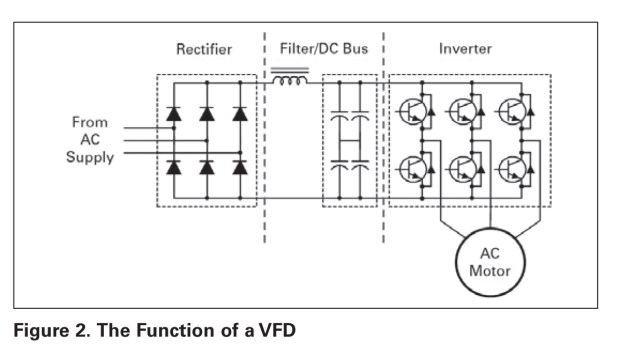
ia04003002e-2

AC supply: Comes from the facility power network (typically 480V, 60 Hz AC)
Rectifier: Converts network AC power to DC power
Filter and DC bus: Work together to smooth the rectified DC power and to provide clean, low ripple DC power to the inverter
Inverter: Uses DC power from the DC bus and filter to invert an output that resembles sine wave AC power using a pulse width modulation (PWM) technique
•  Pulse width modulation: Switches the inverter semiconductors in varying widths and times that, when averaged, create a sine waveform

ia04003002e-3.jpg

Benefits of using a VFD

• Energy savings
• Reduces peak energy demand
• Reduces power when not required
• Fully adjustable speed (pumps, conveyors, and fans)
• Controlled starting, stopping, and acceleration
• Dynamic torque control
• Provides smooth motion for applications such as elevators and escalators
• Maintains speed of equipment, making drives ideal for manufacturing equipment and industrial equipment such as mixers, grinders, and crushers
• Versatility
• Self-diagnostics and communications
• Advanced overload protection
• PLC-like functionality and software programming
• Digital inputs/outputs (DI/DO)
• Analog inputs/outputs (AI/AO)
• Relay outputs

Energy savings

VFDs offer the greatest energy savings for fans and pumps. The adjustable flow method changes the flow curve and drastically reduces power requirements. Centrifugal equipment (fans, pumps, and compressors) follow a general set of speed affinity laws. The affinity laws define the relationship between speed and a set of variables:

• Flow
• Pressure
• Power

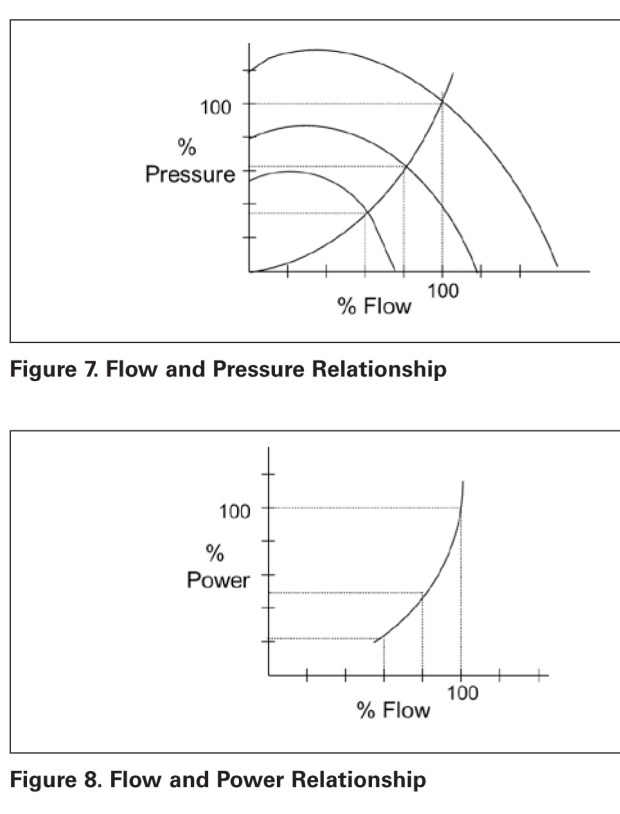
Based on the affinity laws, flow changes linearly with speed while pressure is proportional to the square of speed. The power required is proportional to the cube of the speed. The latter is most important, because if the motor speed drops, the power drops by the cube.

ia04003002e-5.jpg

In this example, the motor is operated at 80 percent of the rated speed. This value can be inserted into the affinity laws formula to calculate the power at this new speed:

ia04003002e-fotrm.jpg

Therefore, the power required to operate the fan at 80 percent speed is half the rated power.ia04003002e-9
Selecting the correct equipment for your needs

Choosing a soft starter or a variable frequency drive often depends on your application. Soft starters are smaller and less expensive when compared with VFDs in larger horsepower applications. Larger VFDs take up more space and are usually more expensive than soft starters.

That being said, while a VFD is often more expensive up front, it can provide energy savings of up to 50 percent, thereby producing more cost savings over the life of the equipment.

Speed control is another advantage of a VFD, because it offers consistent acceleration time throughout the entire operating cycle of the motor, not just during startup. VFDs can also provide more robust functionality than soft starters offer, including digital diagnostic information.

It is important to note that a VFD can initially cost two to three times more than a soft starter. Therefore, if constant acceleration and torque control is not necessary, and your application requires current limiting only during startup, a soft starter may be a better solution from a cost standpoint.

cropped-cmafh-logo-with-tagline-caps.png

CMA/Flodyne/Hydradyne is an authorized  Eaton Electrical distributor in Illinois, Wisconsin, Iowa and Northern Indiana.

In addition to distribution, we design and fabricate complete engineered systems, including hydraulic power units, electrical control panels, pneumatic panels & aluminum framing. Our advanced components and system solutions are found in a wide variety of industrial applications such as wind energy, solar energy, process control and more.
Demand the best from your RFID partner

Guest contributor, Wolfgang Kratzenberg, Balluffrfid

That seems like a no-brainer statement, but often I find myself talking to customers who are frustrated with their current vendor for a myriad of reasons. An RFID project can require a pretty decent chunk of capital investment so when something doesn’t go as planned people start looking for answers immediately. This usually presents a great opportunity for us to go in and save the day, but it’s hard for me to ignore the time, money and resources that were wasted. Having witnessed this on several occasions I have concluded that there are a large number of RFID companies who are niche suppliers, but there are very few who can qualify as an RFID Partner. The RFID partner helps ensure success from idea to implementation to future expansion. That said, here is a list of things to consider prior to discussing your application with an RFID company:

  • Does the partner offer hardware that communicates over USB, Serial, TCP/IP, Ethernet/IP, Profinet/Profibus, CC-Link, Ethercat, etc?
  • Does the partner offer a wide range of form factors of readers, tags, and antennae?
  • Does the partner build hardware for multiple frequencies?
  • Is the partner willing to build custom equipment just right for your application?
  • Does the partner offer support before, during and after the project?
  • Does the partner have a core competency in the application?
  • Can the partner meet application specs such as, high temperatures, high speed reading on the fly, storing and reading large amounts of data, high ingress protection rating, etc.?
  • Does the partner develop and design products which are scalable and easily expandable?

If you can answer yes to all of these questions then chances are you are pretty well set. With such a mature technology there are many ways for RFID companies to set themselves apart from one another. However, there are only a few who are willing to do what it takes to be considered a partner.

To learn more about RFID technology visit www.balluff.us/rfid

About Us

cropped-cmafh-logo-with-tagline-caps.png

CMA/Flodyne/Hydradyne is an authorized  Balluff distributor in Illinois, Wisconsin, Iowa and Northern Indiana.

In addition to distribution, we design and fabricate complete engineered systems, including hydraulic power units, electrical control panels, pneumatic panels & aluminum framing. Our advanced components and system solutions are found in a wide variety of industrial applications such as wind energy, solar energy, process control and more.

Best Practices: Inconsequential Volume

Guest Contributor: SMC

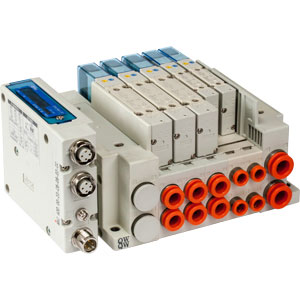
The advent of manifold mounted, plug-in pneumatic valves has been a boon for machine builders. It allows them to mount complete valve packages in a safe and secure location on a machine. Using a D-sub connector, serial interface module, or similar single-point wiring system, all of the electrical control outputs can feed into one location on the manifold, greatly simplifying the wiring. Plumbing issues are reduced, since a single air pressure line can be used to feed a common pressure gallery. The same advantage applies to the common exhaust gallery. No longer would both a plumber and an electrician be required to replace a valve, since any valve can be replaced without disturbing electrical connections or plumbing lines.ex260_ported

Like most advances, there can be some downsides to this type of arrangement, depending upon the application. One of these revolves around considerations for energy conservation. Most circuits include two air lines extending from the valve to the actuator, one for extend and one for retract. Each time the valve cycles, the actuator is pressurized on one side or the other. Of course, the hose or tube that connects them must also be pressurized. This tubing volume is typically ignored as inconsequential when doing our sizing calculations, but should not always be overlooked.

The tubing volume offers no work at all…only a means of transferring the energy of the compressed air to the actuator. Inconsequential? Maybe. But depending upon the application, those volumes can be significant. Here is an example:

A packaging facility has corrugated boxes being erected at a mezzanine level and dropped down to the main floor where they are filled, sealed and palletized. The box drop-down employs gravity to lower the boxes, but incorporates a series of mechanical stops to sequence them as required. Each of the stops includes a pair of 2 inch bore x 1 inch stroke air cylinders to operate a brake that stops the box and releases it when needed. In all, four stops are included for each drop down, meaning eight actuators in total and four valves to control them.

The directional control valves are located at a central location on a single manifold, presenting a clean and compact package. However, the distance from manifold to actuator varies from 10  feet to 25 feet. In operation, each time a valve shifts, it exhausts one length of tubing and fills another. Given the small volume, we might still think this to be inconsequential, but let’s look at the numbers.

Assume ¼” OD tubing with an ID of approximately .180“. With the first station being 10 feet away from the valve, the volume of tubing going to the actuators is only 3.05 cubic inches. Since there are two lines from the valve to each actuator pair, the total volume is 6.10 cubic inches per complete cycle. To put this in perspective, each of the 2×1” cylinders has a total volume of 5-½ cubic inches. That’s the sum of both the extend and retract sides. Since there are two of them, the total cylinder volume is 11 cubic inches. The volume in the tubing is over half that of the actuators. Much of the energy developed at the compressor is being used to fill the tubing lines.

Let’s leave aside the potential problem with poor response times, and just look at the costs. Let’s also assume the working pressure to be 80 psi. By calculating the compression ratio to be 6.33, and multiplying that by the volume, the normalized volume becomes 38.6 standard cubic inches. If we have the cylinders being actuated five times a minute, we will be consuming 193 standard cubic inches per minute, or using more meaningful terms, 0.11 SCFM. That is just for filling the air tubing to the closest single station on the drop-down. How about the other 3 stops on the drop-down?

The chart below shows the air volume for each of the stations, with a total for all. Please note the total volume of the airlines extending out to the cylinders is 42.8 in³. When we calculate the total volume of all eight cylinders we get 44 in³. The volumes are almost identical. Now we have a situation where half the compressed air is consumed filling all the air lines.

smc-iv

If that single drop down operates 24/7 and the cost for electricity is $.10 per KWh, the annual cost to fill those lines is about $110, the same costs we incur to fill the cylinders. With multiple drop-downs, the costs are multiplied. Staying with our example, the facility has 50 packaging lines, for an annual cost of $5500.

While this may be viewed as an extreme example, think back on all the applications where long air feed lines were employed in order to have a clean valve package. Or consider the oversize tubing that was utilized just because it was handy. Many of us might figure that larger tubing is better anyway, and everything will run more efficiently. However, please take into account that the larger tubing may double the volume to be filled without adding any productive benefit at all.

What happens to the same example when 3/8 inch tubing is used instead of the ¼ inch? The tubing ID increases to .27 inches and the volumes increase by a factor of 2.28, as do the costs. Now the annual price tag has jumped to $250. Again…that is just to fill the tubing for one drop-down.

As a side note, there is also some potential for liquid moisture build-up in those long lines when an excess of air is left between the valve and the actuator, even when good air filtration and drying is in place. Problems can arise due to the adiabatic expansion that occurs with each exhaust cycle. Condensation may occur as the exhausting air temperature falls below that of the atmospheric dew point. With long air lines and many cycles, the moisture may not be completely exhausted and can accumulate in the lines. That accumulation will occur near the actuator ports and will eventually work its way into the actuator, shortening its life.

What’s the solution? Have the valves mounted on or near the actuators so that all or most of the air volume is used to actuate the cylinders. This will require a pressure line running the length of the drop-down with a connection to each valve. However, that pressure line represents energy capacitance that works in our favor. We will also have fewer connections, which will translate into fewer potential leaks. Of course, the downside is that electrical lines will have to be extended independently to each valve. However, with low voltage, low wattage coils, this probably is not that difficult. Another benefit to be gained is that electrical response times remain unaffected, while pneumatic response times improve dramatically.  The dollar savings is the reduction in air consumption by half. In our plant, that could be up to $5500.00 every year.

Reducing the costs for compressed air needs to be an ongoing project for any company that uses substantial amounts of air as part of the manufacturing process. There is a tendency to approach the issue at the compressor room and look for answers there. The resulting recommendations can be expensive as well as require a long ROI. However, dealing with demand side issues, as described here, offers an easy solution that can be incorporated at the OEM level with little additional cost. A case can even be made for modifying these types of applications in the field when machines come due for refurbishment. Addressing these “inconsequential” issues will offer significant savings on the bottom line. “Watch the pennies and the dollars take care of themselves”.

To learn more about Best Practices in Pneumatics, please visit http://www.smcusa.com/

About Us

cropped-cmafh-logo-with-tagline-caps.png

CMA/Flodyne/Hydradyne is an authorized  SMC distributor in Illinois, Wisconsin, Iowa and Northern Indiana.

In addition to distribution, we design and fabricate complete engineered systems, including hydraulic power units, electrical control panels, pneumatic panels & aluminum framing. Our advanced components and system solutions are found in a wide variety of industrial applications such as wind energy, solar energy, process control and more.

5 Common IIoT Mistakes and How to Avoid Them

Guest contributor: Pat Millott, Balluff

IIoT is the perfect solution for all your data accessibility needs, right? If you check out my previous blogs, I discussed the many benefits of using the Industrial Internet of Things (IIoT) to remotely access data. However, if not used properly, IIoT can get you into some trouble. Let’s review 5 common mistakes to avoid when building your IIoT application.

1. Excluding your IT department
It’s crucial to make sure your Information Technology group is involved in this project. IIoT applications can be very taxing on your network. It’s easy to forget some key aspects like bandwidth and network traffic when developing your application. But when your application is finished, your IT department is going to want to know what network resources that are being used. Some questions they might ask include:

  • How many potential clients will the server have at any given time?
  • What is the max refresh rate of your application?
  • How frequent do you query the SQL server?
  • How are your queries structured?
  • What might be some vulnerabilities on this application?
  • What measures are you taking to protect these vulnerabilities?

It’s going to be a lot easier if they are included right away so everyone has a good understanding of what resources are available and how to protect them.

2. Excluding OT and Controls Engineers
Similar to the IT department, it’s important to include the controls engineer especially if you plan on hosting data from a PLC. The controls engineer is going to want to determine what data is publicly available and what data should be kept private. Some questions the controls engineer(s) might ask include:

  • What is your application trying to show?
  • What PLC data do you want to use for this?
  • Is your application going to write data to the PLC?
  • Do any modifications need to be made to the PLC code?

Keep in mind that any modifications that need to be made to the PLC will probably have to go through the controls engineer. This is to ensure that no code changes on the PLC will impact the efficiency and safety of production.

3. Running out of date software
Software that you write and the software that your application relies on should always be up to date. In other words, if you use a module or library in your code, it’s important to make sure you have the most up to date version. Also, it’s important to keep updating your application for additional security and functionality. Out of date software can lead to potential application crashes or even vulnerabilities for cyber attacks. Keep in mind, an application that runs on out of date software makes the server host vulnerable as well as its clients.

IIoT_Pyramid4. Unorganized data flow
Data flow is an important concept to consider early on in the development of your application. Say you have a server forwarding PLC data to a SQL database that is then utilized in a web application. The web application acts as a historian and analyzes data change over time. Is it better to calculate the data in the back-end application, the SQL database, the server forwarding the data or the PLC? The answer depends on the situation but typically, it’s best to keep the data calculations as close to the source as possible. For example, say your back-end application calculates percentages based on yesterday’s production compared to today’s. In this situation, if the back-end application crashes, you lose historian calculations. Typically, a SQL database is much more reliable as far as downtime and crashes and it will run whether your back-end application is functional or not. Therefore, it would be better to do these calculations in the SQL database rather than the back-end script. Continuing this concept, what if the PLC could do this calculation? Now the forwarding server, the SQL database, and the back-end script can all crash and you would still have your historian data for when they go back up. For this reason, the closer to the source of data you get, the more reliable your calculations based on that data will be.

5. Unprotected sensitive data
Possibly one of the most important things to remember when developing your application. Even simple applications that just display PLC data can give a hacker enough for an attack. Think about this IoT scenario: Say I have a server that hosts data from my personal home such as whether or not my front door is locked. This information is important to me if I want to check if someone forgot to lock the front door. But to a burglar, this data is just as useful if not more as he/she can now check the status of my door without having to leave their car. If I don’t protect this data, I am openly advertising to the world when my front door is unlocked. This is why encryption is crucial for sensitive data. This is also why it’s important to discuss you project with the controls engineer. Data that seems harmless might actually be detrimental to host publicly.

Data accessibility is evolving from a convenience to a necessity. Everyone’s in a hurry to get their data into the cloud but keeping these ideas in mind early on in the application development process will save everyone a headache later on. That way, IIoT really can be the perfect solution for all you data accessibility needs.

To learn more about IIoT visit www.balluff.us.

About Us

cropped-cmafh-logo-with-tagline-caps.png

CMA/Flodyne/Hydradyne is an authorized  Balluff distributor in Illinois, Wisconsin, Iowa and Northern Indiana.

In addition to distribution, we design and fabricate complete engineered systems, including hydraulic power units, electrical control panels, pneumatic panels & aluminum framing. Our advanced components and system solutions are found in a wide variety of industrial applications such as wind energy, solar energy, process control and more.