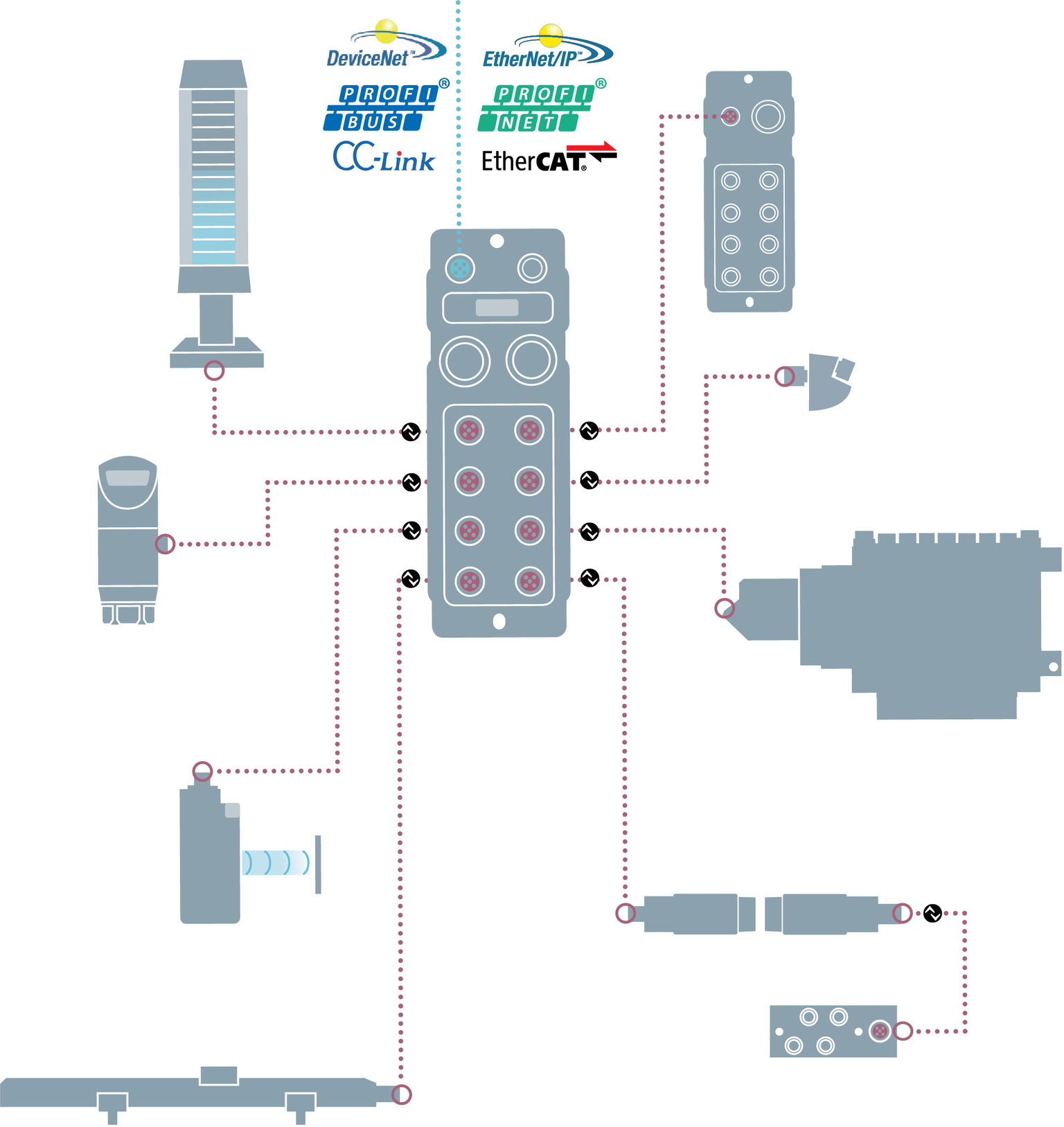
IO-Link

Safely Switch Off Cylinders While Transmitting Field Data

Guest contributor: Matthias Wolfer, Balluff


Is it possible to safely switch off cylinders while simultaneously transmitting field data and set up the system in accordance with standards? Yes!

In order to rule out a safety-critical fault between adjacent printed circuit board tracks/contact points (short circuit) according to DIN EN ISO 13849, clearance and creepage distances must be considered. One way to eliminate faults is to provide galvanic isolation by not interconnecting safety-relevant circuits/segments. This means  charge carriers from one segment cannot switch over to the other, and the separation makes it possible to connect the safety world with automation — with IO-Link. Safely switching off actuators and simultaneously collecting sensor signals reliably via IO-Link is possible with just one module. To further benefit from IO-Link and ensure safety at the same time, Balluff’s I/O module is galvanically isolated with a sensor and an actuator segment. The two circuits of the segments are not interconnected, and the actuator segment can be safely switched off without affecting the sensors. Important sensor data can still be monitoring and communicated.

The topological structure and the application of this safety function is shown in this figure as an example:

2D-SAGT-Betriebsanleitung_v2

  1. A PLC is connected to an IO-Link master module via a fieldbus system.
  2. The IO-Link master is the interface to all I/O modules (IO-Link sensor/actuator hubs) or other devices, such as IO-Link sensors. The IO-Link communication takes place via a standardized M12 connector.|
  3. Binary switching elements can be connected to the galvanically isolated sensor/actuator hub (BNI IOL-355). The four connection ports on the left correspond to the sensor segment and the four ports on the right correspond to the actuator segment. Communication of the states is done via IO-Link.
  4. The power supply for both segments takes place via a 7/8″ connection, whereby attention must be paid to potential separated routing of the sensor and actuator circuits. Both the power supply unit itself and the wiring to the IO-Link device with the two segments must also ensure external galvanic isolation. This is made possible by separating the lines with a splitter.
  5. An external safety device is required to safely interrupt the supply voltage of the actuator segment (four ports simultaneously). Thus, the module can implement safety functions up to SIL2 according to EN62061/PLd and ISO 13849.

For example, this can happen through the use of a safety relay, whereby the power supply is safely disconnected after actuation of peripheral safety devices (such as emergency stops and door switches). At the same time, the sensor segment remains active and can provide important information from the field devices.

The module can handle up to eight digital inputs and outputs. If the IO-Link connection is interrupted, the outputs assume predefined states that are retained until the IO-Link connection is restored. Once the connection is restored, this unique state of the machine can be used to continue production directly without a reference run.

An application example for the interaction of sensors and actuators in a safety environment is the pneumatic clamping device of a workpiece holder. The position feedback of the cylinders is collected by the sensor segment, while at the same time the actuator segment can be switched off safely via its separately switchable safety circuit. If the sensor side is not required for application-related reasons, galvanically isolated IO-Link modules are also available with only actuator segments (BNI IOL 252/256). An isolated shutdown can protect up to two safety areas separately.

cropped-cmafh-logo-with-tagline-caps.pngCMA/Flodyne/Hydradyne is an authorized  Balluff distributor in Illinois, Wisconsin, Iowa and Northern Indiana.

In addition to distribution, we design and fabricate complete engineered systems, including hydraulic power units, electrical control panels, pneumatic panels & aluminum framing. Our advanced components and system solutions are found in a wide variety of industrial applications such as wind energy, solar energy, process control and more.

What Exactly is Safety Over IO-Link?

Automation Pyramid.png

This integrated safety concept is the logical continuation of the IO-Link philosophy. It is the only globally available technology to build on the proven IO-Link standards and profisafe. This means it uses the essential IO-Link benefits such as simple data transport and information exchange, high flexibility and universal applicability for safety signals as well. Safety over IO-Link combines automation and safety and represents efficient safety concepts in one system. Best of all, the functionality of the overall system remains unchanged. Safety is provided nearly as an add-on.

In the center of this safety concept is the new safety hub, which is connected to an available port on an IO-Link master. The safety components are connected to it using M12 standard cable. The safety profisafe signals are then tunneled to the controller through an IO-Link master. This has the advantage of allowing existing infrastructure to still be used without any changes. Parameters are configured centrally through the user interface of the controller.

Safety Hub

The safety hub has four 2-channel safe inputs for collecting safety signals, two safe outputs for turning off safety actuators, and two multi-channel ports for connecting things like safety interlocks which require both input and output signals to be processed simultaneously. The system is TÜV- and PNO-certified and can be used up to PLe/SIL 3. Safety components from all manufacturers can be connected to the safe I/O module.

Like IO-Link in general, Safety over IO-Link is characterized by simple system construction, time-and cost-saving wiring using M12 connectors, reduction in control cabinet volume and leaner system concepts. Virtually any network topology can be simply scaled with Safety over IO-Link, whereby the relative share of automation and safety can be varied as desired. Safety over IO-Link also means unlimited flexibility. Thanks to varying port configuration and simple configuration systems, it can be changed even at the last minute. All of this helps reduce costs. Additional savings come from the simple duplication of (PLC-) projects, prewiring of machine segments and short downtimes made possible by ease of component replacement.

Development of IO-Link, number of sold nodes.png

To learn more about Safety over IO-Link, visit www.balluff.com

cropped-cmafh-logo-with-tagline-caps.pngCMA/Flodyne/Hydradyne is an authorized  Balluff distributor in Illinois, Wisconsin, Iowa and Northern Indiana.

In addition to distribution, we design and fabricate complete engineered systems, including hydraulic power units, electrical control panels, pneumatic panels & aluminum framing. Our advanced components and system solutions are found in a wide variety of industrial applications such as wind energy, solar energy, process control and more.

Hydraulics with IO-Link: Reduced effort, high value

Guest contributor: Theobald Herrmann, Bosch Rexroth

In almost all industries, machine users require increased flexibility for production means for small batches and continuous diagnostics of all actuators and sensors to increase availability. In addition to this, there is quickly increasing horizontal and vertical connection of machinery and systems for Industry 4.0 applications. The open standard IEC 61131-9, IO-Link, fulfills these requirements at low connection costs and energy consumption. Flexibility of hydraulics is increased by transmission of parameter changes in running operation. Provision of diagnostics information offers numerous opportunities to extend the concepts of predictive maintenance to increase availability of the systems. The manufacturer-independent IO-Link can be integrated easily and quickly in any industrial automation application.

Standardized wiring and electronic name plate support commissioning and increase availability

• Open standard for bi-directional point-to-point connections in parallel to field bus
• Easy connection with standard cables and M12 connectors
• No additional engineering tool necessary, possible configuration via control system.
• Data for predictive maintenance and quick device replacement
 Industry 4.0-compatible hydraulic components for vertical flow of information

Introduction: Limits of serial field bus communication

The introduction of field bus technology in the 1980s was the starting point for horizontal connection of decentralized actuators within machinery. Serial wiring lead to a considerable reduction in cabling and opened new possibilities for modularization in mechanical engineering. Field buses as well as most current real-time Ethernet protocols are manufacturer-specific, proprietary systems. The protocols have been developed by control system manufacturers and focus on communication between own electric control systems and selected peripherals. For actuators, sensors and other third-party equipment, either their manufacturers or system integrators are required to provide suitable interfaces in hardware and software for the respective field bus. This is very complex as device profiles and software have to be created in the respective PLC for every individual field bus and control system of each manufacturer.

Possibilities for hydraulic connection

Integration of hydraulics in modern automation systems can be realized in different ways. Numerous existing machine concepts apply on-board electronics for control of hydraulic valves. Exchange of digital information is restricted and only possible if the respective device is connected to a superior control system via individual wiring. This state-of-the-art in technology increasingly no longer meets the requirements of end users.

The alternative are valves with integrated field bus connection. These, however, require extensive wiring as well as integration into the control system and the respective field bus protocol by means of dedicated software. Both requires considerable effort that is too high particularly for price-sensitive applications.

Thanks to IO-Link, machine manufacturer and system integrators are enabled to integrate for example proportional hydraulic series valves and sensors into digital communication structures with very little engineering effort. With its simple communication structure, IO-Link has low hardware requirements. Additionally, the standardized M12 connection technology enables simple and cost-efficient connection of hydraulic valves in the field. This way, previously “deaf-mute” components with analog control are transformed in communicating and flexible actuators and sensors.

IO-Link: Manufacturer-independent and compatible with all field bus protocols

The manufacturer-independent IO-Link according to IEC 61131-9 standardizes connection technology for actuators, sensors and other equipment and provides a digital communication protocol for data exchange between control systems and devices regardless of the field bus. Field bus technology is not replaced but extended. Parallel communication enables machine manufacturers use of IO-Link with all protocols and integration of IO-Link-compatible devices into various concepts without additional effort.

IO-Link is currently already supported by around 130 device manufacturers and companies in the field of technology. Around 40 manufacturers offer IO-Link Masters and the standard is supported by nine manufacturers of control systems with central Masters and respective engineering tools. IO-Link devices are in the product range of almost sixty manufacturers of sensors, actuators and other peripherals. Rexroth, for example, now also offers hydraulic proportional valves and pressure sensors with respective technology. Function and performance of these proportional valves are identical to series valves. However, they also offer all options for bi-directional communication via IO-Link. This way, the hydraulics can be integrated seamlessly into connected structures. Parameters can be changed and operating states changed by the control system during running operation.

IO-Link system set-up

A full IO-Link system consists of one centralized or decentralized IO-Link Master, one or more IO-Link devices as well as unshielded 3 or 5-conductor standard cables with M12 connectors. Project planning and parameterization of the IO-Link Master can be realized in the control system hardware or an optional engineering tool. The point-to-point connections between IO devices and the automation system are established by the Master. It serves as the interface to the superior control system.
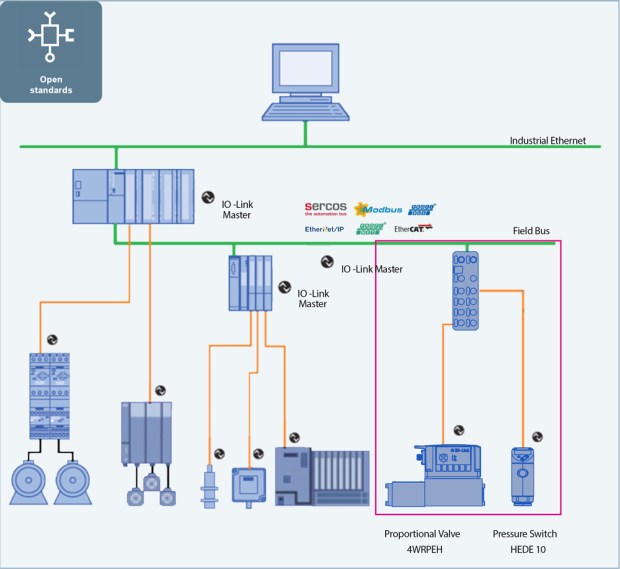
bild01_offenestandards_en

IO-Link Masters are offered by around 50 manufacturers for connection of one IO device per port. The selection includes options for the IP20 control cabinet as well as decentralized modules with protection class IP65/67 for installation at machinery. Particularly in large-scale systems, cabling is considerably reduced.

For decentralized IO-Link Masters, the user organization of IO-Link has defined M12 plug-in connectors with three or five conductors. The 5-pole version “Class B” port is used for devices with increased current consumption like hydraulic valves. The 3-pole version “Class A” port provides an energy supply of up to 200 mA which is sufficient for most sensors. In contrast to analog controls, unshielded cables are sufficient for fault-free communication over a cable length of up to 20 meters. IO-Link standardizes connection technology for all actuators and sensors and eliminates numerous sources of errors during the installation of systems. Otherwise complicated and expensive cable dimensioning with individual wiring and shielding is no longer required. In addition, the logistic effort is reduced thanks to application of uniform M12 cables for sensors and actuators.

Rapid commissioning per software

Every IO-Link device features an electronic device description, referred to as IO Device Description (IODD). It provides standardized important information:

• Device data
• Text description
• Identification, process and diagnosis data
• Communication properties
• Device parameters with value range and default value.
• Image of the device
• Logo of the manufacturer

The IODD set-up is identical for all devices of all manufacturers. The IODD enables automatic recognition of the device by the IO-Link Master for immediate parameterization. Also automatically, device descriptions are included in the system documentation.

For project integration of the IO-Link Master in overall automation, commissioning personnel use the engineering tools of the respective PLC manufacturer. The IO-Link Master is selected from the device portfolio and added to overall automation. Depending on the control system manufacturer, all blocks for communication are available in a library for free.
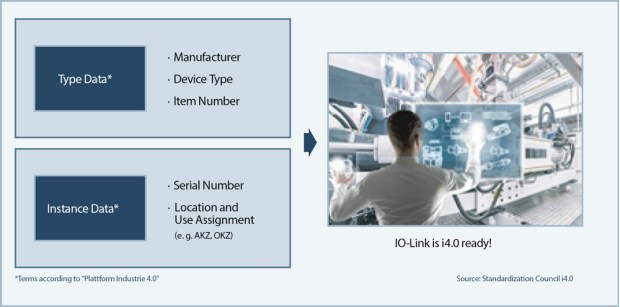
bild02_io_link_en

Via IO-Link to Industry 4.0

IO-Link enables access to device data either directly from the control system or remotely via networks from any location. Particularly important for future-oriented concepts: Already today, IO-Link offers type and instance data of Industry 4.0 devices according to the definition of the German “Plattform Industrie 4.0” initiative.

This way, also hydraulic actuators meet all conditions for future requirements of Industry 4.0 applications. Additionally, this approach is well-suited for subsequent connection of existing machinery and systems with low effort. Users replace installed proportional valves and sensors by interchangeable options with IO-Link connection for direct communication with actuators and sensors.

Diagnosis functions for increased availability

The diagnosis functions of IO-Link devices enable new maintenance concepts and considerably reduce repair times. Now possible call-up of device information in parallel to the process forms the basis for condition-oriented and predictive maintenance concepts. In this respect, proportional valves report whether they are functional as well as errors like under or overvoltage. In addition, the valve and sensor status is displayed for transparent error analysis. An integrated operating hour indicator enables calculation of the residual life-cycle for maintenance and decision-making on further use of the valve.

In case of faults, IO-Link accelerates diagnosis thanks to remote access for maintenance specialists to identify the type and location of any errors. Precise localization without personal presence at the system alone considerably reduces reaction times. If necessary, the maintenance technician opens the IODD file of the respective device in the control system. Other than before, components do not need to be disassembled to decipher hardly readable labels and manufacturers and types no longer need to be looked for in system documentations. Thanks to the electronic name plate, all this information can now be accessed with just one mouse click to initiate the respective order without delay.

IO-Link follows the plug & play principle. Replaced devices are recognized by the IO-Link Master according to their IODD file and the respective parameters are automatically transferred without any actions in the software. This way, even less experienced technicians are enabled to replace components without problems to considerably reduce system downtimes.

Summary

The open IO-Link standard establishes continuous communication with sensors and actuators irrespective of the used field bus. Now, even hydraulic proportional valves can be intelligently, easily and cost-effectively integrated in bi-directional digital communication. This simplifies commissioning in hardware and software and enables flexible adjustment of hydraulic valves for varying production processes. Increased requirements for flexible machinery and systems are now complied with. Extended diagnosis information enables condition-oriented and predictive maintenance concepts and standstill and maintenance times are reduced. This increases the availability of machinery. In addition, IO-Link enables future-proof integration of hydraulic valves into connected structures as Industry 4.0 components with all their related features.

Why hydraulics and IO-Link? Click here

Learn more about Rexroth and IO-Link

cropped-cmafh-logo-with-tagline-caps.pngCMA/Flodyne/Hydradyne is an authorized Bosch Rexroth distributor in Illinois, Wisconsin, Iowa and Northern Indiana.

In addition to distribution, we design and fabricate complete engineered systems, including hydraulic power units, electrical control panels, pneumatic panels & aluminum framing. Our advanced components and system solutions are found in a wide variety of industrial applications such as wind energy, solar energy, process control and more.

A Smarter SmartLight

Guest contributor: Tom Rosenberg, Balluff

Just when you thought the SmartLight was the most flexible Tower Indicator light ever, it gets even more flexible with the addition of a new mode. This new mode is appropriately named “Flexible Mode”. The new Flexible mode enables two new applications: User defined segments and Point-of-use indication.

User Defined Segments

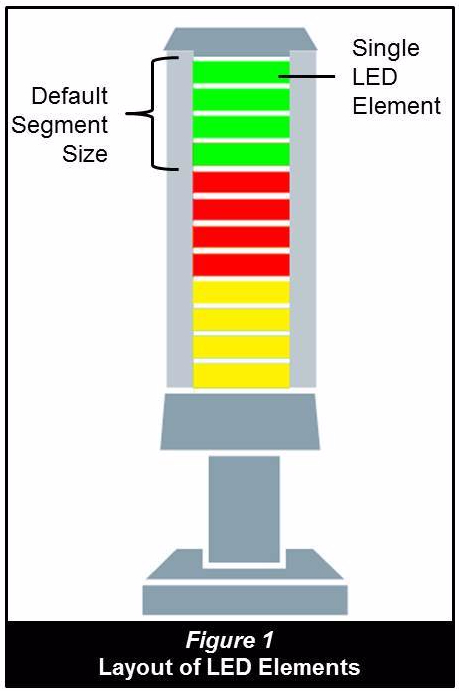
For traditional tower light applications, it’s now Figure 1possible to define the segments as you see fit. It works by taking control of every LED element. Each SmartLight segment is comprised of four LED elements that can be controlled anyway you want (see Figure 1).  For example, with the 3-segment SmartLight, you actually have 12 LED elements that you can organize any way you want. In Figure 2, we only use three LED elements per SmartLight segment, making it a four segment SmartLight. By using two LED elements we create six segments. Figure 3 is even more interesting, in this example we can see the size of the segments are sized by the intended users. Forklift Drivers need a larger light due to the distance and the fact that they are moving. Operators are closer than the forklift drivers, so their segment can be smaller, and maintenance can use the smallest segments because they are closest to the SmartLight when working on the machine.

Point of Use Indication

In these types of applications, the SmartLight is usedSocket Tray Appin close proximity, usually within the work envelope of the operators. In the example shown, the SmartLight is used in a socket tray application. The SmartLight indicates to the operator which socket is required for a specific task. Inductive proximity sensors connected to an IO-Link Hub verify the correct socket was pulled. The photo is showing an All-Call (all lights lit). Here you can see the unique LED element grouping only available with the new Flexible mode. Other applications for operator guidance are essentially endless. There are no technical limitations to your creativity.

The Flexible mode is available in all SmartLights with firmware version 3.0 or greater. So go have some fun!

Learn more about the SmartLight at www.balluff.com.

cropped-cmafh-logo-with-tagline-caps.pngCMA/Flodyne/Hydradyne is an authorized  Balluff distributor in Illinois, Wisconsin, Iowa and Northern Indiana.

In addition to distribution, we design and fabricate complete engineered systems, including hydraulic power units, electrical control panels, pneumatic panels & aluminum framing. Our advanced components and system solutions are found in a wide variety of industrial applications such as wind energy, solar energy, process control and more.

Back to the Basics: What is the Value of IO-Link?

Guest Contributor: Will Healy III, Balluff

IO-Link

With the demands for flexible manufacturing, efficient production & visibility in our factories, smart manufacturing is driving the way we work today.  Analytics and diagnostics are becoming critical to our ability to perform predictive maintenance, improve equipment effectiveness and monitor the condition of the machine as well as the components inside the machine.  Typically, our first reaction is to put these devices onto Ethernet.  However, the implementation of Ethernet requires a high skill set that is scarce in our traditional manufacturers today.  Due to the simple control architecture of IO-Link devices, it allows for many Smart devices to provide the data we need for analytics with a reduction in the Ethernet skill set that has become a roadblock for many manufacturers.

Many people think IO-Link is a new industrial network to compete with EtherNet/IP or Profinet, but this is a common misconception. IO-Link is complementary to those networks and typically enables those networks to do even more than previously thought.

Standard IO-Link Setup_01_preview

Open Standard

IO-Link is an open standard designed with the idea to act like USB for industrial automation.  IO-Link is meant to simplify the smart sensor & intelligent device connectivity on the factory floor in a similar way that USB simplified connectivity to computers for auxiliary devices.  IO-Link is not an industrial network or fieldbus; it is an industrial network and industrial controller agnostic. Designed with a master to slave configuration, addressing of the devices is point-to-point, similar to USB.  Compatible IO-Link masters can act as slaves or nodes on a variety of industrial protocols and act complementary to the network of the user’s choosing.  Eliminating the need for serial communication configuration or network addressing simplifies the connection and integration of devices.

Value in Machine Builds

IO-Link has advantages for both machine io-link master_18x18_300dpibuilders and discrete manufacturers.  For machine builders, the biggest advantage comes from the simplified wiring scheme of IO-Link devices.  We have seen machine builder users of IO-Link reduce their wiring hardware & labor costs by 30%-60% for sensors,
outputs & controls.  This is realized with the simple sensor tool cords used for connections, quick-disconnect connectors on the cables and machine mount Ethernet masters devices.  It is also realized for machine builders in an increase of turns on their floor, a reduction in build labor and significantly faster commissioning time.

Value on the Production Floor

For discrete manufacturers, the biggest advantages have come from the parameterization and diagnostic features on the IO-Link devices.  With the ability to store & send parameters between the master & slave, IO-Link devices can be automatically configured. Hot-swapping a complex smart device like a pressure sensor can go from a stressful ordeal including 14-plus setpoints to literally a push of one button.  Combining this functionality with multiple diagnostics both in the master & slaves eliminates human error and dramatically reduces downtime & troubleshooting for manufacturers.

To learn more about market leading IO-Link technologies, visit www.balluff.com.

cropped-cmafh-logo-with-tagline-caps.pngCMA/Flodyne/Hydradyne is an authorized  Balluff distributor in Illinois, Wisconsin, Iowa and Northern Indiana.

In addition to distribution, we design and fabricate complete engineered systems, including hydraulic power units, electrical control panels, pneumatic panels & aluminum framing. Our advanced components and system solutions are found in a wide variety of industrial applications such as wind energy, solar energy, process control and more.

Boost Size-Change Efficiency with IO-Link Magnetic Encoders and Visualization

Guest contributor: Henry Menke, Balluff

In many industries, especially in Packaging, the need to minimize capital equipment costs drives engineers to implement low-cost, manual methods of size change (also called format change) on their machinery. In most cases, this means hand-driven cranks with mechanical dial pointers and/or mechanical revolution counters.

While cost is saved on the procurement side, cost is also shifted over to the operational side. Plant management is left with the task of keeping accurate records of various machine set-ups needed to run different products, as well as the task of training machine operators to perform all machine set-ups correctly. It doesn’t always go as smoothly as expected, and machine reformatting can result in longer downtime than planned, machine stoppages, and possibly excessive scrap.

The key to size-change improvement is capturing the linear movements of the machine components and bringing them into the control system, and then providing “smart” visual feedback to the machine operator during setup. For capturing machine position, a robust and cost-effective magnetic linear encoder is ideal. However, traditional linear encoders deliver an A-B quadrature incremental signal, which requires re-homing upon start-up or after a power loss. What’s needed is an absolute encoder signal, but that brings other challenges such as the cost and complexity of implementing an absolute signal like SSI (Synchronous Serial Interface).

Fortunately, there’s a new encoder interface BML SL1 Absolute Magnetic Encoder with IO-Linkoption that eliminates the problem of non-absolute feedback and the hassle of absolute position signal interface: IO-Link. IO-Link is a multi-vendor, non-proprietary, device-level serial digital interface that can be aggregated onto today’s Ethernet industrial networks. Magnetic linear encoders are now available that feature absolute position indication combined with the ease and convenience of the IO-Link communication protocol.

Now we just need to provide visual feedback to the machine operator regarding which direction and how far to turn the hand cranks. Once smartlight_18x18_300dpiagain, IO-Link provides the answer in the form of an IO-Link-enabled, fully programmable multi-segment LED stack light. When a new machine set up is required, the position parameters are stored in the controller. The controller communicates over IO-Link to the LED stack lights, indicating to the operator which dials need to be turned and in which direction. For example, a horizontally mounted stack light could be lit red on the right half, indicating that the dial needs to be turned to the right. As the position moves closer to the proper setting, the red segments count down until the entire stack light goes green, indicating that the correct position for that axis has been reached. No paper records to maintain and store, and very little training required with the intuitive operator visualization.

For more information about IO-Link linear encoders click here, and to learn more about IO-Link programmable LED stack lights visit www.balluff.com.

cropped-cmafh-logo-with-tagline-caps.pngCMA/Flodyne/Hydradyne is an authorized  Balluff distributor in Illinois, Wisconsin, Iowa and Northern Indiana.

In addition to distribution, we design and fabricate complete engineered systems, including hydraulic power units, electrical control panels, pneumatic panels & aluminum framing. Our advanced components and system solutions are found in a wide variety of industrial applications such as wind energy, solar energy, process control and more.

IO-Link Measurement Sensors Solve Application Challenges

In industrial distance and position measurement applications, one size definitely does not fit all.  Depending on the application, the position or distance to be measured can range from just a few millimeters up to dozens of meters.  No single industrial sensor technology is capable of meeting these diverse requirements.

Fortunately, machine builders, OEM’s and end-users can now choose from a wide variety of IO-Link distance and position measurement sensors to suit nearly any requirement.  In this article, we’ll do a quick rundown of some of the more popular IO-Link measurement sensor types.

(For more information about the advantages of IO-Link versus traditional analog measurement sensors, see the following blog posts, Solving Analog Integration Conundrum, Simplify Your Existing Analog Sensor Connection, and How Do I Make My Analog Sensor Less Complex?)

Short Range Inductive Distance Sensors

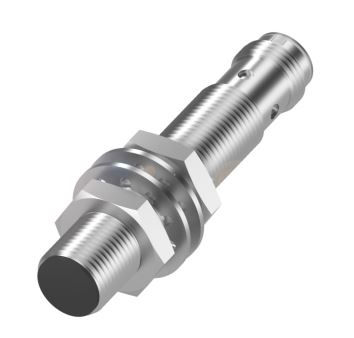
These sensors, available in tubular and blockScott Image1.JPG style form factors are used to measure very short distances, typically in the 1…5 mm range.  The operating principle is similar to a standard on/off inductive proximity sensor.  However, instead of discrete on/off operation, the distance from the face of the sensor to a steel target is expressed as a continuously variable value.  Their extremely small size makes them ideal for applications in confined spaces.

Inductive Linear Position Sensors

Inductive linear position sensors are available in several block style form factors, and are used for position measurement over stroke lengths up to about 135 mm.  These types of sensors use an array of inductive coils to accurately measure the position of a metal target.  Compact form factors and low stroke-to-overall length factor make them well suited for application with limited space.

BIP(1)_46630_Produktnews_korrBIP(2)_55370_00_P_00_00_00

Magnetostrictive Linear Position Sensors

IO-Link Magnetostrictive linear position sensors are available in rod style form factors for hydraulic cylinder position feedback, and in external mount profile form factors for general factory automation position monitoring applications.  These sensors use time-proven, non-contact magnetostrictive technology to provide accurate, absolute position feedback over stroke lengths up to 4.8 meters.

Laser Optical Distance Sensors


Scott Image 4.JPGLaser distance sensors use either a time-of-flight measuring principle (for long range) or triangulation measuring principle (for shorter range) to precisely measure sensor to target distance from up to 6 meters away.  Laser distance sensors are especially useful in applications where the sensor must be located away from the target to be measured.


Magnetic Linear Encoders

IO-Link magnetic linear encoders use an absolute-codedScott Image 5flexible magnet tape and a compact sensing head to provide extremely accurate position, absolute position feedback over stroke lengths up to 8 meters.  Flexible installation, compact overall size, and extremely fast response time make magnetic linear encoders an excellent choice for demanding, fast moving applications.

IO-Link Measurement Sensor Trends

The proliferation of available IO-Link measurement sensors is made possible, in large part, due to the implementation of IO-Link specification 1.1, which allows faster data transmission and parameter server functionality.  The higher data transfer speed is especially important for measurement sensors because continuous distance or position values require much more data compared to discrete on/off data.  The server parameter function allows device settings to be stored in the sensor and backed up in the IO-Link master.  That means that a sensor can be replaced, and all relevant settings can be downloaded from master to sensor automatically.

To learn about IO-Link in general and IO-Link measurement sensors in particular, visit www.balluff.com.

cropped-cmafh-logo-with-tagline-caps.pngCMA/Flodyne/Hydradyne is an authorized  Balluff distributor in Illinois, Wisconsin, Iowa and Northern Indiana.

In addition to distribution, we design and fabricate complete engineered systems, including hydraulic power units, electrical control panels, pneumatic panels & aluminum framing. Our advanced components and system solutions are found in a wide variety of industrial applications such as wind energy, solar energy, process control and more.
Boost Size-Change Efficiency with IO-Link Magnetic Encoders and Visualization

In many industries, especially in Packaging, the need to minimize capital equipment costs drives engineers to implement low-cost, manual methods of size change (also called format change) on their machinery. In most cases, this means hand-driven cranks with mechanical dial pointers and/or mechanical revolution counters.

While cost is saved on the procurement side, cost is also shifted over to the operational side. Plant management is left with the task of keeping accurate records of various machine set-ups needed to run different products, as well as the task of training machine operators to perform all machine set-ups correctly. It doesn’t always go as smoothly as expected, and machine reformatting can result in longer downtime than planned, machine stoppages, and possibly excessive scrap.

The key to size-change improvement is capturing the linear movements of the machine components and bringing them into the control system, and then providing “smart” visual feedback to the machine operator during setup. For capturing machine position, a robust and cost-effective magnetic linear encoder is ideal. However, traditional linear encoders deliver an A-B quadrature incremental signal, which requires re-homing upon start-up or after a power loss. What’s needed is an absolute encoder signal, but that brings other challenges such as the cost and complexity of implementing an absolute signal like SSI (Synchronous Serial Interface).

Fortunately, there’s a new encoder interface BML SL1 Absolute Magnetic Encoder with IO-Linkoption that eliminates the problem of non-absolute feedback and the hassle of absolute position signal interface: IO-Link. IO-Link is a multi-vendor, non-proprietary, device-level serial digital interface that can be aggregated onto today’s Ethernet industrial networks. Magnetic linear encoders are now available that feature absolute position indication combined with the ease and convenience of the IO-Link communication protocol.

Now we just need to provide visual feedback to the machine operator regarding which direction and how far to turn the hand cranks. Once smartlight_18x18_300dpiagain, IO-Link provides the answer in the form of an IO-Link-enabled, fully programmable multi-segment LED stack light. When a new machine set up is required, the position parameters are stored in the controller. The controller communicates over IO-Link to the LED stack lights, indicating to the operator which dials need to be turned and in which direction. For example, a horizontally mounted stack light could be lit red on the right half, indicating that the dial needs to be turned to the right. As the position moves closer to the proper setting, the red segments count down until the entire stack light goes green, indicating that the correct position for that axis has been reached. No paper records to maintain and store, and very little training required with the intuitive operator visualization.
For more information about IO-Link linear encoders click here, and to learn more about IO-Link programmable LED stack lights visit www.balluff.com.

cropped-cmafh-logo-with-tagline-caps.pngCMA/Flodyne/Hydradyne is an authorized  Balluff distributor in Illinois, Wisconsin, Iowa and Northern Indiana.

In addition to distribution, we design and fabricate complete engineered systems, including hydraulic power units, electrical control panels, pneumatic panels & aluminum framing. Our advanced components and system solutions are found in a wide variety of industrial applications such as wind energy, solar energy, process control and more.

Imagine the Perfect Photoelectric Sensor

Guest contributor: Jack Moermond, Balluff

Photoelectric sensors have been around for a long time and have made huge advancements in technology since the 1970’s.  We have gone from incandescent bulbs to modulated LED’s in red light, infrared and laser outputs.  Today we have multiple sensing modes like through-beam, diffuse, background suppression, retroreflective, luminescence, distance measuring and the list goes on and on.  The outputs of the sensors have made leaps from relays to PNP, NPN, PNP/NPN, analog, push/pull, triac, to having timers and counters and now they can communicate on networks.

The ability of the sensor to communicate on a network such as IO-Link is now enabling sensors to be smarter and provide more and more information.  The information provided can tell us the health of the sensor, for example, whether it needs re-alignment to provide us better diagnostics information to make troubleshooting faster thus reducing downtimes.  In addition, we can now distribute I/O over longer distances and configure just the right amount of IO in the required space on the machine reducing installation time.

IO-Link networks enable quick error free replacement of sensors that have failed or have been damaged.  If a sensor fails, the network has the ability to download the operating parameters to the sensor without the need of a programming device.

With all of these advancements in sensor technology why do we still have different sensors for each sensing mode?  Why can’t we have one sensor with one part number that would be completely configurable?

BOS21M_Infographic_112917

Just think of the possibilities of a single part number that could be configured for any of the basic sensing modes of through-beam, retroreflective, background suppression and diffuse. To be able to go from 30 or more part numbers to one part would save OEM’s end users a tremendous amount of money in spares. To be able to change the sensing mode on the fly and download the required parameters for a changing process or format change.  Even the ability to teach the sensing switch points on the fly, change the hysteresis, have variable counter and time delays.  Just imagine the ability to get more advanced diagnostics like stress level (I would like that myself), lifetime, operating hours, LED power and so much more.

Obviously we could not have one sensor part number with all of the different light sources but to have a sensor with a light source that could be completely configurable would be phenomenal.  Just think of the applications.  Just think outside the box.  Just imagine the possibilities.  Let us know what your thoughts are.

To learn more about photoelectric sensors, visit www.balluff.com.

cropped-cmafh-logo-with-tagline-caps.pngCMA/Flodyne/Hydradyne is an authorized  Balluff distributor in Illinois, Wisconsin, Iowa and Northern Indiana.

In addition to distribution, we design and fabricate complete engineered systems, including hydraulic power units, electrical control panels, pneumatic panels & aluminum framing. Our advanced components and system solutions are found in a wide variety of industrial applications such as wind energy, solar energy, process control and more.

Demystifying Class A and Class B Type IO-Link Ports

Since the inception of the Class (or Type) A and Class (or Type) B ports in the IO-Link specifications, there have been several new IO-Link devices and IO-Link masters introduced to the market. This has caused a lot of confusion about when and where to use Class A and Class B IO-Link masters and devices.

Before getting into the details of Class A vs. Class B, I would like to address one question that I get asked quite often: are Class B master ports safety-rated? The answer is no. Just like any other network I/O modules (with the exception of the Safety I/O modules), any type of IO-Link master (whether it is Class A, Class B or mixed) is not safety rated. If the block is safety-rated, I am certain that the manufacturers of these blocks will kindly let you know. So, we just busted the first myth about Class B ports. Side note: the IO-Link Consortium just released a specification for IO-Link Safety. At the time of this posting (Oct. 2017), there are no IO-Link masters on the market that are safety rated, even when the IO-Link master ports exist alongside Safety I/O parts on the same block.

Capture.JPG

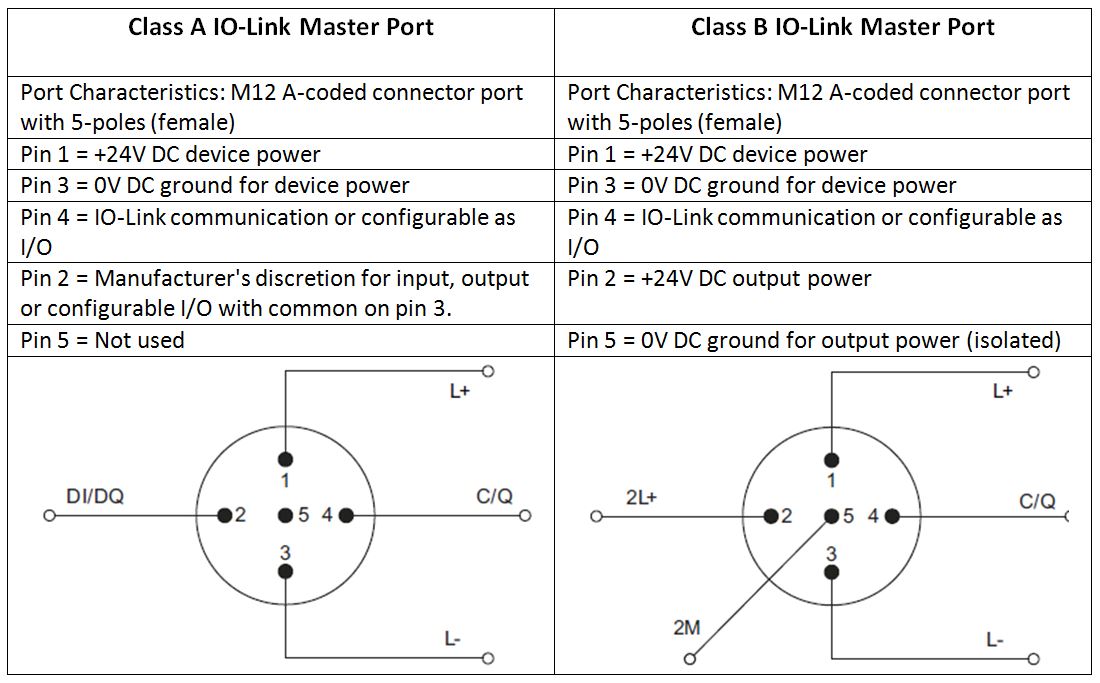
For IO-Link communication, only pins 1, 3 and 4 have significance. The implementations of pin 2 and 5 is where Class A and Class B ports differ and with that, the advantages and disadvantages of the uses for these ports.

Clearly, with the wiring diagrams above, a Class A port offers more flexibility in terms of additional I/O count and in some cases high-amperage outputs to drive high-current devices such as valves.  We will discuss the detailed power routing and application flexibility of Class A ports in a later blog.

With Class B ports, Pin 2 and Pin 5 are tied to a separate power source and cannot really be used as I/O.  Pin 5, the ground for output power, is separated from pin 3, the ground for device power. Actuation devices, such as valve banks, that are now offered on IO-Link could utilize separate output power that can be turned off through safety relays. Technically, this separation of power is possible with Class A ports as well, but it is inherent with Class B ports.

A word of caution when implementing I/O architectures with Class B masters: since the commons for device power and output power are isolated at the master, the power fed to this device should be isolated at the source as well to keep the isolation intact. That means, the power supplies feeding the power to these devices should be isolated.

Another question that I get asked frequently reveals another myth about Class B master ports: do Class B master ports offer any extra power than Class A ports? Again the answer is no. Class B does not mean extra power or the ability to provide more power. It simply means output power with isolated commons. What leads to that thinking is that on several IO-Link masters in the market, the outputs available on pin 2 of Type A ports have lower amperage ratings, because in most cases the output power is shared or drawn from the same source that feeds device power.  There will be more discussion about this in my next blog!

A third interesting question is, can you plug Class A IO-Link devices into Class B master ports? In most cases there is no problem doing this as a true IO-Link Class A device is only a 3 pin device using pins 1,3, and 4 shown above. So as long as pin 2 of the device does not exist or is not being used for any purpose, it is possible to use Class A devices with Class B ports. Caution: several manufacturers make sensors that can be used in IO-Link mode as well as analog or digital mode and the implementation may have more than 3 pins. In these circumstances, you will need to use a 3-pole cable to keep the device unharmed or the pin 2 of the type B port that always has +24V going through may damage or disrupt the sensor.

Meanwhile, I hope this blog helped provide some clarity on Class A and Class B ports.

cropped-cmafh-logo-with-tagline-caps.pngCMA/Flodyne/Hydradyne is an authorized  Balluff distributor in Illinois, Wisconsin, Iowa and Northern Indiana.

In addition to distribution, we design and fabricate complete engineered systems, including hydraulic power units, electrical control panels, pneumatic panels & aluminum framing. Our advanced components and system solutions are found in a wide variety of industrial applications such as wind energy, solar energy, process control and more.