New hydraulic design for presses

Guest contributor: Stefan Zimmerman

New drive concept makes hydraulics economical and intelligent

By means of variable-speed pump drives, new, patented hydraulic axes simplify the design and control of presses of any kind. They considerably reduce the power consumption as well as the required oil quantity by up to 90 percent. To this extent, the control technology of a valve control moved into the software of intelligent servo drives of a displacer control. This reduces the complexity and opens up new levels of flexibility and of condition monitoring.

Worldwide, the climate change has increasingly drastic effects on the everyday life. Thus, governments and international organizations have defined climate targets in order to limit the CO2emissions. What has already become standard in light bulbs and household devices also takes increasingly more effect in the industry. Energy-efficiency has become a decisive criterion for the machine users when it comes to the selection of machinery and systems. They expect a considerably increased output with clearly reduced current and resource consumption. Apart from that, numerous companies have already publicly obliged themselves to reduce their CO2 emissions by defined quantities. They can only achieve these targets if new machinery and systems are considerably more energy-efficient. So it is the challenge of machine manufacturers to develop new concepts.

29813-1200x350

Using the hydraulic force density as required

In large systems with very high processing forces as they are required for forming methods, the hydraulics as main drive is one of the largest power consumers. The end users have accepted this for a long time as they wanted to have the maximum force available at any time, even if the process did not permanently require it. Modern hydraulic drives distinguish themselves by the physical unique selling points such as power density and robustness; however, they clearly reduce the power consumption by controlling the displacer as required. Thanks to its hybrid concept, the new hydraulicAxis patented by Bosch Rexroth for presses of different kinds, from low to high drive power, connects the advantages of hydraulics with those of the electric drive technology. First equipment according the new concept has shown that the power consumption can be reduced by more than 30 percent. The required oil quantity of the hydraulic installation can be reduced by up to 90 percent.

Conventional hydraulic systems

For decades, conventional systems have proven of value for presses in the medium and high performance range as drive technology of choice. In this connection, these systems mostly work with a central hydraulic power unit with several variable displacement pumps.  Moreover they are operated by electric motors directly connected to the mains. Apart from that, central or decentralized manifolds with on/off and proportional servo valve technology are required in order to control the cylinder(s) in rapid traverse, working or pressing mode and in the so-called return.

One disadvantage of this concept are idling losses during the standstill times. In the control of the cylinders, there are also throttle losses caused by the valve control. There is partly considerable heat introduction into the hydraulic oil, which must afterwards be compensated again by corresponding cooling.

Hydraulic axis replaces central power unit

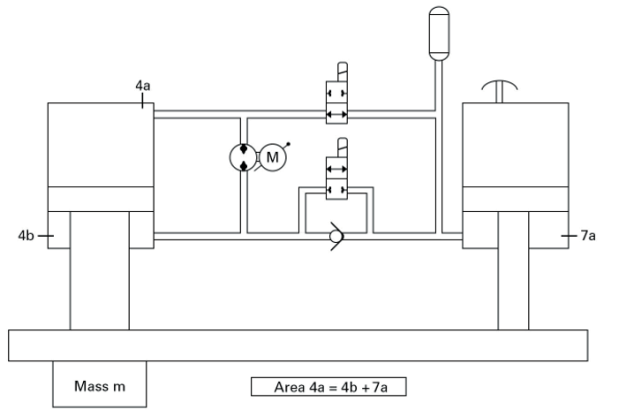
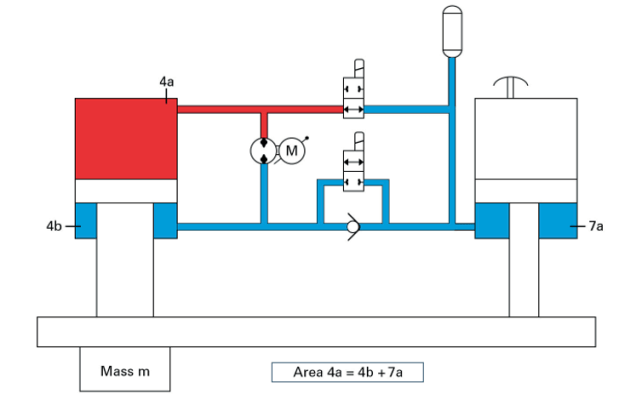
A new, patented hydraulic concept replaces the previously common central power unit with valve control by a patented hydraulic axis with speed-controlled displacer control and a closed, decentralized fluid circuit. The hydraulic axis consists of a differential cylinder with a cylinder chamber and ring chamber. The cylinder chamber is for a powerful working movement and the ring chamber for the fast rapid traverse movement. An auxiliary cylinder takes up the oscillating volume during the different movements and in this way creates a closed circuit. A central oil tank is no longer necessary and thus completely omitted.

Pic_1


The flow is generated by variable-speed pump drives. In order to satisfy the high precision and dynamics requirements, servomotors in combination with adjustable axial piston pumps lend themselves. Thus, all options of the 4-quadrant operation are available to the design engineers. With several cylinders, a corresponding number of Hydraulic axes is used. The synchronization control is performed by the software of the intelligent servo drives, synchronized by means of real-time communication.

Reversal of the movement by changing the direction of rotation

The area switchover for the relevant movement is effected by means of two valves. During the pressing process, the cylinder areas are large. Thus, the cylinders reach high forces at low velocity. During the return of the cylinders, however, the areas in the ring chamber are small in order to achieve the maximum rapid traverse velocity with low forces and to thus reduce the downtimes of the presses. For the reversal of the movement, the servomotors change their direction of rotation. If adjustable axial piston pumps are used, the swash plate of which can be swiveled through zero, the direction of the movement can also be changed by adjusting the swivel angle.

Pic_2


Energy efficiency in practice: Presses consume more than 30 percent less

The hydraulic axis works in a strictly need-oriented manner. At partial load, the servo drive controllers reduce the speeds of the pump motors to the lowest value possible. During standstill times, e.g. for cooling down the tools, the motors are standing and do not consume any energy. During that time, safety valves support the return. Depending on the cycle times, variable-speed pump drives allow for energy savings of more than 80 percent as compared to constantly driven power units without variable displacement pumps. In practice, the first presses with hydraulic axes achieved reduced consumption of 30 percent as compared to already energetically optimized, conventional hydraulic solutions.

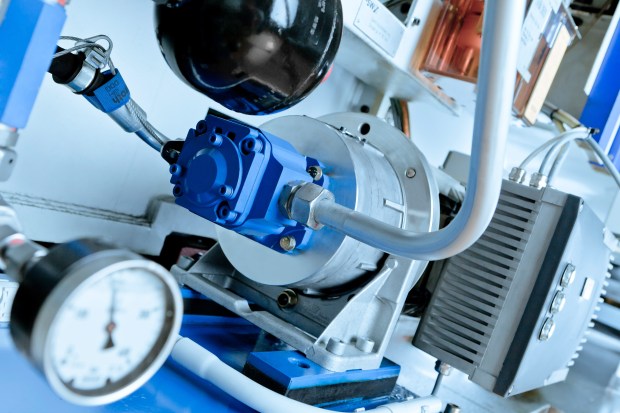
BR_Homburg_Booster-105Regarding the Sytronix family, Rexroth offers more than one hundred pump drives with variable speed relating to power and function. These can be integrated into all usual automation structures thanks to multi-Ethernet interfaces.

Exceeding the savings due to the need-based closed-loop speed control, additional functions increase the energy efficiency of the presses even further. In the lowering movement, the servomotors recuperate the braking energy and either feed it into an electric accumulator, make it available to other actuators, e.g. handling axes, via an intermediate circuit or feed it back into the mains.

Synchronization control of the hydraulic cylinders via intelligent software

The synchronization control can be effected via all common real-time protocols such as PROFINET, Ethernet IP, EtherCat or Sercos if the servo drive controllers provide corresponding multi-Ethernet interfaces. Changes in motion sequences are only transmitted via the machine control by means of software command to the intelligent drives. Mechanical adjustment works at the hydraulic axis are not necessary. So due to short changeover times, end users gain flexibility. At the same time, you can continuously document the manufacturing processes of every component by means of the servo-drive data. This satisfies the increasing demands on the traceability of products.

90 percent less hydraulic oil – central tank omitted

Due to the new concept of the hydraulic axis, the movements are primarily controlled via variable-speed pumps rather than the throttling of the flow by the valves. So considerably less heat is introduced into the hydraulic oil and only minor agitation results. Result: In the first presses with hydraulic axes, the manufacturer could reduce the oil volume from e.g. 10,000 liters to only 900 liters. This saves space for the tank and reduces the operating costs as in an oil exchange, less than ten percent of the previously used oil quantity have to be purchased and disposed of.

An additional advantage is the clearly reduced average noise emission. With variable-speed pump drives, it is up to 20 db(A) below that of constantly driven pumps. During standstill, the noise level of the hydraulics falls to zero. Due to the omitted tank and complex piping for a power distribution, resonance bodies for the structure-borne sound are omitted. With the new concept, the expenses for the noise insulation are considerably lower.

Easier hydraulic construction with quick commissioning

For manufacturers of hydraulic presses, the conversion to hydraulic axes brings about considerable savings in the design, assembly and commissioning. Tank, cooling and piping are completely or largely omitted as is the valve technology. The variance of different motion sequences is moved from the valve technology into the drive controller software. Here, Bosch Rexroth has, for example, integrated best-in-class controllers for different force/path and synchronization controls. Due to the corresponding commissioning software, the engineers don’t even need in-depth hydraulic knowledge for the initial commissioning. Software wizards propose suitable parameters. This considerably shortens the commissioning phases of a hydraulic press.

Condition monitoring increases the availability

The data that is gathered by the intelligent servo drives anyway and that can be amended by more sensors is particularly interesting for end users. It forms the basis for condition monitoring strategies increasing the availability. Based on the analysis of the data, the corresponding software identifies wear and errors before they will lead to standstills. So machine downtimes are replaced by scheduled maintenance measures.

Find out more about self-contained hydraulic actuators here.

cropped-cmafh-logo-with-tagline-caps.pngCMA/Flodyne/Hydradyne is an authorized Bosch Rexroth distributor in Illinois, Wisconsin, Iowa and Northern Indiana.

In addition to distribution, we design and fabricate complete engineered systems, including hydraulic power units, electrical control panels, pneumatic panels & aluminum framing. Our advanced components and system solutions are found in a wide variety of industrial applications such as wind energy, solar energy, process control and more.

Economical and intelligent: Handling solutions re-conceived

Guest contributor: Andreas Gryglewski, Bosch Rexroth

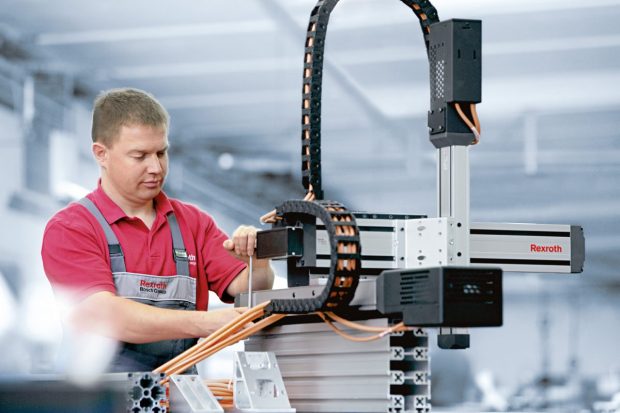
The market for handling and robotic solutions is highly price-driven, yet still leaves room for disruptive ideas. Bosch Rexroth provides proof of this with an advanced solution package for Cartesian kinematics. It combines an economical industrial controller with state-of-the-art web technology and assured instruction via a standard tablet. The result: minimum investment costs and maximum efficiency – before and during operation.

Manufacturers of handling solutions for loading and unloading face fierce competition. The volume market demands cost-optimized, rugged and user-friendly solutions that optimally fulfill all requirements in terms of accuracy and cycle times. In addition, users expect quick commissioning with as little programming, instruction and training expenditures as possible. A high degree of productivity and flexibility is also required for the operational phase in order to reduce downtime and so that format or process changes can be more quickly implemented.

All of these requirements are addressed by Bosch Rexroth with a particularly economical solution package for Cartesian kinematics that combines a high-performance motion controller with state-of-the-art web technologies and innovative value-added features. The automation experts make the solution package even more economical with an especially clever idea: users can perform the setup and assured teaching-in on any standard commercially available tablet.

Industrial control, web technology, consumer tablets

In its solution package for Cartesian kinematics, Bosch Rexroth combines a powerful motion controller with modern web technologies and innovative value-added features.

The disruptive solution approach for Cartesian handling from Bosch Rexroth is particularly suitable for machinery manufacturers and end users who want to implement flexibly and reliably adaptable pick-and-place tasks in a short time and at a low cost. Examples include the loading and unloading of injection-molded parts, the sorting of workpieces, or a wide range of intralogistics applications. Bosch Rexroth combines its proven industrial controller with a webserver and a bracket for a typical standard tablet, by means of which the user can visualize the connected handling solution and – graphically-supported – program, teach-in and adjust it as needed. The solution package is comprised of other basic components such as compact servo motors and drives for the kinematics movement, as well as a safety controller for connecting to the tablet bracket for safe teaching-in. From a single source, Bosch Rexroth also optionally offers the mechanical equipment, includinglinear axes with a belt or ball-screw drive and grabbers.

The utmost in connectivity and IT security

In its new handling solution, Bosch Rexroth placed special emphasis on the two key properties of i4.0 –connectivity and IT security. While the optional IoT Gateway ensures the horizontal and vertical networking, the security router with a newly developed IoT firewall, which is also optional, guarantees secure communication between the tablet and controller. Consequently, unauthorized persons can neither log into the controller nor can a virus attack the controller or spread throughout a company’s IT network.

Bild_2_21263-1200x800

Thanks to the newly developed solution packages, handling systems from Bosch Rexroth can be more quickly commissioned, easily programmed, and taught most economically using standard tablets.

Easy commissioning without parameterization

One of the numerous unique features is the operating concept for the handling solution: Immediately after a servo motor is connected with a drive, the latter reads out the stored parameter set from the feedback memory and thus already has all the characteristic data of the mechanical equipment. The result: a considerable time savings and prevention of errors during commissioning, because the user no longer has to manually enter up to 70 parameters. When Rexroth mechanical equipment is ordered in the future, the parameters will be stored in the feedback memory of the motor while still in the plant. If the user puts his own mechanical equipment into operation; the associated parameter file can also be stored in the feedback memory and is efficiently read into the drive upon connecting.

Safe teaching-in using a standard tablet

The disruptive character of the new handling solution becomes clear during setup, which can be performed wirelessly with almost any consumer tablet. It is expeditiously fastened in a bracket especially developed by Bosch Rexroth for teaching-in, which can be adjusted to the respective size and securely encloses the mobile device. On the top left is a combination emergency stop and enabling button that makes reliable and comfortable teaching-in possible for the user. While the left hand holds the tablet and can press the red button, the right hand is free for other operational tasks. The visualization and operation of the handling system is web-based and applies the HTML5 standard, hence is independent of the tablet OS. An optional security router with an integrated firewall provides for IT security.

Programming without programming knowledge

Bosch Rexroth also made the process programming, which precedes the teaching-in sequence, as uncomplicated as possible. Because it uses the graphical programming language Google Blockly, as is the case with the tablet, no programming skills in conventional terms are required. In order to move an axis from point A to point B, for example, only the start and end positions need to be specified, and a line to connect them with each other. The grabbers are also opened or closed by means of graphical elements. Thanks to variables, logical expressions and loops, it is possible to easily specify and clearly represent various processes, also complex ones if necessary.

Features for increasing productivity and quality

Positively contributing to the performance of an especially economical operating phase of the new handling solution are its versatile functions and expansion options. These ultimately also afford the user a high degree of flexibility for changes in process or format. For example, the Active vibration damping function, which provides greater product quality in combination with a sensor, or initiates the exact countermovements in the open-loop process in the linear module in order to prevent undesirable vibrations or to move sensitive products. Thus, for instance, the utmost in accuracy can be achieved when loading and unloading using the grabber sparing the mechanical equipment for a longer service life.

Preventive maintenance and IoT integration

Preventive maintenance can also be cost-efficiently realized in combined usage with the optional IoT Gateway. In order to collect data for analysis and evaluation of the service life, the motor decoder can also be used as an intelligent sensor. If the motor revolutions are converted into linear movements, the timing for lubrication intervals or the replacement of components can be derived, for example. Communication standards such as OPC UA can provide for easy integration into customer-specific IoT systems as needed.

Economical in every way

The solution package is especially suited for pick-and-place tasks that must be quickly and flexibly adaptable – such as for the loading and unloading of injection-molded parts, the sorting of workpieces, or for various intralogistics applications.


With the new solution package, Bosch Rexroth introduces a fresh impetus into the competitive market for Cartesian handling. Automation expertise, modern web and IoT technologies, and productivity-enhancing features are combined in a rugged and practical solution concept that takes into account current and future market requirements, and which generates disruptive energy. Consequently, machinery manufacturers and end users find quick and very economical way to implement a reliable, efficient and flexible handling solution that can be commissioned, taught, and adapted to current requirements without any significant knowledge of programming and parameterization.

Innovative approaches of the new handling system:

  • A comprehensive economic package comprising industrial controller, servo motor, drives, security zone module and teaching-in bracket for consumer tablets
  • Maximum security through a router with firewall (optional)
  • Minimal total cost of ownership thanks to:
    • Commissioning without the need for parameterization: Drives automatically read stored mechanical parameters when connected with a motor
    • Device-independent visualization and operation (HTML5)
    • Safe teaching-in bracket for consumer tablets
    • Simplified process flow design without programming knowledge, thanks to Google Blockly
  • Added value functions for productivity and quality – for example vibration absorption
  • Prepared for data tracking for preventive maintenance
  • Easy integration into IoT systems through open interfaces such as OPC UA

cropped-cmafh-logo-with-tagline-caps.png

CMA/Flodyne/Hydradyne is an authorized Bosch Rexroth distributor in Illinois, Wisconsin, Iowa and Northern Indiana.

In addition to distribution, we design and fabricate complete engineered systems, including hydraulic power units, electrical control panels, pneumatic panels & aluminum framing. Our advanced components and system solutions are found in a wide variety of industrial applications such as wind energy, solar energy, process control and more.
Innovative automation solutions for additive manufacturing 2.0

Guest contributor: Peter Berens, Bosch Rexroth

Additive manufacturing is a growth market – sales worth tens of billions of euros are expected by 2020. However, innovative automation solutions are needed if this disruptive technology is to achieve a breakthrough and make the leap from prototype construction and toolmaking to industrial mass production.

If machine manufacturers want to achieve the productivity needed for mass production, they need to reduce the amount of manual work involved, the reject rate and the quality assurance outlay and successfully integrate the machines into the production line. Both challenges can be met through high-performance, intelligent and connective automation.

IoT as a key technology

In the factory of the future, AM machines will be connected horizontally and vertically to higher-level and neighboring IT systems. When it comes to the industrial Internet of things, Bosch Rexroth relies on open i4.0 standards such as OPC UA. With full server/client functionality, processes, cycle times and energy consumption can be evaluated in real time and optimized to achieve better productivity and quality. In conjunction with intelligent algorithms in drive and control technology, Bosch Rexroth also carries out predictive maintenance.

3D printing and the factory of the future

Thanks to decentralized intelligence, drive technology without control cabinets and open standards, the next generation of AM machines is ready for the factory of the future. Wireless communication and modular production lines increase flexibility while reducing set-up times. As a result, the factory layout can be geared to current and future requirements. The next logical step is the decentralization of the control system which will then receive its programs as necessary from the cloud.

What the hardware must be capable of

Whether it be metal, plastic or ceramic: the output in the relevant AM procedure depends very much on the performance of the CNC or motion control system. The shorter the cycle times, the more quickly the NC programs run. The higher the performance, the quicker 3D data can be computed on the CNC and process data collected and processed in real time. The MTX CNC system from Rexroth achieves this with a combination of a high-performance dual core processor and decentralized intelligence allowing fast reaction times. As a result, many additional tasks can be performed by the machine. Planning, programming and the commissioning of all system components take place in a standardized manner via IndraWorks Engineering.

Abbildung_2_Werkstücke-768x257

Software makes all the difference

In order to be able to control the application of additive materials precisely and to influence it easily with process variables, the control software too must be particularly powerful. The MTX system software includes numerous AM-specific CNC functions for this purpose. These include an intelligent temperature control system and a 3D online simulation with collision recognition which automatically visualizes the construction time, positioning and printing head travel. The standardized G code is supported by any slicer software. Integrated NC encoding systems protect manufacturer-specific know-how.

Digitizing the workflow

Another key development area is the digitization of the workflow with typical tasks such as print configuration, job management, machine monitoring including online process modification or controlling intralogistics. Because this is not possible without interfaces to the software programs involved (e.g. CAD/CAM systems or simulation solutions), the MTX CNC system has an open system architecture and the Open Core Interface. As a result, machine operators can easily integrate their workflows. In a pre-production context, there are numerous benefits including material simulations or the certification of quality-related parameters. The CNC system thus fits seamlessly into simulation environments as “hardware in the loop”.

2Abbildung_3_CNC-System_MTX-768x513

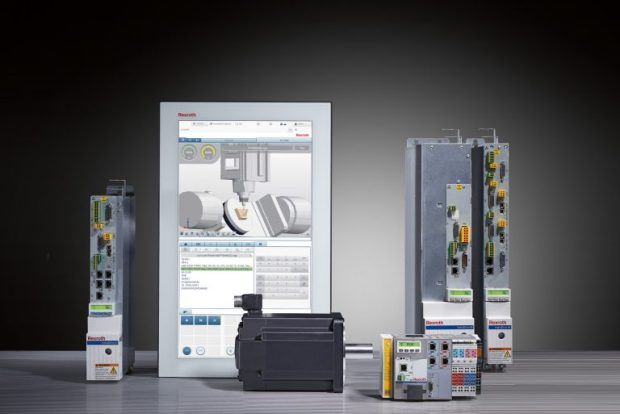
Efficient, intelligent and connective: the MTX CNC system from Rexroth. (Source: Bosch Rexroth AG)

Industrial 3D printing in practice

Norsk Titanium AS demonstrates just how efficient industrial 3D printing can be. The world’s leading provider of additive manufacturing technologies for aerospace-grade titanium established the first additive production facility on an industrial scale. In its Rapid Plasma Deposition™ machines, an MTX system controls not only plasma burners but also ten servo axes for producing components and conveying or handling the titanium wire. The MTX system also takes care of process optimization in real time by evaluating sensors and calculating correction values. Bosch Rexroth contributed to the partnership through the experience that it gained during more than 100 group AM projects along with various system components such as drive controllers, supply units, motors and linear systems including the IMS high-precision integrated measuring system.

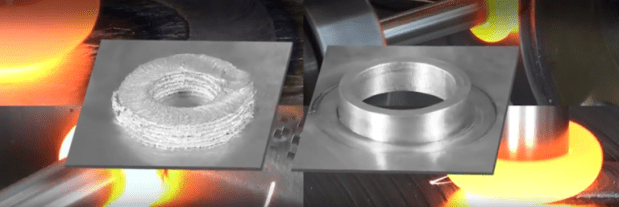
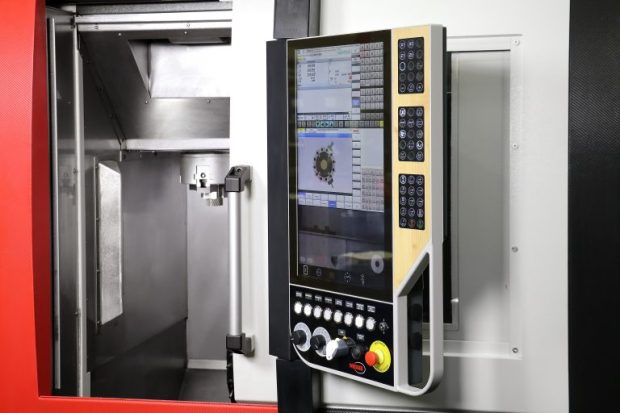
The German machine tool manufacturer Weisser presented its Weisser additive manufacturing exhibit for the first time at the EMO 2017 and the Metav 2018. Equipped with an additive friction welding unit (AFW), it allows fine layers of metal to be deposited on metal materials and then precision-machined using metal-cutting techniques. As a result, the final contour is maintained with minimal material use. This technology too benefits from the MTX CNC system whose user interface can be integrated seamlessly into the multi-touch operating panel thanks to the open architecture.

3Abbildung_1_PanelMaschine-768x512

The future will be even simpler

With high-performance and high-connectivity automation solutions, industrial 3D printers will be fast and reliable enough for use in mass production. Open interfaces will help to digitize workflows. IoT connectivity is paving the way for the factory of the future. At the same time, experienced system partners such as Bosch Rexroth who provide not only engineering and application support but also complementary technologies such as decentralized drive or linear technology with integrated sensor systems can help manufacturers to acquire the necessary know-how.

cropped-cmafh-logo-with-tagline-caps.png

CMA/Flodyne/Hydradyne is an authorized Bosch Rexroth distributor in Illinois, Wisconsin, Iowa and Northern Indiana.

In addition to distribution, we design and fabricate complete engineered systems, including hydraulic power units, electrical control panels, pneumatic panels & aluminum framing. Our advanced components and system solutions are found in a wide variety of industrial applications such as wind energy, solar energy, process control and more.
Essential tips for Temperature Management in the Food Industry

Guest contributor:  Karl Lycett, Product Manager for Climate Control, Rittal

Food processing is a sector that demands very high standards of efficiency to meet daily production throughput targets.  Any unexpected breakdown of critical components which stops production lines can have a major impact, not just in terms of loss of output, but also unplanned maintenance.

Electrical componentry is protected by an enclosure which is designed to protect the equipment from the ambient environment and create a secure atmosphere in which the climate is maintained within the required parameters.

As the temperature rises due to the summer months or random heat waves throughout the year, these parameters can be breached. In turn, the overall life of the componentry within the enclosures can reduce and the probability of an unexpected system failure increases drastically.

Care needs to be taken when implementing climate control equipment to ensure it is suitable to handle the rigours of the environment in which it is situated.

Below are some key aspects to consider when reviewing your climate control solutions.

Is your solution right for the environment?

The type of product being processed on-site and/or the location of the equipment within the facility are likely to heavily influence your climate control solution.

  1. If the ambient temperature of your facility remains lower, year-round, than the desired enclosure internal enclosure temperature then fan-and-filter units and air-to-air heat exchangers can be very effective. They use the ambient air to remove heat energy from the enclosure, releasing it back into the environment.If the ambient temperature rises above the desired internal temperature then units with active cooling circuits must be used. Wall/roof-mounted cooling units and air-to-water heat exchangers include a refrigerant to remove the excess heat from enclosures and maintain the desired conditions.

    Already in 2018 we have seen unexpected jumps in average temperatures across the country, and this will only increase as we move into the summer months. These jumps, as I’ve indicated, are what put cooling equipment under the most strain, therefore reviewing existing equipment sooner rather than later can reduce the likelihood of unexpected breakdowns.

  1. Dusty or acidic contamination (e.g. flour or yeast/vinegar extracts) can interfere with switchgear and cause short circuits or a reduction in service life.

HD 2

Applying filter mats to fan and filter units will help, but if the environment is extremely contaminated you might be better off installing a cooling unit to ensure that the internal and external air-paths are exclusive thus ensuring contaminated air isn’t drawn into the enclosure.

Cleaning/Maintenance Regime

Establishing a regular inspection and cleaning of cooling equipment is very good practice.  For example, vacuum cleaning units with filter mats to remove any dust and debris which might choke the fan. The will mean the unit works harder for longer and also reduces its cooling capacity.

Cooling units must also be kept clean to maintain the highest standards of hygiene. Some will be cleaned daily with pressure washers and jet steam cleaners in which case use units which meet the required ingress protection rating desired for your site and purchase additional cowls or covers as needed.

Increasing Energy Efficiency = Reduced Costs

Many food production facilities work around the clock and with energy prices rising globally, it’s vital to get early warning of any potential issue which could impact on productivity or costs.

For example, unlike speed-controlled cooling devices, such as the new Rittal Blue e+ cooling units, conventional units start when the temperature inside the enclosure gets above set point (normally 35°C) and finish when the shutdown temperature of  30°C is achieved (at a typical hysteresis of 5K).  If the device does not reach the shutdown temperature it will continue to operate at full output, using large amounts of energy.  This is one good indicator that the unit is inadequate for the job and that too little cooling air may be getting to electrical components.

The best course of action in all instances is to undertake a survey of your existing cooling equipment utilising the points above.

HD 1

Rittal is happy to offer you a free RiAssure Cooling Inspection in which one of our trained representatives visits your site to provide you with honest, clear advice on your existing equipment and its suitability within the chosen environment/process.

We will then provide you with a short report which includes feedback on the next best steps forward for your installation, whether it is implementing a maintenance contract to prolong the life of existing equipment or the replacement of units that are undersized to improve performance and increase the energy efficiency of your site.

Learn more:  https://www.rittal.com/us-en/content/en/start/

cropped-cmafh-logo-with-tagline-caps.png

CMA/Flodyne/Hydradyne is an authorized  Rittal distributor in Illinois, Wisconsin, Iowa and Northern Indiana.

In addition to distribution, we design and fabricate complete engineered systems, including hydraulic power units, electrical control panels, pneumatic panels & aluminum framing. Our advanced components and system solutions are found in a wide variety of industrial applications such as wind energy, solar energy, process control and more.

What Exactly is Safety Over IO-Link?

Automation Pyramid.png

This integrated safety concept is the logical continuation of the IO-Link philosophy. It is the only globally available technology to build on the proven IO-Link standards and profisafe. This means it uses the essential IO-Link benefits such as simple data transport and information exchange, high flexibility and universal applicability for safety signals as well. Safety over IO-Link combines automation and safety and represents efficient safety concepts in one system. Best of all, the functionality of the overall system remains unchanged. Safety is provided nearly as an add-on.

In the center of this safety concept is the new safety hub, which is connected to an available port on an IO-Link master. The safety components are connected to it using M12 standard cable. The safety profisafe signals are then tunneled to the controller through an IO-Link master. This has the advantage of allowing existing infrastructure to still be used without any changes. Parameters are configured centrally through the user interface of the controller.

Safety Hub

The safety hub has four 2-channel safe inputs for collecting safety signals, two safe outputs for turning off safety actuators, and two multi-channel ports for connecting things like safety interlocks which require both input and output signals to be processed simultaneously. The system is TÜV- and PNO-certified and can be used up to PLe/SIL 3. Safety components from all manufacturers can be connected to the safe I/O module.

Like IO-Link in general, Safety over IO-Link is characterized by simple system construction, time-and cost-saving wiring using M12 connectors, reduction in control cabinet volume and leaner system concepts. Virtually any network topology can be simply scaled with Safety over IO-Link, whereby the relative share of automation and safety can be varied as desired. Safety over IO-Link also means unlimited flexibility. Thanks to varying port configuration and simple configuration systems, it can be changed even at the last minute. All of this helps reduce costs. Additional savings come from the simple duplication of (PLC-) projects, prewiring of machine segments and short downtimes made possible by ease of component replacement.

Development of IO-Link, number of sold nodes.png

To learn more about Safety over IO-Link, visit www.balluff.com

cropped-cmafh-logo-with-tagline-caps.pngCMA/Flodyne/Hydradyne is an authorized  Balluff distributor in Illinois, Wisconsin, Iowa and Northern Indiana.

In addition to distribution, we design and fabricate complete engineered systems, including hydraulic power units, electrical control panels, pneumatic panels & aluminum framing. Our advanced components and system solutions are found in a wide variety of industrial applications such as wind energy, solar energy, process control and more.

Time is money: snappy automation of testing machines

Guest contributor: Andreas Sokoll, Bosch Rexroth

Usefully combining automation and IT is not only typical of Industry 4.0. In the engineering of measuring and testing machines, open interfaces also unleash great potential for efficiency. With the aid of National Instruments’ LabVIEW graphic programming environment and Open Core Engineering, they can now be modelled and automated in an integrated manner without creating a separate PLC code. The effect: a significantly quicker time to market!

Why complicate things if they can be actually be done simply

The idea of precisely modeling customer-specific measuring and testing machines without having to acquire and coordinate an additional PLC programmer is very attractive to many manufacturers. That’s because, until now, they had to program I/O queries and axis motions separately and transfer them into a joint machine program throughout all the development phases. An irksome and time-consuming task, which introduces additional sources of errors. However, this cost and quality-related factor can be minimized if the development environment communicates directly with the control core.

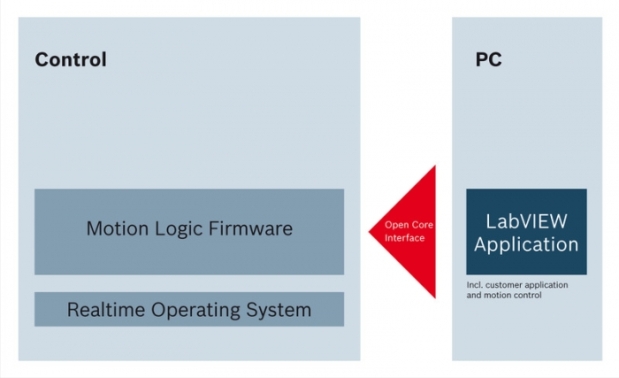
Modeling measuring and testing machines without additional PLC programming: in National Instruments’ LabVIEW programming environment, manufacturers can execute the motion sequences as well as measuring and testing tasks. The Open Core Interface acts as an open interface between the control system and the PC.

Parameterizing instead of programming

National Instruments’ LabVIEW graphic programming environment, which is widely used in the measuring and testing machines field, satisfies this requirement by supporting Bosch Rexroth’s Open Core Interface. Development engineers therefore get direct access to the control functions via their usual interface. Device drivers and functions can consequently be quickly and simply selected as graphic modules (Virtual Instruments) and then only need to be parameterized. This also speeds up commissioning. This is because, in addition to the measuring and testing applications, the full machine workflow can now be mapped in LabVIEW, and consequently in a joint project. There’s no need for the PLC code to be written in parallel and continually coordinated.

control_PC

Reduced engineering workload: Since LabVIEW supports Bosch Rexroth’s Open Core Interface, machine developers no longer have to work in two environments. The axis motions can also now be produced directly in LabVIEW.

Over 550 VIs to be parameterized

With its Open Core Interface, Bosch Rexroth has established the basis for not only the graphic LabVIEW language but also other modern high-level languages, software solutions from the simulation and model-based engineering fields, and open i4.0 standards such as OPC-UA being able to access control functions directly. The seamless integration in the respective programming environment is achieved by using a software development kit (SDK). In the case of LabVIEW, it contains more than 550 Virtual Instruments (VIs). They control the connection set up (ApiLib), access to direct motion commands (MotionLib), and access to the control system (SytemLib) or the drive and control parameters (ParameterLib) among other things. They are clearly structured in function libraries and they can be simply dragged & dropped into the project and then parameterized.

Motion PLC, drive and control functions: The LabVIEW SDK contains eight libraries with over 550 additional Virtual Instruments.

Fully fledged HMI for M2M communication

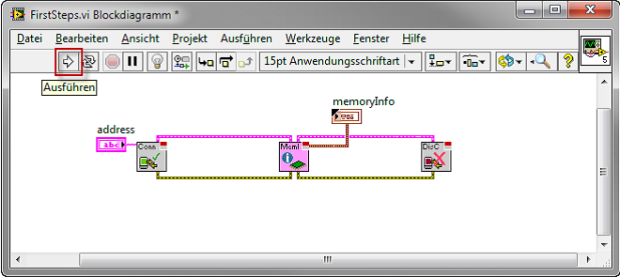
Both the “front panel” and “block diagram” programming windows that are typical of LabIEW now form a fully fledged user interface for man-machine communication. The block diagram shows the flow logic in the form of VIs and links, and all the control and display elements appear in the front panel, e.g. buttons, switches or graphical displays. So direct operation of the machine is also possible. For instance, in order to move an axis, the programmer simply activates the corresponding VI. The SDK provides numerous example projects illustrating the initial steps. The HMI templates that they contain can be quickly adapted to the respective requirements.

BlockdiagrammSimple block diagram: In this example, the logically linked Virtual Instruments read a value from the control unit.
Force measurement practical example

Force measurements are by far the most common form of test task. Including handling tasks, an estimated 90 to 95 percent of all measuring and testing tasks can in practice be carried out just by using LabVIEW. Here’s an example of the monitoring of a joining process:

A DIN 625 industrial bearing is to be pressed into a tolerance ring in a controlled manner. In order to control the linear axis motion, measure the pressing force and compare it with the tolerance range, the programmer divides the project into five steps: Connect, move (axes into position), start force control and measuring, measurement completed, and retract axis. The programming takes place purely in LabVIEW with the aid of self-explanatory VIs such as “Standstill”, “MoveVelocity”, “Continuous Motion” or “Stop”. The VIs are linked by connections in the graphical user interface and are activated and deactivated via target and transfer values such as “TRUE” and “FALSE”.

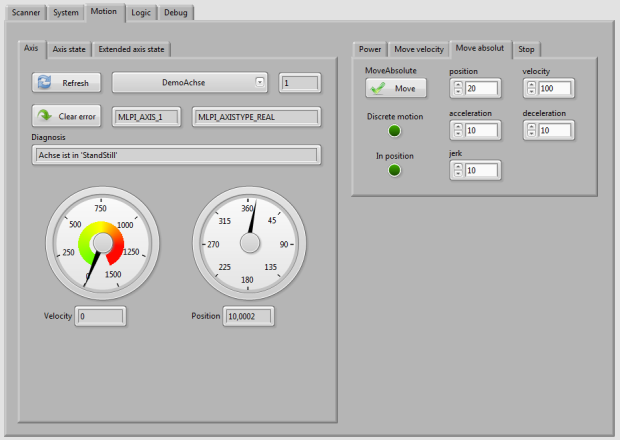
HMIQuick access to the desired operating interfaces: The SDK for LabVIEW comes with lots of example projects in which the HMI can be quickly and easily adjusted.
Complete control set from a single source

In addition to pure modeling and programming in LabVIEW, as a system manufacturer Bosch Rexroth provides even more ways of increasing engineering efficiency. In the practical example shown for instance, the press-fit procedure is carried out via an energy-efficient electromechanical cylinder (EMC) with an integrated force sensor and drive. In combination with an IndraControl XM control this produces a fast, higher-level control loop in which the mechanical and electrical components work together optimally with short cycle times of 250 µs. The test system is quick to set up so it can precisely control the force moments which arise, run at constant speeds and position the work piece in a highly dynamic, flexible and precise manner depending on the requirements. A Bosch Rexroth linear motion technology tolerance ring is used as a frictionally engaged connection element for the insertion of the bearing.

Quicker to market due to large time savings

With the aid of LabVIEW and the Open Core Interface technology, together with Bosch Rexroth’s modern automation solutions, precise movements can be carried out in measuring and testing machines even without any PLC programming – including interfaces, handshakes and synchronization. For users this results in an enormous saving of time, especially since troubleshooting can also concentrate on one instead of two programming environments. This considerable time saving enables manufacturers of measuring and testing machines to bring innovative and complex products to market much more quickly and also inexpensively than before – but without compromising on quality.

cropped-cmafh-logo-with-tagline-caps.png

CMA/Flodyne/Hydradyne is an authorized Bosch Rexroth distributor in Illinois, Wisconsin, Iowa and Northern Indiana.

In addition to distribution, we design and fabricate complete engineered systems, including hydraulic power units, electrical control panels, pneumatic panels & aluminum framing. Our advanced components and system solutions are found in a wide variety of industrial applications such as wind energy, solar energy, process control and more.

The digital twin is the key to the Factory of the Future – Part II

Guest Contributor: Hans Michael Krause, Bosch Rexoth
The modular assembly line of Dassault Systèmes and Bosch Rexroth presented at the Hannover Messe is the result of a change in perspective. Planning production processes coming from the product, instead of the machines – that is what the digital twin can put into effect. Marketplaces for digital twins, IoT Gateway software and open standards will mark the route into the factory of the future.

The demo assembly line from Bosch Rexroth shows how digital twins completely reverse the logic of production, if you think of the Factory of the Future. It is no longer the machines that determine the processes, but the products. A customer’s order automatically leads to the creation of a digital twin. This is connected, for example via an RFID chip as a reference to the blank to inform the machines later about the respective processing steps. As a crucial precondition for this evolution, Bosch Rexroth has already created behavioral models for many automation components, which are available on request for systems engineering. As part of the online configuration, customers already receive the CAD models of the components in the appropriate data format automatically.

Next evolutionary step: Marketplaces for digital twins

In a future scenario that is interesting for mechanical engineers, digital twins could be made available from automation components but also via a marketplace in order to bring them into the simulation environment with a single click. As a result, the OEMs could parameterize the automation immediately, test it and put the entire model into virtual operation quickly and safely. In addition, the marketplace could become a PLM platform, where all digital twins for current and past solutions are available. To prepare for this scenario, Bosch Rexroth is currently seeking a dialog with its customers in order to jointly define the exact requirements for the simulation models.

Pioneering: IoT Gateway software and open standards

In order to achieve continuous improvements in production using the digital twin, the real operating data from the assembly line can be compared with its simulation. This allows the quality of the manufacturing process to be monitored in real time and the maintenance to be modeled and optimized based on the current condition. The assembly line shown at the Hannover Messe also depicts the current state of the art in this respect. The IoT Gateway software from Bosch Rexroth, which is installed on a pocket-sized box PC, collects data from the controller via the Industry 4.0 standard OPC UA and transfers it to a higher-level IT system for visualization and analysis using 5G technology. With regard to the investment security of IoT solutions, Bosch Rexroth consistently relies on open standards such as OPC UA.

DC-AE_SMP4_Dassault_AE_Demonstrator_3-768x663

In future, it is no longer the machines that determine the processes, but the products.

Important stage on the way to the Factory of the Future

Dassault Systèmes’ and Bosch Rexroth’s partnership is a powerful testament to the competitive advantages that machine builders and end users derive from a seamless workflow, from virtual engineering to intelligent automation. The digital twin of the demonstration line not only forms the basis for the fastest possible start-up, but also for the quickest possible production changeover and easy continuous process optimization with the help of IoT services. The close partnership of both companies is another stage win along the way to the Factory of the Future.

For more information about the collaboration with Dassault Systèmes and the road to the factory of the future, please read our blog post “With the digital Twin to the Factory of the Future”.

cropped-cmafh-logo-with-tagline-caps.png

CMA/Flodyne/Hydradyne is an authorized Bosch Rexroth distributor in Illinois, Wisconsin, Iowa and Northern Indiana.

In addition to distribution, we design and fabricate complete engineered systems, including hydraulic power units, electrical control panels, pneumatic panels & aluminum framing. Our advanced components and system solutions are found in a wide variety of industrial applications such as wind energy, solar energy, process control and more.

With Digital Twin to the Factory of the Future – Part I

Guest contributor: Hans Michael Krause, Bosch Rexroth

Bosch Rexroth and Dassault Systèmes will use a modular assembly line to show how the Factory of the Future can be efficiently planned, implemented and continuously improved using digital twins. The key ingredients for this recipe for success: model-based systems engineering, intelligent controls and drives with open interfaces, and continuous improvement through IoT services.

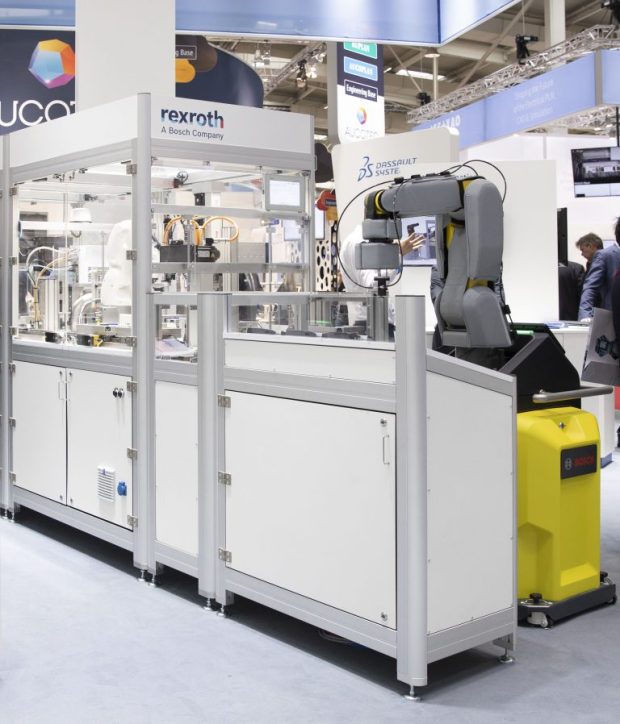
Manufacturers of complex products and machines face the challenge of meeting the most diverse requirements in even shorter development cycles. With a demonstration assembly line, Dassault Systèmes and Bosch Rexroth will show at the Hannover Messe how time-to-market can be shortened with the greatest possible flexibility if production and product engineering seamlessly mesh on the data side. In addition, the turnkey assembly line highlights the added value that machine builders and end users can generate in conjunction with IoT services. The cornerstone of all this is the ‘digital twin’, a realistic depiction of product, production and performance.


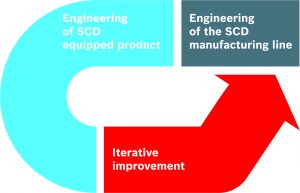
DC-AE-SMP4_Blogbeitrag_Dassault_Grafik_Engineering_EN_201804_vl-300x193

At the Hannover Messe, Bosch Rexroth and Dassault Systèmes will demonstrate the seamless and profitable interaction of line and product engineering.

“Single source of truth” for the product, production and performance

Dassault Systèmes integrates the sample project from Bosch Rexroth into the integrated engineering workflows of the 3DEXPERIENCE platform, which provides a central source of information for designers, electricians and programmers. All platform functions for virtual engineering access a common database. For example, the simulation software receives direct access to the design data from the CAD program. In addition, it enables visualization in real time, so that visitors to the Bosch Rexroth booth can observe the 3D model of the demo line connected with the real object in real-time via sensors.

Shortened initial start-up through model-based engineering

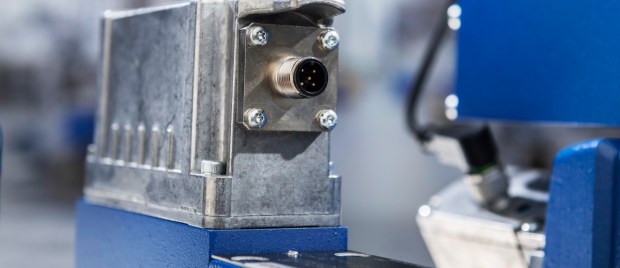
The demo assembly line has a modular structure and is based on intelligent, decentralized automation components that are networked horizontally and vertically via open standards. The product that is assembled on the assembly line, the SCD – Sense Connect Detect sensor introduced by Bosch Rexroth, controls itself along the line using an RFID identifier. As in previous projects, such as the WestRock packaging machine, this system has also been developed, put into virtual operation and implemented in a very short time using models in the framework of Dassault Systèmes’ 3DEXPERIENCE platform. In addition to the CAD data, the behavioral models from the automation also flowed into the digital twin.

DC-AE_SMP4_Dassault_AE_Demonstrator_4-768x898The assembly line at the Hannover Messe.
Collaboration between production and product engineering

The 3DEXPERIENCE platform also acts as an interface to the end user. If the user also depicts a product using a digital twin, the system can adjust to their requirements within a short time. An example: a manufacturer of construction vehicles wants to use the SCD sensor in a future excavator to measure vibrations from the hydraulic pump. He uses the sensor model in the virtual prototype of the excavator and defines a required housing modification. Bosch Rexroth then creates a new digital twin, inserts it into the virtual line model and validates the production capability in the simulation environment. In the same way as in this example, machine builders can use their digital twins to test in advance how new variants affect space requirements, stability, geometry, storage life or transport. In addition, the simulation also exposes critical areas for product quality, thereby reducing the risk of product recalls.

Economical production of batch sizes of 1

The close interlinking of product, production and performance via digital twins also allows for much more flexibility in production. This aspect is also illustrated by the joint demo project from Bosch Rexroth and Dassault Systèmes. To economically produce different sensor variants in small quantities down to a batch size of 1, Dassault Systèmes’ 3DEXPERIENCE platform works with the system via its MES functions. It transmits the jobs individually to the assembly line via the OPC UA interface, and from there receives the production and quality data for each manufactured SCD sensor.

Dassault Systèmes’ and Bosch Rexroth’s partnership is a powerful testament to the competitive advantages that machine builders and end users derive from a seamless workflow, from virtual engineering to intelligent automation.

The digital twin is the key to the Factory of the FuturePart II  Blog Continued here:

cropped-cmafh-logo-with-tagline-caps.png

CMA/Flodyne/Hydradyne is an authorized Bosch Rexroth distributor in Illinois, Wisconsin, Iowa and Northern Indiana.

In addition to distribution, we design and fabricate complete engineered systems, including hydraulic power units, electrical control panels, pneumatic panels & aluminum framing. Our advanced components and system solutions are found in a wide variety of industrial applications such as wind energy, solar energy, process control and more.

Hydraulics with IO-Link: Reduced effort, high value

Guest contributor: Theobald Herrmann, Bosch Rexroth

In almost all industries, machine users require increased flexibility for production means for small batches and continuous diagnostics of all actuators and sensors to increase availability. In addition to this, there is quickly increasing horizontal and vertical connection of machinery and systems for Industry 4.0 applications. The open standard IEC 61131-9, IO-Link, fulfills these requirements at low connection costs and energy consumption. Flexibility of hydraulics is increased by transmission of parameter changes in running operation. Provision of diagnostics information offers numerous opportunities to extend the concepts of predictive maintenance to increase availability of the systems. The manufacturer-independent IO-Link can be integrated easily and quickly in any industrial automation application.

Standardized wiring and electronic name plate support commissioning and increase availability

• Open standard for bi-directional point-to-point connections in parallel to field bus
• Easy connection with standard cables and M12 connectors
• No additional engineering tool necessary, possible configuration via control system.
• Data for predictive maintenance and quick device replacement
 Industry 4.0-compatible hydraulic components for vertical flow of information

Introduction: Limits of serial field bus communication

The introduction of field bus technology in the 1980s was the starting point for horizontal connection of decentralized actuators within machinery. Serial wiring lead to a considerable reduction in cabling and opened new possibilities for modularization in mechanical engineering. Field buses as well as most current real-time Ethernet protocols are manufacturer-specific, proprietary systems. The protocols have been developed by control system manufacturers and focus on communication between own electric control systems and selected peripherals. For actuators, sensors and other third-party equipment, either their manufacturers or system integrators are required to provide suitable interfaces in hardware and software for the respective field bus. This is very complex as device profiles and software have to be created in the respective PLC for every individual field bus and control system of each manufacturer.

Possibilities for hydraulic connection

Integration of hydraulics in modern automation systems can be realized in different ways. Numerous existing machine concepts apply on-board electronics for control of hydraulic valves. Exchange of digital information is restricted and only possible if the respective device is connected to a superior control system via individual wiring. This state-of-the-art in technology increasingly no longer meets the requirements of end users.

The alternative are valves with integrated field bus connection. These, however, require extensive wiring as well as integration into the control system and the respective field bus protocol by means of dedicated software. Both requires considerable effort that is too high particularly for price-sensitive applications.

Thanks to IO-Link, machine manufacturer and system integrators are enabled to integrate for example proportional hydraulic series valves and sensors into digital communication structures with very little engineering effort. With its simple communication structure, IO-Link has low hardware requirements. Additionally, the standardized M12 connection technology enables simple and cost-efficient connection of hydraulic valves in the field. This way, previously “deaf-mute” components with analog control are transformed in communicating and flexible actuators and sensors.

IO-Link: Manufacturer-independent and compatible with all field bus protocols

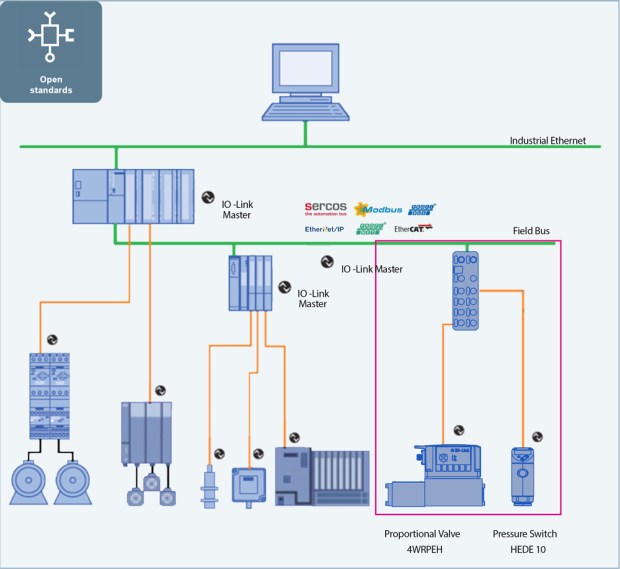
The manufacturer-independent IO-Link according to IEC 61131-9 standardizes connection technology for actuators, sensors and other equipment and provides a digital communication protocol for data exchange between control systems and devices regardless of the field bus. Field bus technology is not replaced but extended. Parallel communication enables machine manufacturers use of IO-Link with all protocols and integration of IO-Link-compatible devices into various concepts without additional effort.

IO-Link is currently already supported by around 130 device manufacturers and companies in the field of technology. Around 40 manufacturers offer IO-Link Masters and the standard is supported by nine manufacturers of control systems with central Masters and respective engineering tools. IO-Link devices are in the product range of almost sixty manufacturers of sensors, actuators and other peripherals. Rexroth, for example, now also offers hydraulic proportional valves and pressure sensors with respective technology. Function and performance of these proportional valves are identical to series valves. However, they also offer all options for bi-directional communication via IO-Link. This way, the hydraulics can be integrated seamlessly into connected structures. Parameters can be changed and operating states changed by the control system during running operation.

IO-Link system set-up

A full IO-Link system consists of one centralized or decentralized IO-Link Master, one or more IO-Link devices as well as unshielded 3 or 5-conductor standard cables with M12 connectors. Project planning and parameterization of the IO-Link Master can be realized in the control system hardware or an optional engineering tool. The point-to-point connections between IO devices and the automation system are established by the Master. It serves as the interface to the superior control system.

bild01_offenestandards_en

IO-Link Masters are offered by around 50 manufacturers for connection of one IO device per port. The selection includes options for the IP20 control cabinet as well as decentralized modules with protection class IP65/67 for installation at machinery. Particularly in large-scale systems, cabling is considerably reduced.

For decentralized IO-Link Masters, the user organization of IO-Link has defined M12 plug-in connectors with three or five conductors. The 5-pole version “Class B” port is used for devices with increased current consumption like hydraulic valves. The 3-pole version “Class A” port provides an energy supply of up to 200 mA which is sufficient for most sensors. In contrast to analog controls, unshielded cables are sufficient for fault-free communication over a cable length of up to 20 meters. IO-Link standardizes connection technology for all actuators and sensors and eliminates numerous sources of errors during the installation of systems. Otherwise complicated and expensive cable dimensioning with individual wiring and shielding is no longer required. In addition, the logistic effort is reduced thanks to application of uniform M12 cables for sensors and actuators.

Rapid commissioning per software

Every IO-Link device features an electronic device description, referred to as IO Device Description (IODD). It provides standardized important information:

• Device data
• Text description
• Identification, process and diagnosis data
• Communication properties
• Device parameters with value range and default value.
• Image of the device
• Logo of the manufacturer

The IODD set-up is identical for all devices of all manufacturers. The IODD enables automatic recognition of the device by the IO-Link Master for immediate parameterization. Also automatically, device descriptions are included in the system documentation.

For project integration of the IO-Link Master in overall automation, commissioning personnel use the engineering tools of the respective PLC manufacturer. The IO-Link Master is selected from the device portfolio and added to overall automation. Depending on the control system manufacturer, all blocks for communication are available in a library for free.

bild02_io_link_en

Via IO-Link to Industry 4.0

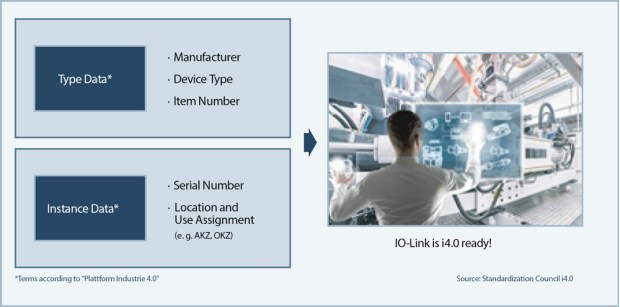
IO-Link enables access to device data either directly from the control system or remotely via networks from any location. Particularly important for future-oriented concepts: Already today, IO-Link offers type and instance data of Industry 4.0 devices according to the definition of the German “Plattform Industrie 4.0” initiative.

This way, also hydraulic actuators meet all conditions for future requirements of Industry 4.0 applications. Additionally, this approach is well-suited for subsequent connection of existing machinery and systems with low effort. Users replace installed proportional valves and sensors by interchangeable options with IO-Link connection for direct communication with actuators and sensors.

Diagnosis functions for increased availability

The diagnosis functions of IO-Link devices enable new maintenance concepts and considerably reduce repair times. Now possible call-up of device information in parallel to the process forms the basis for condition-oriented and predictive maintenance concepts. In this respect, proportional valves report whether they are functional as well as errors like under or overvoltage. In addition, the valve and sensor status is displayed for transparent error analysis. An integrated operating hour indicator enables calculation of the residual life-cycle for maintenance and decision-making on further use of the valve.

In case of faults, IO-Link accelerates diagnosis thanks to remote access for maintenance specialists to identify the type and location of any errors. Precise localization without personal presence at the system alone considerably reduces reaction times. If necessary, the maintenance technician opens the IODD file of the respective device in the control system. Other than before, components do not need to be disassembled to decipher hardly readable labels and manufacturers and types no longer need to be looked for in system documentations. Thanks to the electronic name plate, all this information can now be accessed with just one mouse click to initiate the respective order without delay.

IO-Link follows the plug & play principle. Replaced devices are recognized by the IO-Link Master according to their IODD file and the respective parameters are automatically transferred without any actions in the software. This way, even less experienced technicians are enabled to replace components without problems to considerably reduce system downtimes.

Summary

The open IO-Link standard establishes continuous communication with sensors and actuators irrespective of the used field bus. Now, even hydraulic proportional valves can be intelligently, easily and cost-effectively integrated in bi-directional digital communication. This simplifies commissioning in hardware and software and enables flexible adjustment of hydraulic valves for varying production processes. Increased requirements for flexible machinery and systems are now complied with. Extended diagnosis information enables condition-oriented and predictive maintenance concepts and standstill and maintenance times are reduced. This increases the availability of machinery. In addition, IO-Link enables future-proof integration of hydraulic valves into connected structures as Industry 4.0 components with all their related features.

Why hydraulics and IO-Link? Click here

Learn more about Rexroth and IO-Link

cropped-cmafh-logo-with-tagline-caps.pngCMA/Flodyne/Hydradyne is an authorized Bosch Rexroth distributor in Illinois, Wisconsin, Iowa and Northern Indiana.

In addition to distribution, we design and fabricate complete engineered systems, including hydraulic power units, electrical control panels, pneumatic panels & aluminum framing. Our advanced components and system solutions are found in a wide variety of industrial applications such as wind energy, solar energy, process control and more.

When and Where to Use Continuous Cylinder Position Sensing

The role of smart cylinders — hydraulic or pneumatic cylinders with integrated position detection capability — has increased as manufacturers constantly strive to improve efficiency through automation. Smart cylinders can use either continuous or discrete position sensing, providing manufacturers with options, but possibly leaving them with questions on which is best for their application.

In this post we will review the benefits of continuous position sensors and list the applications where this is the best fit.

Continuous position sensors provide near real-time position feedback throughout the entire stroke of the cylinder making them the ideal choice for applications at the higher end of the control spectrum. Closed-loop servohydraulic systems can achieve sophisticated, dynamic control of motion across the entire cylinder stroke.

Continuous position sensors are commonly used when the application calls for closed-loop servo control, where the position, speed, acceleration, and deceleration of the cylinder must be controlled. Closed-loop servohydraulics have been widely used in industrial applications, such as sawmills, steel processing and tire manufacturing, and more recently in cylinders in off-highway equipment.

Magnetostrictive linear position sensors are the most commonly used continuous position sensors in hydraulic cylinders. These sensors are installed into the back end of the cylinder. The sensor detects the position of a magnet attached to the piston and provides a continuous, absolute position signal.

Blog
Magnetostrictive linear position sensor installed in hydraulic cylinder

The sensor is rated to withstand the full pressure of the hydraulic system. Magnetostrictive technology offers the advantage of being completely non-contact, meaning it requires no mechanical contact between the sensor and the moving cylinder and is not subject to wear and performance degradation. In addition, numerous electrical interface options are available, from simple analog (0 to 10V or 4-20mA) to high-performance industrial fieldbus interfaces that offer advanced functionality.

Continuous position sensors can also be used in pneumatic cylinders. While closed-loop servo control with pneumatics is not as common as it is with hydraulics, there are situations where pneumatic cylinders require continuous position sensing capability. For example, low-pressure pneumatic cylinders are sometimes used as measurement probes, or touch probes, where the cylinder rod is extended until it touches a part to be measured or gaged. In these situations, it is beneficial to be able to get continuous position feedback, especially when there is variability in the measured part.

To learn more about cylinder position sensing, visit www.balluff.com.

cropped-cmafh-logo-with-tagline-caps.pngCMA/Flodyne/Hydradyne is an authorized  Balluff distributor in Illinois, Wisconsin, Iowa and Northern Indiana.

In addition to distribution, we design and fabricate complete engineered systems, including hydraulic power units, electrical control panels, pneumatic panels & aluminum framing. Our advanced components and system solutions are found in a wide variety of industrial applications such as wind energy, solar energy, process control and more.